Introduction to the Heavenly Waters
Ancient sky-watchers imagined a whole region of the heavens given over to water — a cosmic ocean populated by rivers, fish, dolphins, and ships. The Heavenly Waters family collects these aquatic and nautical constellations into a single grouping, united not by one legend but by a shared watery theme that runs through many cultures' star lore.
The bulk of the family lies in the southern sky, in the region the Greeks associated with the sea. Here sails the greatest ship of myth, and here a great river winds down toward the horizon. For northern observers, only a handful of these constellations climb into view — but those that do, like the charming little Dolphin and the lonely bright star Fomalhaut, are longtime favourites.
This is also a family of astronomical superlatives. It contains the second-brightest star in the whole sky, one of the longest constellations, one of the largest and most active star-forming nebulae known, and the fascinating fragmented remains of a constellation so vast that astronomers eventually had to break it apart.
Argo Navis: The Ship Broken into Three
The centrepiece of the Heavenly Waters is a constellation that no longer officially exists. Argo Navis represented the ship on which Jason and the Argonauts sailed in quest of the Golden Fleece. It was one of Ptolemy's original 48 constellations — and by far the largest, sprawling across a huge stretch of the southern Milky Way.
Its very size made it awkward. In the 1750s the French astronomer Nicolas Louis de Lacaille divided the unwieldy ship into more manageable pieces, and the modern constellations preserve that split:
The Pieces of Argo Navis
- Carina (the Keel): Holds Canopus, the sky's second-brightest star, and the immense Carina Nebula
- Puppis (the Stern): A rich Milky Way constellation full of open star clusters
- Vela (the Sails): Contains the Vela supernova remnant and the beautiful Eight-Burst planetary nebula
- Pyxis (the Compass): A small later addition, representing the ship's mariner's compass
Because the pieces were carved from a single constellation, their star designations were kept continuous across the fragments — a quirk that means each of Carina, Puppis, and Vela is missing some Greek-letter star names that belonged to the original whole. Argo Navis remains the only one of the classical constellations to have been retired.
Eridanus: The Celestial River
Eridanus is the great river of the sky, the sixth-largest constellation, winding in a long series of gentle curves from the foot of Orion deep into the far southern sky. In myth it is variously identified with the Nile, the Po, or the river into which Phaethon fell after losing control of the Sun's chariot.
The river begins near brilliant Rigel in Orion and meanders southward for an enormous distance, finally reaching Achernar — "the end of the river" — a hot blue star and the ninth-brightest in the sky. Achernar spins so fast that it bulges dramatically at its equator, making it one of the least spherical stars known.
Along its length Eridanus also passes Epsilon Eridani, one of the nearest sun-like stars at just 10.5 light-years, which is known to host at least one planet and a dusty debris disk — a system that has long fascinated those searching for worlds beyond our own.
The Northern Members: Delphinus, Equuleus and Piscis Austrinus
A few of the Heavenly Waters reach far enough north to be enjoyed from the northern hemisphere.
Delphinus — The Dolphin
Delphinus is a small but delightful constellation near the Summer Triangle, its compact diamond of stars genuinely suggesting a leaping dolphin. Two of its stars carry the whimsical names Sualocin and Rotanev — "Nicolaus Venator" spelled backwards, a playful signature left by a 19th-century astronomer's assistant. In myth the dolphin was a messenger of the sea god Poseidon.
Equuleus — The Little Horse
Equuleus is the second-smallest constellation of all, a faint little group beside Delphinus representing the head of a small horse or foal. Modest and easily overlooked, it is nonetheless one of the ancient 48.
Piscis Austrinus — The Southern Fish
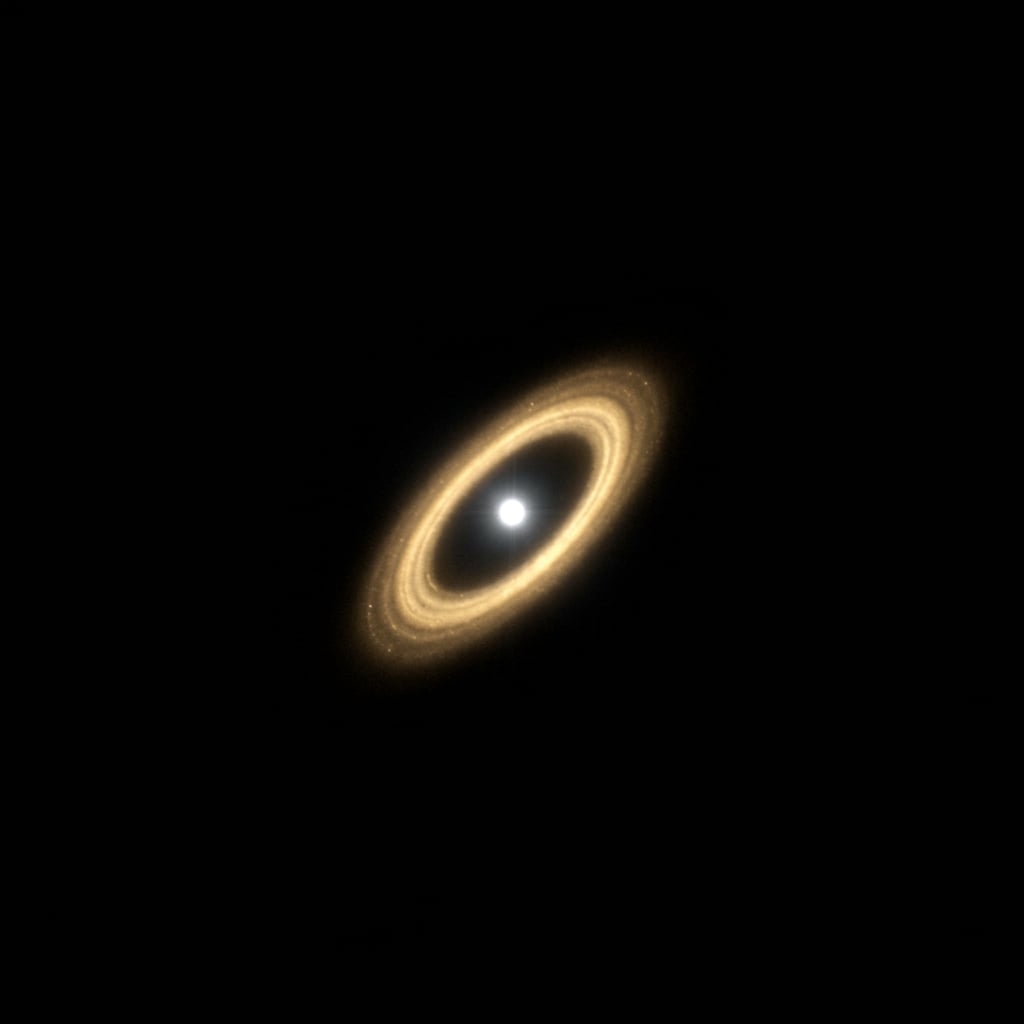
Piscis Austrinus, the Southern Fish, is best known for Fomalhaut, a bright, isolated star that shines alone in an otherwise empty stretch of the northern autumn sky, earning it the nickname "the Lonely Star." Fomalhaut is encircled by a striking ring of dust and debris, within which one of the first directly imaged exoplanet candidates was found.
Columba and the Southern Fragments
Rounding out the family are the smaller and fainter southern members:
- Columba (the Dove): A modest southern constellation below Orion and Lepus, representing the dove that Noah — or, in the Greek tradition, the Argonauts — sent out to find land. It offers a gentle counterpoint to the sea imagery around it.
- Pyxis (the Compass): A tiny constellation of the mariner's compass, added by Lacaille to accompany the pieces of the ship Argo. It sits in a rich part of the southern Milky Way.
Together with the ship fragments and the river, these constellations complete a coherent maritime scene painted across the southern heavens — a reminder of how deeply the sea shaped the imaginations of the cultures that first charted the stars.
Deep-Sky Treasures
Because so much of the family lies along the southern Milky Way, it is extraordinarily rich in clusters and nebulae — some of the finest objects in the entire sky.
Standout Objects
- Carina Nebula (NGC 3372): A colossal star-forming region around the unstable star Eta Carinae
- Vela Supernova Remnant: The tattered shell of a star that exploded ~11,000 years ago, with a pulsar at its heart
- Eight-Burst Nebula (NGC 3132): A bright planetary nebula in Vela, imaged in detail by James Webb
- M46, M47 & M93: Rich open star clusters in Puppis
- Achernar: The remarkably flattened blue star at the river's end
- Fomalhaut's debris disk: A dusty ring around a nearby star, a nursery for possible planets
The Carina Nebula is the crown jewel: spanning several full-Moon widths of sky and glowing across a region hundreds of light-years wide, it dwarfs the Orion Nebula and contains some of the most massive, violent stars in the galaxy. For southern observers it is one of the unmissable sights of the night sky.
Observing the Heavenly Waters
How much of this family you can see depends strongly on your latitude, since most of it is a southern-sky spectacle.
From the Southern Hemisphere
- Find Canopus: This brilliant white star, second only to Sirius, is your anchor for Carina and the ship constellations.
- Sweep the Milky Way: Puppis, Vela, and Carina lie in a glorious band of the galaxy; binoculars reveal cluster after cluster.
- Seek the Carina Nebula: Under a dark sky it is visible to the naked eye as a bright patch of the Milky Way.
From the Northern Hemisphere
- Delphinus: Look just off the Summer Triangle for the tiny leaping dolphin on summer evenings.
- Fomalhaut: On autumn evenings, look low in the south for a lone bright star — that is Fomalhaut in Piscis Austrinus.
- Eridanus: Trace the river's northern beginning near Rigel in Orion during winter, though its southern end stays hidden.
Interesting Facts About the Heavenly Waters
- The only retired constellation: Argo Navis is the sole classical constellation to have been broken up and removed from the modern list of 88.
- A star that guides spacecraft: Canopus is so bright and well-placed that many space probes use a "Canopus star tracker" to orient themselves in deep space.
- Eta Carinae's Great Eruption: In the 1840s this monster star flared to become the second-brightest star in the sky, ejecting the glowing Homunculus Nebula, yet it somehow survived — and may explode as a supernova at any time.
- A backwards signature: The Delphinus star names Sualocin and Rotanev encode "Nicolaus Venator" reversed, a cheeky joke by an assistant at the Palermo Observatory.
- The flattest star: Achernar, at the end of Eridanus, spins so rapidly that its equatorial diameter is roughly 50% larger than its polar diameter.
- The Lonely Star: Fomalhaut appears to shine in solitude because the surrounding autumn sky is so sparse of bright stars — and it hosts one of the first debris disks ever imaged.
- Shared star names across a ship: Because Argo was split up, the Greek-letter labels of its stars carry over between Carina, Puppis, and Vela, so no single fragment has a complete alphabet.
External Resources
- NASA Webb Telescope — Spectacular images of the Carina Nebula and Southern Ring Nebula
- IAU Constellations — Official boundaries of the Heavenly Waters constellations
- Argo Navis on Wikipedia — History of the great ship constellation and its division
- SEDS Messier Catalog — Data on the open clusters of Puppis and other objects
Frequently Asked Questions
What are the Heavenly Waters constellations?
The Heavenly Waters is a constellation family of nine water-associated patterns: Eridanus (the River), Carina (the Keel), Puppis (the Stern), Vela (the Sails), Pyxis (the Compass), Columba (the Dove), Delphinus (the Dolphin), Equuleus (the Little Horse), and Piscis Austrinus (the Southern Fish). They are grouped by their shared aquatic or nautical themes rather than by a single myth, and most lie in the southern sky.
What was Argo Navis?
Argo Navis was a huge ancient constellation representing the ship Argo sailed by Jason and the Argonauts in Greek myth. It was so large and unwieldy that in the 18th century the astronomer Nicolas Louis de Lacaille divided it into three separate constellations: Carina (the keel), Puppis (the stern), and Vela (the sails). A small nearby constellation, Pyxis (the compass), is sometimes considered a fourth fragment. Argo Navis is the only one of the classical 48 constellations that is no longer in use.
What is the brightest star in the Heavenly Waters?
Canopus, in Carina, is the brightest star in the family and the second-brightest star in the entire night sky, after Sirius. It is a brilliant white supergiant about 310 light-years away and shines prominently in the southern sky. Historically Canopus was vital for navigation and is still used as a reference star by spacecraft to orient themselves. In the north, Fomalhaut in Piscis Austrinus is the family’s brightest star.
What is the River Eridanus?
Eridanus is a long, winding constellation representing a celestial river. It is the sixth-largest of all 88 constellations, meandering from near Rigel in Orion far down into the southern sky, ending at the bright star Achernar — whose name means "the end of the river" in Arabic. Achernar is one of the flattest known stars, spun into a pronounced oval by its extremely rapid rotation.
What is special about the Carina Nebula?
The Carina Nebula (NGC 3372) is one of the largest and brightest nebulae in the sky, far bigger and more luminous than the famous Orion Nebula, though it lies deep in the southern sky and is less well known in the north. It surrounds the unstable, hugely massive star Eta Carinae, which erupted in the 1840s to briefly become the second-brightest star in the sky. The nebula is a spectacular region of star birth and death, and a favourite target of the James Webb and Hubble telescopes.
Where can I see the Heavenly Waters constellations?
Most of the family lies in the southern sky and is best or only seen from the southern hemisphere or low northern latitudes. Carina, Puppis, Vela, Columba, and Pyxis are essentially southern constellations, superb from places like Australia, South Africa, and southern South America. A few members reach into northern skies: Delphinus and Equuleus are small northern-summer constellations near the Summer Triangle, and Piscis Austrinus, with bright Fomalhaut, is visible on northern autumn evenings low in the south.