Introduction to the Hercules Family
The Hercules family is a giant among constellation groupings — literally the largest, encompassing 19 of the 88 constellations. Named for the greatest hero of Greek myth, it sprawls across an enormous expanse of sky, from high overhead on northern summer nights down to constellations that only fully clear the horizon from the southern hemisphere.
Because it is so vast, the family is best understood in sections. In the north lie Hercules himself and the brilliant trio of Lyra, Cygnus, and Aquila that build the Summer Triangle. Along the ecliptic sprawl Ophiuchus and the two halves of Serpens. And in the deep south stretch Centaurus, Lupus, Ara, Crux, and their neighbours — some of the richest star fields in the entire sky.
This family also contains some of the most rewarding deep-sky objects accessible to amateurs, from the showpiece globular cluster M13 to the delicate Ring Nebula, along with the nearest star system to our own. Whatever your latitude, some part of the Hercules family is worth seeking out.
Hercules the Hero
The constellation Hercules is large but surprisingly subdued, with no first-magnitude stars. Its most recognizable feature is the Keystone, a lopsided square of four stars marking the hero's torso. Once you find the Keystone, the rest of the sprawling figure — arms raised, one foot on the head of the dragon Draco — can be traced outward.
In mythology Hercules (the Roman name for the Greek Heracles) was the strongman demigod who performed twelve seemingly impossible labours. Several nearby constellations recall these feats: Leo the Nemean Lion, Hydra the many-headed water serpent, and Cancer the crab all feature in his exploits, weaving the hero's story across a large region of sky.
The Hercules Star Pattern
- The Keystone: Four stars forming the hero's torso — the key to finding the constellation
- Kornephoros (Beta Herculis): The brightest star, a yellow giant
- Rasalgethi (Alpha Herculis): A striking red giant and double star marking the hero's head
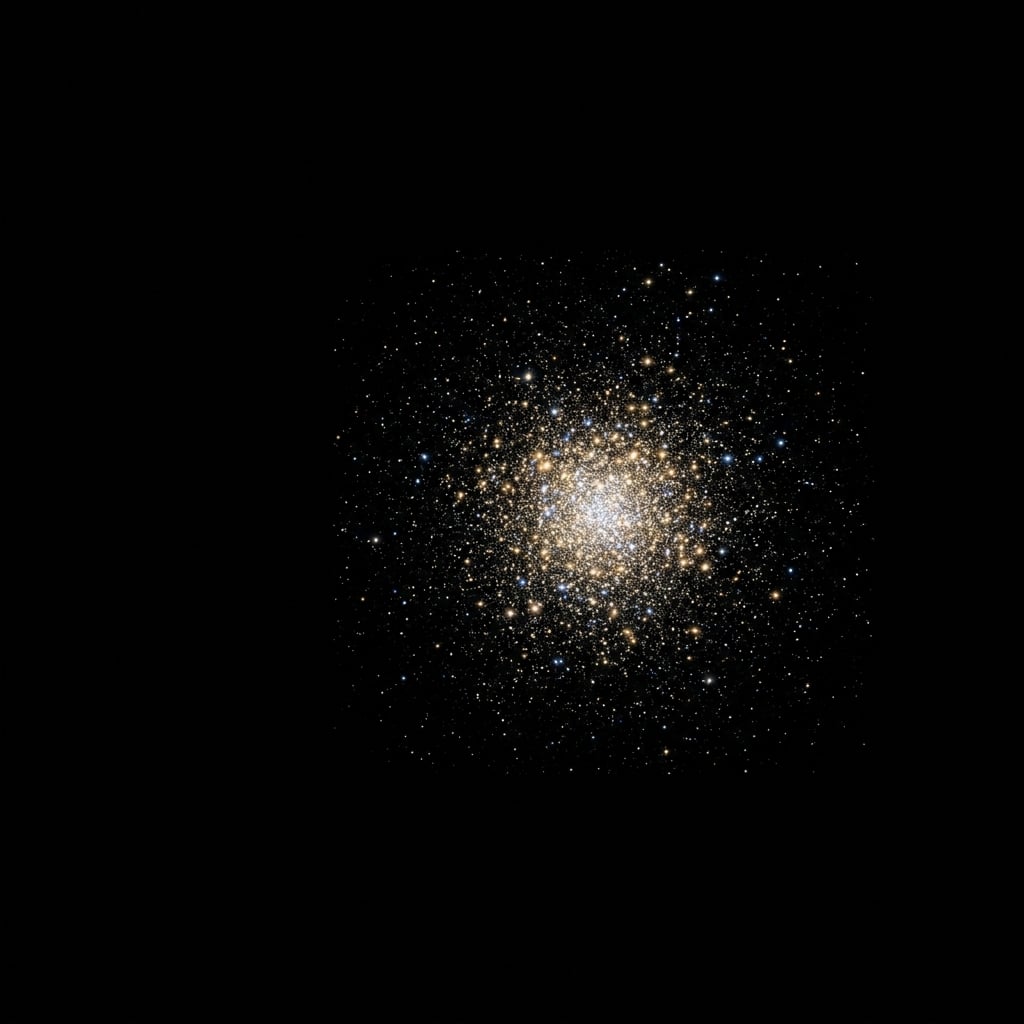
- M13: The Great Globular Cluster, on the edge of the Keystone
The Summer Triangle: Lyra, Cygnus and Aquila
Three of the Hercules family's constellations contribute the stars of the Summer Triangle, the defining pattern of the northern summer sky.
Lyra — The Lyre
Small but brilliant, Lyra is crowned by Vega, the fifth-brightest star in the sky and once the pole star some 12,000 years ago (a role it will hold again through precession). Vega blazes blue-white nearly overhead in summer. Below it, Lyra holds the celebrated Ring Nebula (M57), a glowing smoke-ring of gas cast off by a dying star, and the famous "Double Double" star Epsilon Lyrae.
Cygnus — The Swan
Cygnus, the Swan, flies down the length of the summer Milky Way, its main stars forming the Northern Cross. Its head is marked by Albireo, one of the sky's most beautiful double stars — a golden and a blue-green sun side by side. The tail is Deneb, a staggeringly luminous supergiant so far away (over 1,500 light-years) that its brilliance in our sky hints at a true output tens of thousands of times the Sun's.
Aquila — The Eagle
Aquila, the Eagle, carries Altair, the twelfth-brightest star and the closest corner of the Summer Triangle at just under 17 light-years. Altair spins so rapidly it is flattened into an oval. Aquila straddles the celestial equator along a rich stretch of the Milky Way, near the small, dart-shaped constellation Sagitta and the little "Coathanger" asterism in Vulpecula.
Ophiuchus and the Serpent
Ophiuchus, the Serpent Bearer, is a large constellation straddling the celestial equator and the ecliptic. It depicts a man grasping a snake — and uniquely, that snake is a separate constellation, Serpens, split into two halves: Serpens Caput (the head) to one side and Serpens Cauda (the tail) to the other. It is the only constellation divided into two disconnected pieces.
Ophiuchus is traditionally identified with Asclepius, the mythical healer whose serpent-entwined staff remains the symbol of medicine today. The Sun passes through Ophiuchus for about 18 days each year, making it the "13th zodiac" constellation that astrology omits.
Lying toward the crowded region near the galactic centre, Ophiuchus and Serpens are strewn with globular clusters and the vivid Eagle Nebula (M16) — home of the iconic "Pillars of Creation." Tucked beside them is Scutum, a tiny constellation holding the Wild Duck Cluster (M11), one of the richest open clusters in the sky.
The Southern Members
A large share of the Hercules family lies in the southern sky, containing some of the most spectacular star fields visible from Earth.
- Centaurus (the Centaur): A brilliant southern constellation holding Alpha Centauri, the nearest star system to the Sun, and Omega Centauri, the largest globular cluster in the sky. It also frames the radio galaxy Centaurus A.
- Crux (the Southern Cross): The smallest of all 88 constellations but one of the most famous, a compact cross pointing toward the south celestial pole, beside the dark Coalsack Nebula.
- Lupus (the Wolf): A rich Milky Way constellation between Centaurus and Scorpius, once seen as a beast speared by the Centaur.
- Ara (the Altar): A southern constellation of the altar on which the gods swore allegiance before battling the Titans.
- Triangulum Australe (the Southern Triangle): A neat, bright triangle deep in the south.
- Corona Australis (the Southern Crown): A delicate arc of stars mirroring its northern counterpart.
Also part of the family are the faint northern-spring constellations Sextans, Crater (the Cup), and Corvus (the Crow), which perch along the back of the great water snake Hydra.
Deep-Sky Treasures
Spanning so much of the Milky Way, the Hercules family is a treasure chest for observers of all kinds.
Standout Objects
- M13 (Great Hercules Cluster): The finest globular cluster in the northern sky, a swarm of hundreds of thousands of stars
- M57 (Ring Nebula): A perfect smoke-ring planetary nebula in Lyra
- Omega Centauri: The biggest, brightest globular cluster in the whole sky
- M16 (Eagle Nebula): Home of the "Pillars of Creation," in Serpens
- Veil & North America Nebulae: Vast glowing clouds in Cygnus
- Albireo: A gorgeous gold-and-blue double star in Cygnus
M13 alone justifies a summer observing session: through even a modest telescope it resolves from a fuzzy ball into a glittering sphere of individual stars, a city of suns some 25,000 light-years away and 11–12 billion years old.
Observing the Hercules Family
Because the family is so spread out, the best strategy is to anchor on the Summer Triangle and work outward.
Finding Your Way
- Start with the Summer Triangle: Vega, Deneb, and Altair are the three brightest stars high in the summer sky; learn them first.
- To Hercules: Look between Vega and the bright orange star Arcturus to find the Keystone, then M13 on its edge.
- Down the Milky Way: Follow the glowing band from Cygnus through Aquila toward Ophiuchus, Serpens, and the galactic centre.
- South of the horizon: For Centaurus, Crux, and the southern members, a location well south (or a trip to the southern hemisphere) is needed.
Best Conditions
The northern members peak on summer evenings from June through September, when the Milky Way arches overhead. A dark sky transforms the experience — the star clouds of Cygnus and the globulars of Ophiuchus come alive far from city lights. The southern constellations are best in southern-hemisphere autumn and winter (April–July).
Interesting Facts About the Hercules Family
- The largest family, the largest constellation: The Hercules family is the biggest constellation grouping, and it contains Hydra, the single largest of all 88 constellations.
- Our nearest neighbours: Alpha Centauri in Centaurus is the closest star system to the Sun, and its faint member Proxima Centauri is the nearest individual star, just 4.24 light-years away.
- Vega was and will be the pole star: Precession made Vega the north pole star around 12,000 BCE, and it will take that role again around the year 13,700.
- A message to the stars: The 1974 Arecibo radio message, humanity's most powerful deliberate signal to possible extraterrestrials, was aimed at M13, the Great Hercules Cluster.
- The only split constellation: Serpens is the sole constellation divided into two separate pieces, held on either side of Ophiuchus the Serpent Bearer.
- Deneb's astonishing power: Though it appears fainter than nearby Vega, Deneb is vastly more luminous — it only looks dimmer because it is roughly 100 times farther away.
- The Pillars of Creation: The Eagle Nebula in Serpens contains the famous towering columns of gas imaged by Hubble, where new stars are being born.
External Resources
- NASA Hubble — Imagery of the Eagle Nebula, Ring Nebula, and globular clusters
- IAU Constellations — Official boundaries of the family's 19 constellations
- Hercules on Wikipedia — The constellation, its stars, and mythology
- SEDS Messier Catalog — Data on M13, M57, M11, M16 and more
Frequently Asked Questions
What is the Hercules family of constellations?
The Hercules family is the largest of the constellation families, containing 19 constellations associated with the hero Hercules and his labours. Its members include Hercules, Sagitta, Aquila, Lyra, Cygnus, Vulpecula, Hydra, Sextans, Crater, Corvus, Ophiuchus, Serpens, Scutum, Centaurus, Lupus, Corona Australis, Ara, Triangulum Australe, and Crux. They stretch across a huge swathe of the summer and southern skies.
What is the Summer Triangle?
The Summer Triangle is a large, bright asterism formed by three first-magnitude stars from three different Hercules-family constellations: Vega in Lyra, Deneb in Cygnus, and Altair in Aquila. It is not an official constellation but one of the most useful signposts of the northern summer sky, riding high overhead on warm evenings and helping observers locate the constellations around it and the Milky Way running through its middle.
What is the brightest star in the Hercules family?
Alpha Centauri, in Centaurus, is the brightest star in the family and the third-brightest in the entire night sky. It is also the closest star system to the Sun at 4.37 light-years, and includes Proxima Centauri, the nearest individual star of all. In the northern sky, Vega in Lyra is the family’s brightest star, ranking fifth overall and serving as a brilliant anchor of the Summer Triangle.
Why is the constellation Hydra so large?
Hydra, the Water Snake, is the single largest of all 88 constellations, covering 1,303 square degrees — more than 3% of the entire sky. It stretches over a quarter of the way around the celestial sphere, from near Cancer in the north to Libra in the south. Despite its enormous length, Hydra is faint, with only one notably bright star, Alphard, the "solitary one," standing out in an otherwise empty stretch of sky.
Is Ophiuchus part of the zodiac?
Ophiuchus, the Serpent Bearer, is a Hercules-family constellation that the Sun genuinely passes through for about 18 days each year, making it a de facto 13th zodiac constellation. However, it was never included in the traditional 12-sign zodiac, which was fixed in ancient times to match the 12 lunar months. So while Ophiuchus straddles the ecliptic, astrology has always left it out.
What deep-sky objects are in the Hercules family?
The family is exceptionally rich. Hercules holds the Great Globular Cluster M13, one of the finest globulars in the northern sky. Lyra contains the famous Ring Nebula (M57). Cygnus, lying along the Milky Way, is packed with nebulae including the North America and Veil nebulae. Ophiuchus and Serpens border the vibrant star-forming regions near the galactic centre, and Centaurus hosts Omega Centauri, the largest and brightest globular cluster in the sky.