Introduction to the Orion Family
No region of the night sky is richer or more beloved than the patch dominated by Orion. The Orion family — one of the constellation groupings recognized by astronomers — brings together five neighbouring constellations bound by a shared winter setting and, for most of them, a shared myth. At its centre stands Orion the Hunter, arguably the most magnificent constellation visible from anywhere on Earth.
What makes this family special is not just its mythology but its sheer astronomical wealth. Within a modest span of sky you can find the brightest star in the heavens, two of the ten brightest overall, a red supergiant destined to explode, a blue supergiant thousands of times more luminous than the Sun, and the closest large region of active star formation to our Solar System.
Because Orion straddles the celestial equator, it is one of the few constellations visible from virtually the entire planet, from the Arctic to the far south. This universality made it a fixture of sky-lore across cultures — the Egyptians linked it to Osiris, and its stars aligned with the great pyramids of Giza.
Orion the Hunter
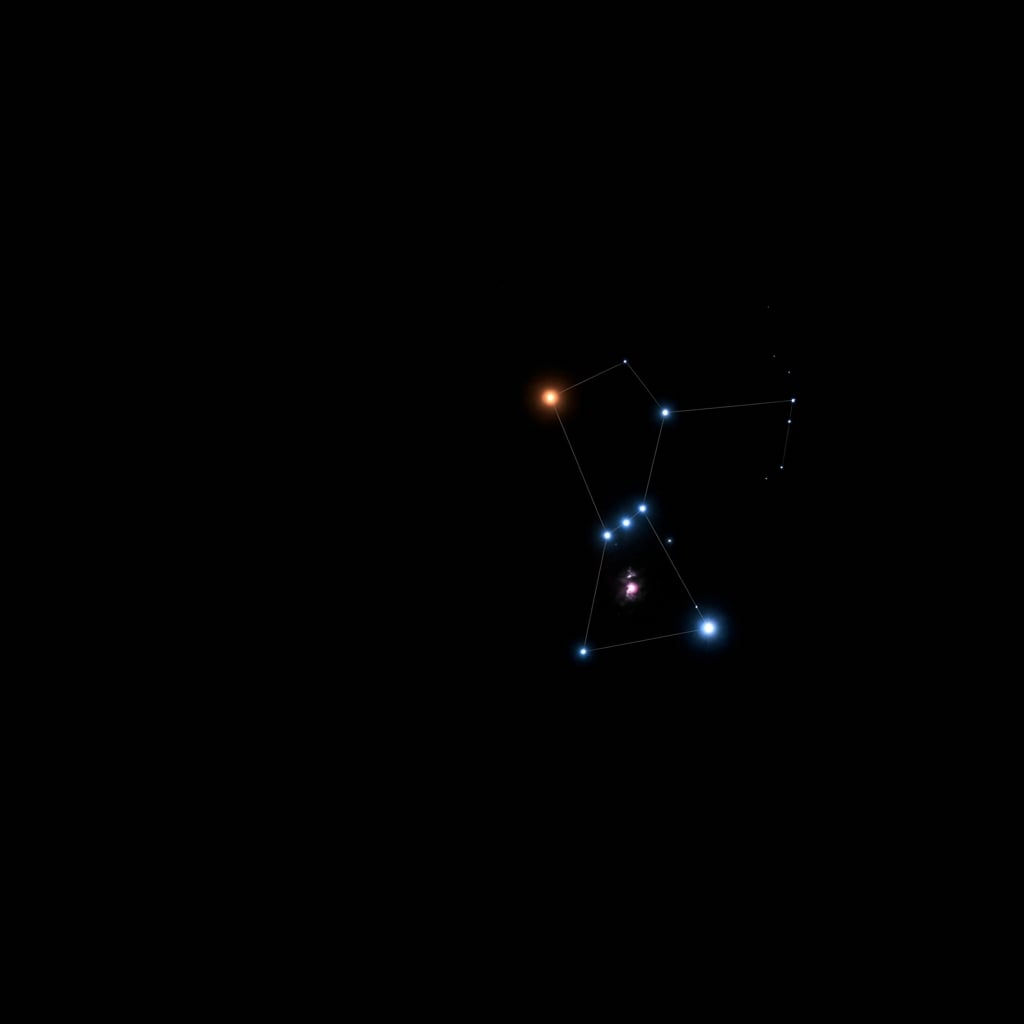
Orion depicts a giant hunter striding across the sky, club raised and shield forward. Its brightest stars form a clear human figure, anchored by the three-star belt at his waist — Alnitak, Alnilam, and Mintaka — perhaps the single most recognizable star pattern in the entire sky.
The Principal Stars of Orion
- Rigel: A brilliant blue-white supergiant marking Orion's foot; the brightest star in the constellation and 7th brightest overall
- Betelgeuse: A red supergiant at Orion's shoulder, so large it would swallow the orbit of Jupiter; a future supernova
- Bellatrix: The "female warrior," a hot blue-white star at the other shoulder
- Alnitak, Alnilam, Mintaka: The three belt stars, all hot, luminous, distant blue giants and supergiants
- Saiph: A blue supergiant marking the hunter's other foot/knee
In Greek myth, Orion was a boastful giant hunter. Several stories describe his death: some say he was slain by a scorpion sent by Gaia (which is why Orion and Scorpius sit on opposite sides of the sky, forever chasing but never meeting), others that Artemis killed him. Whichever tale you prefer, the placement of the constellations preserves the drama — as Scorpius rises in the east, Orion sets in the west, fleeing his nemesis.
The colour contrast between the two brightest stars is a highlight for the naked eye: cool orange Betelgeuse on one side, hot blue Rigel diagonally opposite. It is one of the finest demonstrations that stars come in different colours, and those colours reveal their temperatures.
The Hunting Dogs: Canis Major and Canis Minor
Following at the hunter's heels are his two faithful dogs. Together with Orion they form part of a striking asterism, the Winter Triangle, linking three of the sky's brightest stars.
Canis Major — The Great Dog
Canis Major is crowned by Sirius, the Dog Star, the brightest star in the entire night sky. At just 8.6 light-years distant, Sirius is one of our closest neighbours, and its dazzling white light — sometimes twinkling through a rainbow of colours near the horizon — is unmistakable. Sirius has a tiny white dwarf companion, Sirius B, nicknamed "the Pup." The rest of Canis Major forms a recognizable dog shape and contains the beautiful open cluster M41.
Canis Minor — The Lesser Dog
Canis Minor is a small constellation of essentially two notable stars, dominated by Procyon, the eighth-brightest star in the sky. Like Sirius, Procyon is nearby (11.5 light-years) and has a white dwarf companion. Procyon, Sirius, and Betelgeuse form the Winter Triangle, an easy signpost that helps orient observers among the winter constellations.
Monoceros and Lepus
Monoceros — The Unicorn
Monoceros is a faint modern constellation occupying the sky between Orion's dogs, within the Winter Triangle. Its stars are dim, so it is easily overlooked, yet it lies across a rich band of the Milky Way and hides some spectacular deep-sky objects, including the Rosette Nebula and the Christmas Tree Cluster with its remarkable Cone Nebula. Because it sits in the winter Milky Way, Monoceros rewards binocular and telescope sweeps despite its lack of bright stars.
Lepus — The Hare
Crouching directly beneath Orion's feet is Lepus, the Hare — traditionally the quarry that Orion and his dogs are hunting. It is a modest but genuine constellation with a clear compact shape. Lepus contains the fine globular cluster M79, unusual for being visible in the winter sky (most globulars favour summer), and the deep-red carbon star R Leporis, nicknamed "Hind's Crimson Star" for its striking colour.
Deep-Sky Treasures of the Orion Family
The Orion family is one of the most rewarding regions of sky for telescopes and binoculars, largely because it straddles a rich section of the winter Milky Way.
Must-See Objects
- Orion Nebula (M42): A naked-eye stellar nursery in Orion's sword; spectacular in any telescope
- Horsehead Nebula (Barnard 33): A famous dark nebula silhouetted against glowing gas near Alnitak
- Flame Nebula (NGC 2024): A bright emission nebula beside the belt star Alnitak
- Rosette Nebula (Monoceros): A vast flower-shaped cloud surrounding a young star cluster
- M41 (Canis Major): A bright open cluster just south of Sirius
- M79 (Lepus): A rare winter globular cluster
The Orion Nebula in particular is a target no observer should miss. Even a small telescope reveals the Trapezium — four hot young stars whose fierce ultraviolet light causes the surrounding hydrogen gas to fluoresce. It is, in effect, a window onto the very process that formed our own Sun some 4.6 billion years ago.
Observing the Orion Family
The Orion family is the ideal winter-sky starting point because Orion itself is so easy to find, and it acts as a signpost to everything around it.
Star-Hopping from Orion
- Find the Belt: The three evenly spaced belt stars are your anchor for the whole region.
- To Sirius: Extend the belt line down and to the left (northern hemisphere) to reach dazzling Sirius in Canis Major.
- To Aldebaran and the Pleiades: Extend the belt line up and to the right to find orange Aldebaran in Taurus and the Pleiades beyond.
- The Winter Triangle: Betelgeuse, Sirius, and Procyon form a huge, nearly equilateral triangle framing the faint unicorn Monoceros.
- The Sword: Below the belt, look for the fuzzy glow of the Orion Nebula — obvious even in binoculars.
Best Conditions
Orion rides highest around local midnight in December and in the early evening by February and March. A dark sky brings out the nebulosity in the sword, but even from a city the main figure and its bright stars cut through light pollution, making this family a reliable target on any clear winter night.
Interesting Facts About the Orion Family
- Orion and Scorpius never meet: Placed on opposite sides of the sky, the hunter sets in the west as the scorpion that killed him rises in the east — an eternal chase written into the constellations.
- Betelgeuse is unimaginably large: If placed at the centre of our Solar System, this red supergiant would engulf Mercury, Venus, Earth, Mars, and reach out toward Jupiter.
- The belt aligns with the pyramids: Some researchers note that the three pyramids of Giza mirror the arrangement of Orion's Belt, reflecting the constellation's importance in ancient Egyptian religion.
- Sirius once appeared red: Ancient texts describe Sirius as reddish, a puzzle astronomers still debate, since today it shines pure white. Atmospheric effects or historical misinterpretation are the likely explanations.
- Rigel outshines the Sun 120,000 times: This blue supergiant is one of the most intrinsically luminous stars visible to the naked eye, appearing "only" 7th brightest because it lies about 860 light-years away.
- The Orion Nebula is a cosmic newborn: The stars of the Trapezium are just a few hundred thousand to a million years old — mere infants compared with our 4.6-billion-year-old Sun.
- A universal timekeeper: Because Orion is visible from almost the whole planet, cultures worldwide — Greek, Egyptian, Aboriginal Australian, and many others — built their own myths and calendars around it.
External Resources
- NASA Hubble — Stunning imagery and science of the Orion Nebula
- IAU Constellations — Official boundaries of Orion and its neighbours
- Orion on Wikipedia — Detailed guide to the constellation and its stars
- SEDS Messier Catalog — Data on M42, M41, M79, and other objects in the family
Frequently Asked Questions
What constellations make up the Orion family?
The Orion family consists of five constellations clustered in the winter sky: Orion (the Hunter), Canis Major (the Great Dog), Canis Minor (the Lesser Dog), Monoceros (the Unicorn), and Lepus (the Hare). They are grouped together both because they lie near one another and because most share the mythological theme of Orion the hunter, his two hunting dogs, and the hare they pursue.
Why is Orion so easy to recognize?
Orion is dominated by seven bright stars in a distinctive figure, most notably the three evenly spaced, similarly bright stars of Orion’s Belt — a pattern that appears nowhere else in the sky. Flanking the belt are two brilliant stars of contrasting color: red-orange Betelgeuse at the hunter’s shoulder and blue-white Rigel at his foot. This combination of bright, colorful stars and the unmistakable belt makes Orion the most recognizable constellation in the night sky.
What is the Orion Nebula?
The Orion Nebula (Messier 42) is a vast cloud of glowing gas and dust about 1,340 light-years away, hanging in Orion’s "sword" below the belt. It is visible to the naked eye as a fuzzy patch and is one of the closest and most studied stellar nurseries, where new stars are actively being born. Through binoculars or a telescope it reveals intricate wisps of nebulosity surrounding the Trapezium, a compact cluster of hot young stars whose radiation makes the surrounding gas glow.
What is the brightest star in the Orion family?
Sirius, in Canis Major, is the brightest star in the entire night sky at magnitude −1.46. Often called the "Dog Star," it lies just 8.6 light-years away, making it one of our nearest stellar neighbours. Its brilliance is a combination of genuine luminosity and proximity. You can find Sirius easily by following the line of Orion’s Belt down and to the left (in the northern hemisphere).
When is the best time to see the Orion family?
The Orion family dominates the winter evening sky in the northern hemisphere, best seen from December through March when the constellations ride high after dark. In the southern hemisphere they appear during summer, though "upside down" compared with the northern view. Around June the group lies too close to the Sun to observe, disappearing into the daytime sky for a couple of months.
Is Betelgeuse going to explode?
Betelgeuse is a red supergiant nearing the end of its life, and it will eventually explode as a supernova. However, "eventually" on stellar timescales could mean any time within roughly the next 100,000 years — likely not in our lifetimes. When it does, it will briefly shine as bright as the crescent Moon and be visible in daylight, before fading over months. In 2019–2020 Betelgeuse dimmed dramatically, but this turned out to be caused by an ejected cloud of dust, not an imminent explosion.