Introduction to the Perseus Family
Few regions of the sky tell a story as complete as the Perseus family. Where most constellation groupings are loose collections, this one is a genuine cast of characters — nearly all drawn from a single Greek myth and arranged across the heavens so that the drama plays out among the stars each autumn night.
The family occupies the northern autumn sky, anchored by the enormous Great Square of Pegasus. From it, chains of stars lead outward to the hero, the princess, and her parents enthroned near the pole. For northern observers, the rise of these constellations in the evening is one of the surest signs that autumn has arrived.
Beyond mythology, the Perseus family is astronomically extraordinary. It contains the nearest large galaxy to our own, one of the most famous variable stars in the sky, a pair of dazzling star clusters, and the radiant of the beloved Perseid meteor shower. Few families pack so much both to see and to contemplate.
The Myth Written in the Sky
What makes this family unique is that its constellations were placed to preserve a story. Queen Cassiopeia's boast of unmatched beauty angered the sea god Poseidon, who sent the monster Cetus to ravage the kingdom of her husband Cepheus. To appease it, their daughter Andromeda was chained to a rock by the sea as a sacrifice.
Meanwhile the hero Perseus had slain the Gorgon Medusa, whose gaze turned onlookers to stone, and was flying home — in most tellings aboard the winged horse Pegasus, born from Medusa's blood. Spotting Andromeda in peril, he swooped down, used Medusa's severed head to petrify Cetus, and freed the princess, whom he later married.
The sky preserves the whole tableau. Cassiopeia and Cepheus sit enthroned near the pole; Andromeda stretches out chained; Perseus stands beside her holding Medusa's head, marked by the winking star Algol; Pegasus soars nearby; and Cetus lurks below along the watery region of the sky. Reading the myth turns a jumble of stars into a coherent, memorable map.
Perseus and Andromeda
Perseus — The Hero
Perseus is a bright constellation lying along the Milky Way, shaped like an inverted Y. Its brightest star is Mirfak, a luminous yellow-white supergiant surrounded by a scattered group of stars. But Perseus is most famous for Algol, the "Demon Star," marking the head of Medusa. Algol is a prototype eclipsing binary — every 2.87 days its brightness visibly drops as a companion star passes in front of it, a "winking" that ancient sky-watchers linked to the Gorgon's severed head.
Andromeda — The Chained Princess
Andromeda is a long chain of stars extending from one corner of the Great Square of Pegasus. Its stars are moderately bright, but its glory lies just off the main figure: the Andromeda Galaxy (M31), a vast spiral of a trillion stars and the nearest large galaxy to the Milky Way. To the naked eye under dark skies it is a faint oval glow — and the most distant object the human eye can see unaided, its light having travelled 2.5 million years to reach us.
The Royal Parents: Cassiopeia and Cepheus
Cassiopeia — The Queen
Cassiopeia is one of the most recognizable constellations in the northern sky, forming a distinctive "W" (or "M," depending on the season) of five bright stars. Circumpolar from most northern latitudes, it wheels around Polaris opposite the Big Dipper and can serve as an alternative pointer to the North Star. Lying in a rich band of the Milky Way, Cassiopeia is packed with open star clusters. In myth, the vain queen was set among the stars condemned to circle the pole upside-down as punishment for her arrogance.
Cepheus — The King
Cepheus, the king, is a fainter constellation shaped like a child's drawing of a house, tucked between Cassiopeia and the pole. Though less showy than his queen, Cepheus is scientifically important: it contains Delta Cephei, the prototype of the Cepheid variable stars whose predictable pulsations became the "standard candles" astronomers use to measure cosmic distances. It also hosts the striking red hypergiant Mu Cephei, "Herschel's Garnet Star," one of the reddest stars visible to the naked eye.
Pegasus, Cetus, Auriga and the Rest
- Pegasus (the Winged Horse): Dominated by the Great Square, four stars marking the horse's body. The Great Square is a key autumn landmark and a handy tool for gauging sky darkness by counting the stars visible within it.
- Cetus (the Sea Monster): A sprawling constellation of the "watery" sky region. It contains Mira, the first pulsating variable star ever discovered, which swings from naked-eye brightness to invisibility over about eleven months.
- Auriga (the Charioteer): A bright pentagon crowned by brilliant Capella, the sixth-brightest star in the sky. Lying on the Milky Way, Auriga holds a fine trio of open clusters (M36, M37, M38).
- Triangulum (the Triangle): A small but genuine constellation whose three stars form a slender triangle. It hosts the Triangulum Galaxy (M33), the third-largest member of our Local Group.
- Lacerta (the Lizard): A faint, zigzagging modern constellation squeezed between Cygnus, Cassiopeia, and Andromeda.
Deep-Sky Treasures
Straddling both the crowded Milky Way and clear windows onto distant galaxies, the Perseus family is one of the richest hunting grounds in the sky.
Highlights of the Family
- Andromeda Galaxy (M31): The nearest large spiral, with satellites M32 and M110
- Triangulum Galaxy (M33): A large, face-on spiral in the Local Group
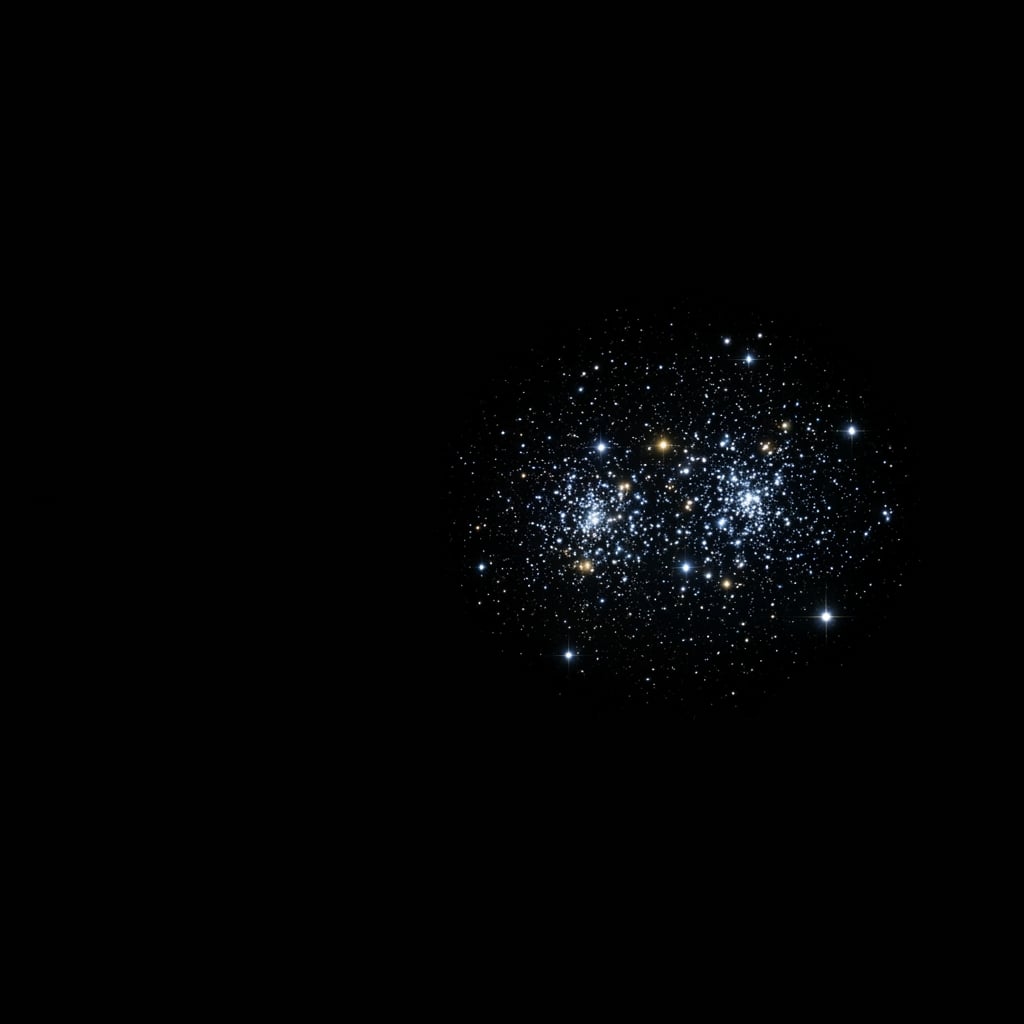
- Double Cluster (NGC 869 & 884): A breathtaking pair of open clusters in Perseus, superb in binoculars
- M36, M37, M38: A rich trio of open clusters in Auriga
- Algol: The prototype eclipsing binary, easy to monitor by eye
- Delta Cephei: The prototype Cepheid variable, a cornerstone of the cosmic distance scale
The Double Cluster in Perseus deserves special note — two glittering swarms of young stars side by side in the same binocular field, so bright they can be glimpsed with the naked eye as a fuzzy patch in the Milky Way between Perseus and Cassiopeia. It is one of the finest sights the autumn sky has to offer.
Observing the Perseus Family
The Great Square of Pegasus is the key that unlocks this entire region, serving as the starting point for finding every other member.
Star-Hopping the Autumn Sky
- Start with the Great Square: Find the four stars of Pegasus high in the autumn sky; it is large and unmistakable.
- To Andromeda and M31: A chain of stars runs off the Square's top-left corner into Andromeda; hop two stars along and up to find the galaxy's faint glow.
- To Perseus: Continue past Andromeda to reach Perseus and, between it and Cassiopeia, the Double Cluster.
- To Cassiopeia: The bright W lies on the opposite side of Polaris from the Big Dipper — impossible to miss.
- Monitor Algol: Over a single evening you can sometimes watch Algol dim and recover — a rare chance to see a star change before your eyes.
The Perseid Meteor Shower
Each August, the Perseid meteor shower radiates from Perseus, delivering up to 60 or more meteors per hour at its peak around August 12–13. Though the constellation itself is best seen in autumn, the Perseids make Perseus a summer highlight too — no equipment needed, just a dark sky and patience after midnight.
Interesting Facts About the Perseus Family
- You can see 2.5 million years into the past: The light from the Andromeda Galaxy left before modern humans existed; seeing it is the farthest back in time the naked eye can look.
- A galactic collision is coming: The Andromeda Galaxy is approaching the Milky Way at about 110 km/s and will merge with it in roughly 4.5 billion years to form a giant elliptical galaxy.
- Algol may have been noticed in antiquity: Some evidence suggests ancient Egyptians tracked Algol's variability over 3,000 years ago, long before its eclipsing nature was understood in 1783.
- Cepheids measure the universe: Delta Cephei's discovery led to the period–luminosity relation that let Edwin Hubble prove other galaxies exist and measure cosmic distances.
- The upside-down queen: Cassiopeia was placed so that she circles the pole head-over-heels for part of each night — an eternal humbling for her vanity.
- Mira, the Wonderful: Cetus's Mira was the first star found to vary in brightness (in 1596), swinging over a factor of hundreds across its 11-month cycle.
- A meteor gift from a comet: The Perseids are debris from Comet Swift–Tuttle, a 26-kilometre giant that last passed the Sun in 1992 and returns every 133 years.
External Resources
- NASA Hubble — Imagery and science of the Andromeda and Triangulum galaxies
- IAU Constellations — Official boundaries of the Perseus family constellations
- Perseus on Wikipedia — The constellation, its stars, and mythology
- SEDS Messier Catalog — Data on M31, M33, and the Auriga clusters
Frequently Asked Questions
What constellations make up the Perseus family?
The Perseus family contains nine constellations, most of them characters from a single Greek myth: Perseus (the hero), Andromeda (the princess he rescues), Cassiopeia (her mother), Cepheus (her father), Pegasus (the winged horse), and Cetus (the sea monster). Added to these are Auriga (the charioteer), Lacerta (the lizard), and Triangulum (the triangle). They dominate the autumn evening sky in the northern hemisphere.
What is the story behind the Perseus family?
The constellations tell one connected legend. Queen Cassiopeia boasted that she — or her daughter Andromeda — was more beautiful than the sea nymphs. As punishment, the sea monster Cetus was sent to ravage the coast, and Andromeda was chained to a rock as a sacrifice. The hero Perseus, returning on the winged horse Pegasus after slaying the Gorgon Medusa, saw Andromeda, defeated Cetus, and rescued her. All the main characters were placed together in the sky.
What is the most famous object in the Perseus family?
The Andromeda Galaxy (Messier 31) is the standout. At about 2.5 million light-years away, it is the most distant object visible to the unaided eye and the nearest large spiral galaxy to our own Milky Way. Under a dark sky it appears as a faint elongated smudge in the constellation Andromeda. It is on a collision course with the Milky Way and will merge with it in roughly 4.5 billion years.
What is the Demon Star, Algol?
Algol (Beta Persei) is a famous eclipsing binary star in Perseus, marking the head of Medusa. Every 2.87 days a dimmer companion passes in front of the brighter star, causing Algol to fade noticeably for several hours before recovering. Ancient observers who noticed this "winking" gave it an ominous reputation — the name comes from the Arabic for "the ghoul," and it represents the severed head of the Gorgon.
Are the Perseids meteors related to the constellation Perseus?
The Perseid meteor shower, one of the best of the year, appears to radiate from the constellation Perseus, which is why it bears that name. However, the meteors have nothing physically to do with the stars of Perseus — they are tiny debris particles shed by Comet Swift–Tuttle, burning up in Earth’s atmosphere. The shower peaks around August 12–13 each year, and Perseus simply marks the direction from which the meteors seem to stream.
When is the best time to see the Perseus family?
The Perseus family rules the autumn evening sky in the northern hemisphere, best placed from September through December. The Great Square of Pegasus is high overhead in October evenings, with Andromeda and Perseus trailing off to one side and Cassiopeia’s W nearly overhead. Cassiopeia and Cepheus are circumpolar from northern latitudes, so they can be seen year-round, but the full family is best in autumn.