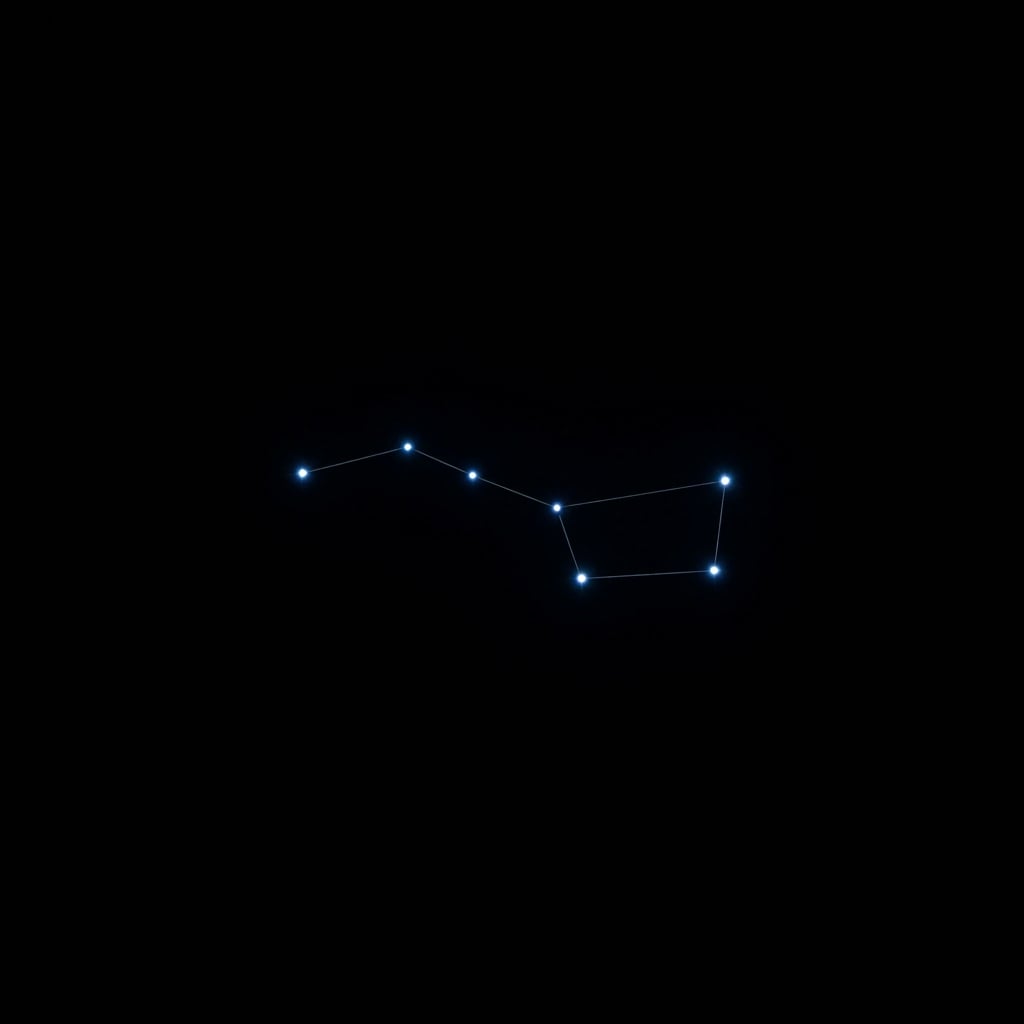
Introduction to the Ursa Major Family
If any constellation deserves to be called the anchor of the northern sky, it is Ursa Major. The Ursa Major family — one of the traditional groupings of the 88 constellations — assembles the Great Bear together with its near neighbours in the region surrounding the north celestial pole. For observers across Europe, North America, and much of Asia, these are the constellations that never truly leave the sky.
Unlike families bound by a single legend, the Ursa Major group is defined mainly by geography: these ten constellations share the northern circumpolar and high-northern sky. Some, like Ursa Major and Ursa Minor, are ancient and famous; others, like Lynx and Leo Minor, are faint modern inventions created to fill gaps between the brighter figures.
What unites them for the practical observer is their role as the sky's great signpost region. Master the Big Dipper and you hold the key to navigating the entire celestial sphere — from it you can hop to Polaris, arc to Arcturus, and trace lines to a dozen other constellations. This is why nearly every beginner's guide to astronomy starts here.
Ursa Major — The Great Bear
Ursa Major is the third-largest of all 88 constellations, sprawling across a huge area of the northern sky. Yet most people know it only through its brightest section, the seven stars of the Big Dipper (called the Plough in Britain). These form the bear's tail and hindquarters, while fainter stars outline its head and legs.
The Seven Stars of the Big Dipper
- Dubhe & Merak: The "Pointers" at the end of the bowl that lead to Polaris
- Phecda & Megrez: The other two bowl stars
- Alioth, Mizar & Alkaid: The three handle stars
- Mizar & Alcor: A famous naked-eye double at the bend of the handle — a classic test of eyesight
Five of the seven Dipper stars are physically related, drifting through space together as part of the Ursa Major Moving Group — the nearest such stellar association to the Sun. The two exceptions, Dubhe and Alkaid, are moving in different directions, which means that over tens of thousands of years the familiar dipper shape will slowly distort and eventually break apart.
The Great Bear appears in the mythologies of many cultures. In Greek legend it is the nymph Callisto, transformed into a bear and placed in the sky by Zeus. Remarkably, many Native American traditions also saw a bear in these same stars — a coincidence so striking that some scholars trace it to a shared myth carried across the Bering land bridge in the deep past.
Ursa Minor and Draco
Ursa Minor — The Little Bear
Ursa Minor contains the Little Dipper and, at the tip of its handle, Polaris — the North Star. Because Polaris sits almost exactly at the north celestial pole, the entire sky appears to rotate around it while Polaris itself stays nearly fixed. This makes Ursa Minor one of the most important constellations for navigation, even though most of its stars are faint. Its two brightest bowl stars, Kochab and Pherkad, are known as the "Guardians of the Pole."
Draco — The Dragon
Draco is a long, winding constellation that snakes between the two bears and coils around Ursa Minor. Though none of its stars are especially bright, its sinuous shape is distinctive once traced. Its star Thuban was the pole star around 3000 BCE, when the pyramids were built — a reminder that precession slowly shifts which star marks the pole. Draco also hosts the Cat's Eye Nebula, one of the most complex and beautiful planetary nebulae known.
Boötes and Its Companions
Boötes — The Herdsman
Boötes is a large kite- or ice-cream-cone-shaped constellation crowned by Arcturus, the fourth-brightest star in the night sky and the brightest in the entire northern celestial hemisphere. This red-orange giant is easy to find by following the arc of the Big Dipper's handle — "arc to Arcturus." Boötes is often pictured as a herdsman driving the bears around the pole.
Canes Venatici — The Hunting Dogs
Tucked beneath the Big Dipper's handle, Canes Venatici represents the dogs held by Boötes. Its brightest star, Cor Caroli, is a fine double. The constellation's real fame comes from its galaxies, above all the magnificent Whirlpool Galaxy (M51).
Corona Borealis — The Northern Crown
Between Boötes and Hercules lies Corona Borealis, a graceful semicircle of stars forming a jewelled crown. Small but elegant, it is easy to recognize and contains the famous recurrent nova "Blaze Star" (T Coronae Borealis), which flares to naked-eye brightness roughly every 80 years.
The Faint Members: Coma Berenices, Camelopardalis, Lynx and Leo Minor
Several of the family's constellations are subtle, filling the spaces between the brighter figures.
- Coma Berenices (Berenice's Hair): A faint but lovely scattering of stars representing the shorn hair of an Egyptian queen. It contains a large, sparse naked-eye star cluster and lies toward a rich field of galaxies at the edge of the Virgo Cluster.
- Camelopardalis (the Giraffe): A large, dim modern constellation filling the otherwise empty region between Ursa Major, Cassiopeia, and Perseus near the pole.
- Lynx: So named by Johannes Hevelius, who joked that only the sharp-eyed lynx could see its faint stars. It bridges the gap between Ursa Major and Auriga.
- Leo Minor (the Lesser Lion): A small, faint constellation nestled between Ursa Major and Leo, another of Hevelius's creations.
Though none of these will impress the naked-eye observer, they matter to the astronomer as home to numerous distant galaxies and as part of the complete tiling of the sky into 88 defined regions.
Deep-Sky Treasures
Because it faces away from the dusty plane of the Milky Way, the Ursa Major family offers a clear window onto the distant universe, making it one of the premier regions for observing galaxies.
Notable Objects
- M51 (Whirlpool Galaxy): A classic face-on spiral with a companion, in Canes Venatici
- M81 & M82 (Bode's and the Cigar): A bright interacting galaxy pair in Ursa Major
- M101 (Pinwheel Galaxy): A large, face-on spiral in Ursa Major
- M63 (Sunflower Galaxy): A richly detailed spiral in Canes Venatici
- M97 (Owl Nebula): A planetary nebula near the Dipper's bowl
- Cat's Eye Nebula (NGC 6543): An intricate planetary nebula in Draco
The M81/M82 pair is a particular favourite: both galaxies fit in the same low-power telescope field, one a graceful spiral and the other a galaxy torn by a burst of star formation triggered by their gravitational encounter — a dramatic contrast in a single view.
Observing the Ursa Major Family
This family is the natural starting point for learning the sky because the Big Dipper is bright, circumpolar, and endlessly useful as a pointer.
Star-Hopping from the Big Dipper
- To Polaris: Follow the Pointers Dubhe and Merak to the North Star.
- To Arcturus: "Arc to Arcturus" by following the curve of the Dipper's handle.
- To Spica: Continue that same arc past Arcturus to reach Spica in Virgo.
- To Cassiopeia: Draw a line from the Dipper through Polaris and out the far side to find the W of Cassiopeia.
- To Leo: Punch a hole in the bottom of the Dipper's bowl and the pair of stars there points down to Leo.
The Mizar Eyesight Test
Look at Mizar, the middle star of the Dipper's handle. Sharp-eyed observers under a dark sky can split it into Mizar and its fainter companion Alcor — a test of vision used since antiquity. A telescope reveals that Mizar itself is a double, and each of those is spectroscopically double again, making the Mizar–Alcor system a remarkable multiple star.
Interesting Facts About the Ursa Major Family
- The Dipper is changing shape: Because its stars move at different speeds and directions, the familiar Big Dipper looked noticeably different 100,000 years ago and will look different again 100,000 years from now.
- A shared bear across continents: Both ancient Greek and many Native American cultures independently pictured a bear in these stars, one of the great puzzles — and possible deep connections — of world mythology.
- Thuban, the pyramid pole star: Draco's Thuban marked the pole around 2700 BCE and was sighted down the descending passage of the Great Pyramid of Giza.
- The nearest moving group: Five of the Dipper's stars belong to the Ursa Major Moving Group, the closest stellar association to the Sun — and our Sun happens to be passing through its outskirts, though it is not a member.
- Follow the arc, twice: The mnemonic "arc to Arcturus, then spike to Spica" chains two of the sky's brightest stars off the Dipper's handle.
- A window on galaxies: Facing away from the Milky Way's dust, the family region is one of the richest galaxy fields accessible to backyard telescopes.
- Flags and folklore: The Big Dipper appears on the flag of Alaska and has guided travellers — including, by tradition, those following the "Drinking Gourd" to freedom on the Underground Railroad.
External Resources
- IAU Constellations — Official names and boundaries of the family constellations
- NASA Skywatching — Tips for finding the Big Dipper and Polaris
- Ursa Major on Wikipedia — In-depth guide to the Great Bear and its stars
- SEDS Messier Catalog — Data on M51, M81, M101 and the family's many galaxies
Frequently Asked Questions
What constellations belong to the Ursa Major family?
The Ursa Major family is a group of ten constellations occupying the northern sky around the celestial pole: Ursa Major, Ursa Minor, Draco, Canes Venatici, Boötes, Coma Berenices, Corona Borealis, Camelopardalis, Lynx, and Leo Minor. They are grouped by their shared location in the northern heavens rather than by a single myth, and several of them are circumpolar from mid-northern latitudes.
Is the Big Dipper a constellation?
No — the Big Dipper is an asterism, not a constellation. It is a pattern of seven bright stars that forms the most recognizable part of the constellation Ursa Major, the Great Bear. The dipper makes up the bear’s hindquarters and long tail. Because it is so easy to spot, the Big Dipper serves as the gateway to the entire northern sky, pointing the way to Polaris and other constellations.
How do you find Polaris using the Big Dipper?
Locate the two stars at the end of the Big Dipper’s "bowl," farthest from the handle — Dubhe and Merak, known as the Pointers. Draw an imaginary line from Merak through Dubhe and extend it about five times the distance between them. That line leads to Polaris, the North Star, which marks the north celestial pole and sits at the tip of the Little Dipper’s handle in Ursa Minor.
What is the brightest star in the Ursa Major family?
Arcturus, in Boötes, is the brightest star in the family and the fourth-brightest star in the entire night sky. It is a red-orange giant about 37 light-years away. You can find Arcturus by "arcing" along the curve of the Big Dipper’s handle and continuing that arc — the mnemonic is "arc to Arcturus." Continuing the same arc onward leads to Spica in Virgo ("spike to Spica").
Why is Ursa Major important for stargazing?
Ursa Major is one of the most useful constellations because, from most northern locations, it is circumpolar and therefore visible on any clear night of the year. Its Big Dipper asterism acts as a natural signpost: its stars point not only to Polaris but also, by extending various lines, to constellations including Leo, Boötes, and Cassiopeia. Learning the Big Dipper first is the classic entry point into practical astronomy.
What deep-sky objects can be found in this family?
The Ursa Major family is rich in galaxies because it looks away from the crowded plane of the Milky Way. Highlights include the Whirlpool Galaxy (M51) in Canes Venatici, the Pinwheel Galaxy (M101) in Ursa Major, the bright pair Bode’s Galaxy (M81) and the Cigar Galaxy (M82), and the Sunflower Galaxy (M63). Coma Berenices contains the Coma Star Cluster and a portion of the vast Coma–Virgo galaxy cluster, making this region a favourite for galaxy-hunters.