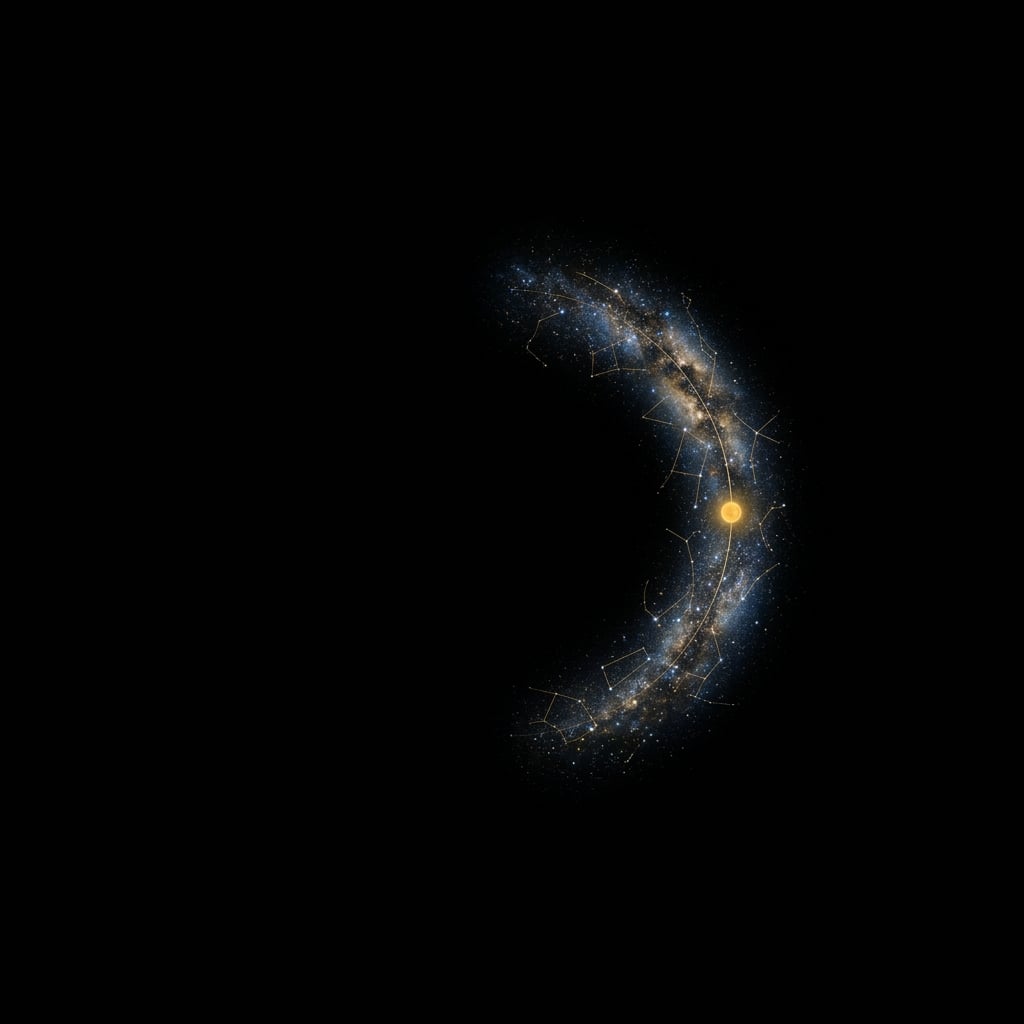
Introduction to the Zodiac
The word "zodiac" comes from the Greek zodiakos kyklos, meaning "circle of little animals" — a reference to the mostly living creatures that populate this band of sky. For at least three thousand years, the 12 zodiac constellations have held a special place in human culture, because they mark the highway travelled by the Sun, Moon, and planets across the celestial sphere.
Unlike the arbitrary groupings elsewhere in the sky, the zodiac constellations share a defining geometric property: they all straddle the ecliptic, the great circle that represents the plane of Earth's orbit projected onto the stars. This is why the zodiac mattered so much to ancient sky-watchers. If you wanted to predict where the wandering planets would appear, you only had to watch these twelve patterns.
Today the zodiac occupies a curious dual identity. To astronomers it is simply the set of constellations along the ecliptic — a useful reference band for tracking the Solar System's objects. To the older tradition of astrology it is a system of 12 equal "signs" that, due to the slow drift of precession, have gradually parted company with the actual stars they were named after.
The Ecliptic: The Sun's Road
The ecliptic is the apparent yearly path of the Sun against the background stars. As Earth orbits the Sun, the Sun appears to move eastward through the constellations, completing one full circuit in 365.25 days and advancing by roughly one degree per day. Because Earth's axis is tilted 23.4 degrees relative to its orbit, the ecliptic is inclined by that same angle to the celestial equator.
The Moon and the eight planets all orbit the Sun in nearly the same plane, so from Earth they too are always found within a few degrees of the ecliptic — a strip of sky about 16 degrees wide known as the zodiac belt. This is why you will never see Jupiter or Saturn near the celestial pole; the planets are permanently confined to the zodiac.
Key Points on the Ecliptic
- Vernal (spring) equinox: The Sun crosses the equator heading north, currently located in Pisces
- Summer solstice: The Sun reaches its northernmost point, in Taurus/Gemini
- Autumnal equinox: The Sun crosses the equator heading south, in Virgo
- Winter solstice: The Sun reaches its southernmost point, in Sagittarius
Eclipses take their name from the ecliptic because they can only occur when the new or full Moon lies exactly on this line, allowing the Sun, Earth, and Moon to align. The Moon's own orbit is tilted about 5 degrees, so most months it passes above or below the Sun rather than directly across it.
The Twelve Zodiac Constellations
Below are the 12 traditional zodiac constellations in the order the Sun passes through them, along with their brightest stars and the season when they are best seen in the evening sky.
The Zodiac in Order
- Aries (The Ram): Small and faint; brightest star Hamal. Best seen on autumn evenings.
- Taurus (The Bull): Marked by orange Aldebaran and the Pleiades and Hyades clusters. Winter.
- Gemini (The Twins): Headed by the bright pair Castor and Pollux. Winter.
- Cancer (The Crab): The faintest zodiac constellation; hosts the Beehive Cluster (M44). Spring.
- Leo (The Lion): A true lion shape anchored by blue-white Regulus. Spring.
- Virgo (The Maiden): The largest zodiac constellation; bright star Spica. Spring.
- Libra (The Scales): The only inanimate zodiac sign; once the claws of Scorpius. Summer.
- Scorpius (The Scorpion): A vivid J-shaped scorpion led by red Antares. Summer.
- Sagittarius (The Archer): The "teapot" pointing to the galactic center. Summer.
- Capricornus (The Sea-Goat): A faint triangular pattern; ancient origins. Autumn.
- Aquarius (The Water Bearer): Large but dim; contains the Helix Nebula. Autumn.
- Pisces (The Fishes): A faint V of two fish; holds the current vernal equinox. Autumn.
Bright and Faint Members
The zodiac is a study in contrasts. Some of its members — Leo, Taurus, Scorpius, and Gemini — are among the most striking and easily recognized constellations in the whole sky, packed with first-magnitude stars. Others — Cancer, Libra, Capricornus, and Pisces — are so faint that they can be difficult to make out from a light-polluted location, and beginners often struggle to trace their shapes without a star chart.
Ophiuchus: The Forgotten 13th
Although tradition fixes the zodiac at 12 constellations, the Sun actually spends about 18 days each year — from roughly November 30 to December 17 — within the boundaries of Ophiuchus, the Serpent Bearer. This large constellation dips its foot across the ecliptic between Scorpius and Sagittarius.
Ophiuchus was excluded from the zodiac not by accident but by design. When Babylonian astronomers laid out the zodiac, they wanted a tidy system of 12 equal segments of 30 degrees each, matching the 12 months of the lunar calendar. The constellations were of unequal size, so the neat 30-degree "signs" of astrology never corresponded exactly to the messy real constellations even at the outset.
Periodically the media rediscovers Ophiuchus and announces that the zodiac has "changed" to include a 13th sign. In reality nothing has changed — Ophiuchus has always straddled the ecliptic, and astrology has always chosen to ignore it. The story simply highlights the gap between the constellations as astronomers define them and the idealized 12-sign scheme of astrology.
Precession and the Astrology Disconnect
Earth's rotational axis does not point in a fixed direction. Like a spinning top slowing down, it traces a slow circle in the sky over a period of about 25,772 years — a motion called axial precession. As the axis wanders, the position of the equinoxes slides westward along the ecliptic at a rate of about one degree every 72 years.
When Greek and Babylonian astronomers codified the zodiac around 2,000 years ago, the vernal equinox sat at the border of Aries, and the astrological signs were defined to begin there. Since then, precession has carried the equinox backward all the way through Pisces. As a result, the astrological sign and the actual constellation are now offset by nearly a full sign.
Sign vs. Constellation Today
- Someone told they are "a Leo" (Sun-sign) actually had the Sun in front of Cancer at birth
- The astrological signs track the seasons (tropical zodiac), fixed to the equinoxes
- The constellations track the stars (sidereal zodiac), which precession moves
- In roughly 12,000 years, Vega will replace Polaris as the northern pole star — the same precession at work
It is important to stress that this is not a criticism of anyone's beliefs but simply a description of the astronomy: the tropical zodiac used in Western astrology was deliberately anchored to the seasons rather than the stars, so the two systems were always destined to drift apart.
Observing the Zodiac
Because the zodiac forms a continuous band circling the entire sky, some portion of it is always visible on any clear night. Tracing the ecliptic by eye is one of the most rewarding skills a beginner can learn, because it reveals the hidden order behind the wandering planets.
How to Follow the Ecliptic
- Find a bright planet: Venus, Jupiter, Mars, and Saturn all lie on the ecliptic. Two or more planets in the sky instantly sketch out the line for you.
- Watch the Moon: Over a week, note how the Moon moves eastward through successive zodiac constellations — it advances about 13 degrees per night.
- Use the seasons: Learn the two or three zodiac constellations best placed each season and build outward from there.
- Start with the showpieces: Taurus, Gemini, Leo, and Scorpius are easy anchors; use them to locate their fainter neighbors.
Deep-Sky Treasures Along the Zodiac
The zodiac is rich in celestial objects for binoculars and telescopes. Taurus holds the Pleiades (M45) and the Crab Nebula (M1). Cancer contains the Beehive Cluster (M44). Sagittarius, gazing toward the heart of the Milky Way, is arguably the single richest constellation in the sky, packed with the Lagoon, Trifid, and Omega nebulae and dozens of star clusters. Virgo lies toward a great cluster of galaxies visible in modest telescopes.
Interesting Facts About the Zodiac
- Libra was once part of Scorpius: The Romans split off the scorpion's claws to create the Scales. The old link survives in the star names Zubenelgenubi and Zubeneschamali — Arabic for the "southern claw" and "northern claw."
- The only non-living sign: Libra is the sole zodiac constellation representing an inanimate object rather than an animal or person, making the Greek name "circle of animals" slightly inaccurate.
- Sagittarius points to the galactic center: The supermassive black hole at the heart of the Milky Way, Sagittarius A*, lies in the direction of this constellation, roughly 26,000 light-years away.
- Aquarius hosts a dying Sun's future: The Helix Nebula in Aquarius is one of the closest planetary nebulae — a preview of what our own Sun will become in about five billion years.
- The equinox is leaving Pisces: The vernal equinox point is slowly moving from Pisces toward Aquarius, which is the astronomical basis for the poetic phrase "the dawning of the Age of Aquarius."
- Zodiacal light: On very dark spring or autumn evenings, a faint pyramid of light called the zodiacal light can be seen along the ecliptic — sunlight scattered by dust grains lying in the plane of the Solar System.
- Ancient consistency: The zodiac is one of the oldest surviving scientific constructs; the Babylonian star catalog MUL.APIN from around 1000 BCE already lists constellations recognizably ancestral to today's zodiac.
External Resources
- NASA Solar System — How the planets move along the ecliptic through the zodiac
- IAU Constellations — Official boundaries and names of the 88 constellations
- Zodiac on Wikipedia — History and astronomy of the zodiac band
- Stellarium — Free planetarium software to trace the ecliptic in real time
Frequently Asked Questions
What are the zodiac constellations?
The zodiac constellations are the 12 star patterns that lie along the ecliptic — the apparent path the Sun traces across the sky over the course of a year. In order, they are Aries, Taurus, Gemini, Cancer, Leo, Virgo, Libra, Scorpius, Sagittarius, Capricornus, Aquarius, and Pisces. Because the Moon and planets also move close to the ecliptic, they too are always found somewhere among these constellations.
Why are there 13 constellations on the ecliptic but only 12 zodiac signs?
The Sun actually passes through a 13th constellation, Ophiuchus (the Serpent Bearer), spending roughly 18 days there each year between Scorpius and Sagittarius. The traditional zodiac was fixed at 12 signs thousands of years ago to match the 12 lunar months in a year, dividing the ecliptic into 12 equal 30-degree segments. Ophiuchus was left out of that scheme even though the modern IAU constellation boundaries place part of the ecliptic firmly within it.
Why don’t astrological signs match the real constellations anymore?
Because of precession — a slow, 26,000-year wobble of Earth’s rotational axis. When the zodiac was formalized around 2,000 years ago, the astrological signs lined up with their namesake constellations. Since then, precession has shifted the Sun’s apparent position by roughly one whole constellation. So when astrology says the Sun is “in Aries,” it is now actually in front of Pisces. The astrological signs are tied to the seasons (the Sun’s position relative to the equinoxes), not to the drifting stars.
Which zodiac constellation is the largest?
Virgo is by far the largest zodiac constellation, covering 1,294 square degrees — the second-largest of all 88 constellations. It contains Spica, a brilliant blue-white star, and lies in the direction of the Virgo Cluster, a swarm of over a thousand galaxies. The smallest zodiac constellation is Capricornus, and one of the faintest is Cancer, whose stars are so dim it is often the hardest zodiac pattern to trace by eye.
What is the brightest star in the zodiac?
The brightest star that lies within a zodiac constellation is Aldebaran in Taurus, a red-orange giant marking the “eye of the bull,” closely rivalled by Antares, the red supergiant heart of Scorpius, and Pollux in Gemini. Regulus (Leo) and Spica (Virgo) are also first-magnitude stars. Because the ecliptic threads through some of the sky’s richest regions, the zodiac is home to several of the most recognizable bright stars in the night sky.
When is the best time to see each zodiac constellation?
A zodiac constellation is best seen at night when it is on the opposite side of the sky from the Sun — roughly six months after the Sun passes through it. For example, the Sun crosses Scorpius in late November, so Scorpius is best observed on summer evenings (June–July) in the northern hemisphere. As a rule of thumb, the winter evening sky shows Taurus and Gemini, spring shows Leo and Virgo, summer shows Scorpius and Sagittarius, and autumn shows Aquarius and Pisces.