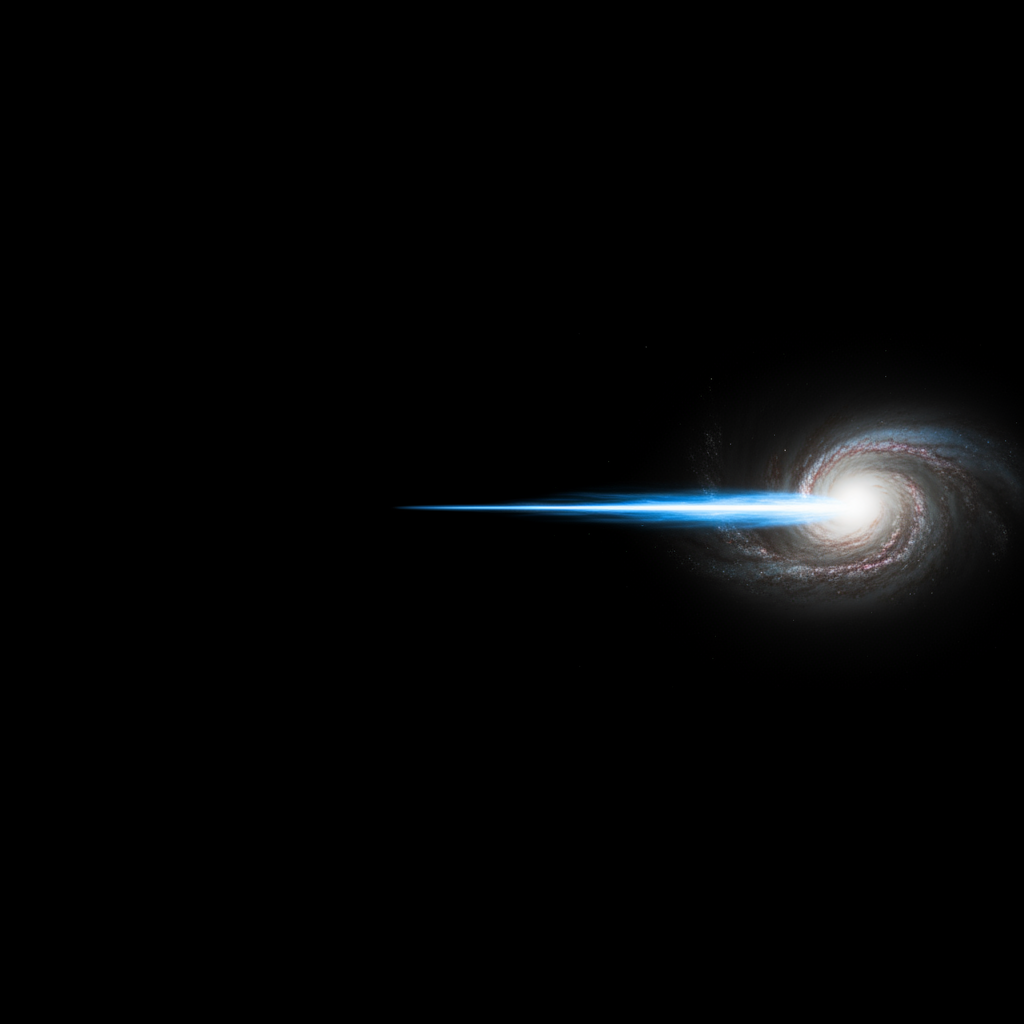
Introduction to Active Galaxies
Every large galaxy in the universe harbors a supermassive black hole at its center — but not all of them are feeding. When a black hole actively accretes surrounding gas, creating a luminous Active Galactic Nucleus (AGN), the galaxy is classified as active. The range of AGN activity spans twelve orders of magnitude in luminosity, from the feeble, intermittent flares of our own Sagittarius A* to the blazing quasars that outshine their host galaxies by a thousandfold.
The discovery of quasars in the 1960s was one of the most revolutionary events in 20th-century astronomy. When Maarten Schmidt measured the redshift of 3C 273 in 1963, he found it to be extraordinarily distant yet extraordinarily bright — requiring a luminosity far beyond any known stellar process. The interpretation, eventually accepted, was that quasars were powered by supermassive black holes consuming matter at rates of tens to hundreds of solar masses per year, releasing energy through an impossibly efficient process.
AGN activity has a dramatic impact on galaxy evolution. The jets and winds launched by AGN can heat gas across enormous volumes, suppress star formation, and even eject gas from the galaxy entirely. This "AGN feedback" is now recognized as one of the key processes that shaped the population of massive galaxies we observe today, explaining why they stopped forming stars billions of years ago.
In the modern universe, quasar activity has largely subsided as black holes have consumed most available fuel. But AGN are still active at lower levels in many galaxies, including in the form of Seyfert galaxies — spirals with luminous, variable nuclei — and low-luminosity AGN that include LINERs and transition objects.
AGN Types and Characteristics
Active galaxies come in several observationally distinct classes, unified by the underlying physics of black hole accretion but differing in luminosity, viewing angle, radio emission, and host galaxy type.
Active Galaxy Quick Facts
- Energy Source: Supermassive black hole accretion disk
- Main Types: Quasars, Seyfert 1 & 2, blazars, radio galaxies, LINERs
- Peak Era: Quasar epoch at redshift z=2–3 (~10 billion years ago)
- Jet Speed: Near the speed of light (relativistic jets)
- Luminosity Range: 10⁴² to 10⁴⁷ ergs/s
- Nearest Quasar: Markarian 231 — 600 million light-years
Data: NASA Galaxies
Seyfert Galaxies
Seyfert galaxies are the most common type of AGN host in the nearby universe. They are typically spiral galaxies with unusually bright, compact, variable nuclei. Seyfert 1 galaxies show both broad and narrow emission lines in their spectra, indicating fast-moving gas very close to the black hole (broad line region) and slower-moving gas further out (narrow line region). Seyfert 2 galaxies show only narrow lines — in the unified model, a torus of dust blocks our direct view of the fast inner material. NGC 4151 and Markarian 573 are well-known nearby examples.
Quasars and Luminous AGN
Quasars (quasi-stellar objects) are the most luminous AGN — high-redshift objects so bright that they appear star-like even at billions of light-years. They represent the most massive black holes accreting at their highest rates, typically in the early universe when gas was plentiful. As the universe aged and galaxies consumed their fuel, quasar activity declined dramatically. Modern quasars are rare and are found predominantly at z>1. Radio-quiet quasars (the majority) produce little radio emission; radio-loud quasars launch prominent jets.
Blazars and BL Lac Objects
Blazars are the most extreme AGN: their relativistic jet points almost directly at Earth, producing dramatically variable, polarized emission across all wavelengths. BL Lac objects (named after their prototype, the variable star-like object BL Lacertae) have featureless optical spectra — the jet emission overwhelms all other galaxy features. Flat-Spectrum Radio Quasars (FSRQs) are higher-luminosity blazars with detectable emission lines from the broad line region. Blazars are the dominant sources of high-energy gamma rays and TeV photons in the extragalactic sky.
Unified Model and AGN Jets
The AGN unified model, developed in the 1980s and 1990s, proposed that the diverse menagerie of active galaxy types could be understood as the same fundamental object viewed from different orientations. The key ingredient in addition to the black hole and accretion disk is an obscuring torus of gas and dust surrounding the nucleus.
The Torus and Viewing Angle
Viewed face-on (looking down the jet axis), the AGN appears as a blazar or quasar with broad emission lines (Seyfert 1 type). Viewed at intermediate angles, the broad line region may be partially or fully obscured by the torus, giving Seyfert 2 characteristics. Viewed edge-on, the torus may block even the narrow line region, creating a completely obscured ("type 2") AGN detectable only in X-rays or infrared. The unification model has been substantially confirmed by polarimetric observations that reveal hidden broad lines in Seyfert 2 nuclei — light scattered into our line of sight from above the torus.
Relativistic Jets and Lobes
About 10–15% of all AGN launch powerful relativistic jets — collimated outflows of magnetized plasma moving at 90–99% of the speed of light. Jets are powered by the rotational energy of the spinning black hole (Blandford-Znajek mechanism) or by the magnetic pressure gradient in the inner accretion disk (Blandford-Payne mechanism). Radio-loud AGN jets inflate giant lobes of radio emission in the surrounding intergalactic medium, sometimes extending millions of light-years from the host galaxy. The largest known radio lobes (Alcyoneus) span 16.3 million light-years.
AGN Feedback and Galaxy Quenching
AGN feedback operates in two modes. In the "quasar mode" (or radiative mode), AGN-driven winds from luminous quasars sweep gas out of the galaxy on timescales of tens of millions of years. In the "radio mode" (or jet mode), lower-luminosity AGN in elliptical galaxies and cluster central galaxies inflate jets and lobes that heat the surrounding hot gas, preventing it from cooling and forming stars. This heating maintains a thermal balance in galaxy clusters and prevents the massive "cooling flows" predicted by naive models. Without radio-mode AGN feedback, the most massive galaxies would be far bluer and more star-forming than observed.
Notable Active Galaxies
3C 273: The first quasar to have its redshift measured (z=0.158), 3C 273 in Virgo is the nearest and brightest quasar at about 2.4 billion light-years. Its luminosity is about 4 trillion times that of the Sun — 100 times the luminosity of the entire Milky Way. Despite this, it requires optical aid to observe. A prominent radio jet extends 200,000 light-years from the nucleus.
Centaurus A (NGC 5128): The nearest radio galaxy at 13 million light-years, Cen A is a giant elliptical galaxy with a spectacular dark dust lane (remnant of a merged spiral) and powerful radio jets. The jets extend nearly a million light-years end-to-end. Its AGN is also a source of X-rays and very high energy gamma rays, and it has been linked to observed ultra-high-energy cosmic rays.
M77 (NGC 1068): The prototypical Seyfert 2 galaxy in Cetus at 47 million light-years. Spectropolarimetric observations in the 1980s revealed hidden broad emission lines, directly confirming the AGN unified model. Its nucleus is one of the most studied AGN in the universe and hosts a 10-million solar mass black hole surrounded by a thick molecular torus.
Markarian 231: The nearest quasar at 600 million light-years, classified as an ultraluminous infrared galaxy (ULIRG). Markarian 231 is the result of two spiral galaxies merging, driving enormous quantities of gas to the nucleus and powering one of the most luminous AGN in the local universe. Its central black hole is accreting at near the theoretical maximum rate.
Cygnus A: The most powerful radio galaxy in the nearby universe, 760 million light-years away. Cygnus A drives twin jets that inflate two giant radio lobes spanning over 300,000 light-years each. The jets are among the most energetic outflows known, depositing enough energy per second to heat a galaxy cluster. It was one of the first extragalactic radio sources identified.
Interesting Facts About Active Galaxies
- Efficiency of Accretion: Nuclear fusion — the energy source of stars — converts about 0.7% of matter's rest mass to energy. Accretion onto a black hole converts 6–42% of the infalling mass to energy, depending on the black hole's spin. This extraordinary efficiency is why AGN can outshine entire galaxies from a region no larger than our solar system. The energy released per unit time in a luminous quasar is equivalent to converting a million suns into pure energy every year.
- Variability: AGN vary in brightness on timescales from minutes (X-rays from the innermost accretion disk) to years (UV/optical from the broader disk). The fastest X-ray variability sets an upper limit on the size of the emitting region — smaller than our solar system. This variability at all wavelengths is a key diagnostic of AGN and what originally distinguished them from normal galactic nuclei.
- The Quasar Epoch: Quasar activity peaked at redshift z ≈ 2–3, corresponding to about 10–12 billion years ago — approximately 2–4 billion years after the Big Bang. At that time, galaxies were gas-rich and actively merging, providing abundant fuel for their central black holes. The dramatic decline in quasar activity since z=2 parallels the overall decline in cosmic star formation rate — both driven by the exhaustion of cold gas in the universe.
- Gravitational Lensing of Quasars: When a foreground galaxy lies along the line of sight to a distant quasar, the galaxy's gravity can split the quasar's image into multiple copies arranged in an arc or Einstein ring. These gravitationally lensed quasars provide measurements of the Hubble constant through time delay cosmography and probe dark matter distributions in lensing galaxies. The "Twin Quasar" (Q0957+561) was the first discovered gravitational lens in 1979.
- Echo Mapping: Reverberation mapping is a powerful technique for measuring the size of the AGN broad line region and the mass of the central black hole. Variations in the AGN continuum emission (from near the black hole) travel outward at the speed of light and cause echoes in the broad emission lines as the light reaches the broader region. By measuring the time delay between continuum and line variations, astronomers can determine the size of the broad line region and infer the black hole mass from the Keplerian orbital velocity of the line-emitting gas.
- Cosmic Rays from Blazars: Ultra-high-energy cosmic rays — particles with energies exceeding 10²⁰ eV — arrive at Earth from unknown extragalactic sources. Blazars are among the prime candidates. The Pierre Auger Observatory has found correlations between the arrival directions of the highest-energy cosmic rays and the positions of nearby AGN, and IceCube Neutrino Observatory has detected high-energy neutrinos associated with the blazar TXS 0506+056 — providing the first evidence for a cosmic ray source.
- Changing Look AGN: Some AGN undergo dramatic spectral transformations on timescales of months to years — transitioning from Seyfert 1 to Seyfert 2 (or vice versa) as broad emission lines appear or disappear. These "changing look AGN" challenge the simple static torus picture of the unified model and suggest that accretion rate changes can rapidly alter the structure of the broad line region itself. The true torus may be a dynamical, clumpy structure rather than a smooth, permanent feature.
- Dual AGN: In galaxy mergers, both galaxies bring their own supermassive black holes. If both are accreting, the result is a dual AGN — two active nuclei within a single galaxy. These systems are expected to eventually form a binary supermassive black hole system that spirals together and merges, emitting a final burst of gravitational waves. No confirmed supermassive black hole binary has yet been observed, but candidates exist, and the Laser Interferometer Space Antenna (LISA) may eventually detect their gravitational wave signals.
External Resources
- NASA Active Galaxies — NASA overview of AGN, quasars, and active galaxy research
- ESA INTEGRAL — AGN — High-energy observations of active galactic nuclei
- AGN on Wikipedia — Comprehensive overview of AGN types, physics, and unified model
- Quasar on Wikipedia — Detailed article on the most luminous active galaxies
Frequently Asked Questions
What is an active galaxy?
An active galaxy is a galaxy whose central region — the Active Galactic Nucleus (AGN) — is unusually luminous, often outshining the rest of the galaxy combined. This extraordinary luminosity is powered not by stars but by a supermassive black hole actively consuming surrounding gas and dust. As matter spirals inward through an accretion disk, it releases an enormous amount of energy — up to 10% of its rest mass energy, compared to just 0.7% for nuclear fusion. Active galaxies include quasars, Seyfert galaxies, blazars, and radio galaxies.
What is a quasar?
A quasar (quasi-stellar object, or QSO) is the most luminous type of AGN. At their peak, quasars can outshine the combined light of all the stars in their host galaxy by a factor of thousands or even trillions. They are predominantly found at high redshift — the early universe, 10+ billion years ago — when gas was abundant and black holes were actively growing. The nearest quasar, Markarian 231, is about 600 million light-years away. Quasars were originally thought to be stars because of their unresolved, point-like appearance on photographic plates.
What is the unified model of AGN?
The AGN unified model proposes that quasars, Seyfert 1 and 2 galaxies, blazars, and radio galaxies are all the same fundamental type of object — a supermassive black hole with an accretion disk and often jets — viewed from different angles. A torus of gas and dust surrounding the nucleus blocks our view of the accretion disk from certain angles, while a jet aligned with our line of sight produces blazar characteristics. This model explains why different AGN classes show such different observational properties despite sharing a common physical mechanism.
What is a blazar?
A blazar is an AGN whose relativistic jet is pointed almost directly at Earth. The jet emission, boosted by Doppler beaming, dominates all other emission from the galaxy, making blazars the most variable and most luminous of all AGN types. They are divided into BL Lac objects (named after BL Lacertae, the prototype) and Flat-Spectrum Radio Quasars (FSRQs). Blazars emit across the entire electromagnetic spectrum from radio to very high-energy gamma rays, and they are the most powerful persistent sources of high-energy cosmic rays and gamma rays in the universe.
How does AGN feedback affect galaxy evolution?
AGN feedback is one of the most important processes in galaxy evolution. As a black hole accretes, it drives winds and jets that can heat the surrounding gas to millions of degrees, preventing it from cooling and forming new stars. This "negative feedback" is thought to explain why the most massive galaxies stopped forming stars billions of years ago — the AGN in their nuclei effectively quenched star formation across the entire galaxy. Without AGN feedback, simulations produce galaxies far more massive and star-rich than observed. Conversely, AGN can also trigger star formation by compressing gas clouds with their winds ("positive feedback").
Can we observe AGN in the Milky Way?
Yes — Sagittarius A* (Sgr A*), the Milky Way's central supermassive black hole, shows weak AGN activity. It flares in X-rays and infrared when small amounts of gas or asteroids fall near the event horizon, but it is far too quiet to be classified as a Seyfert or quasar. Evidence from the Fermi Bubbles — giant lobes of gamma-ray emission extending 25,000 light-years above and below the galactic plane — suggests that Sgr A* may have been far more active millions of years ago, during a period now called the "Sgr A* flaring event" or "Seyfert phase."
What are radio galaxies?
Radio galaxies are AGN that emit enormous amounts of energy in the form of radio waves from relativistic jets. These jets, launched from near the central black hole, can extend for hundreds of thousands or even millions of light-years beyond the galaxy, inflating giant radio-emitting lobes in the surrounding intracluster or intergalactic medium. Cygnus A is the most powerful radio galaxy in the local universe; Centaurus A (NGC 5128) is the nearest. The jets in radio galaxies can heat the intracluster medium of galaxy clusters, preventing cooling flows and regulating star formation across scales much larger than the galaxy itself.