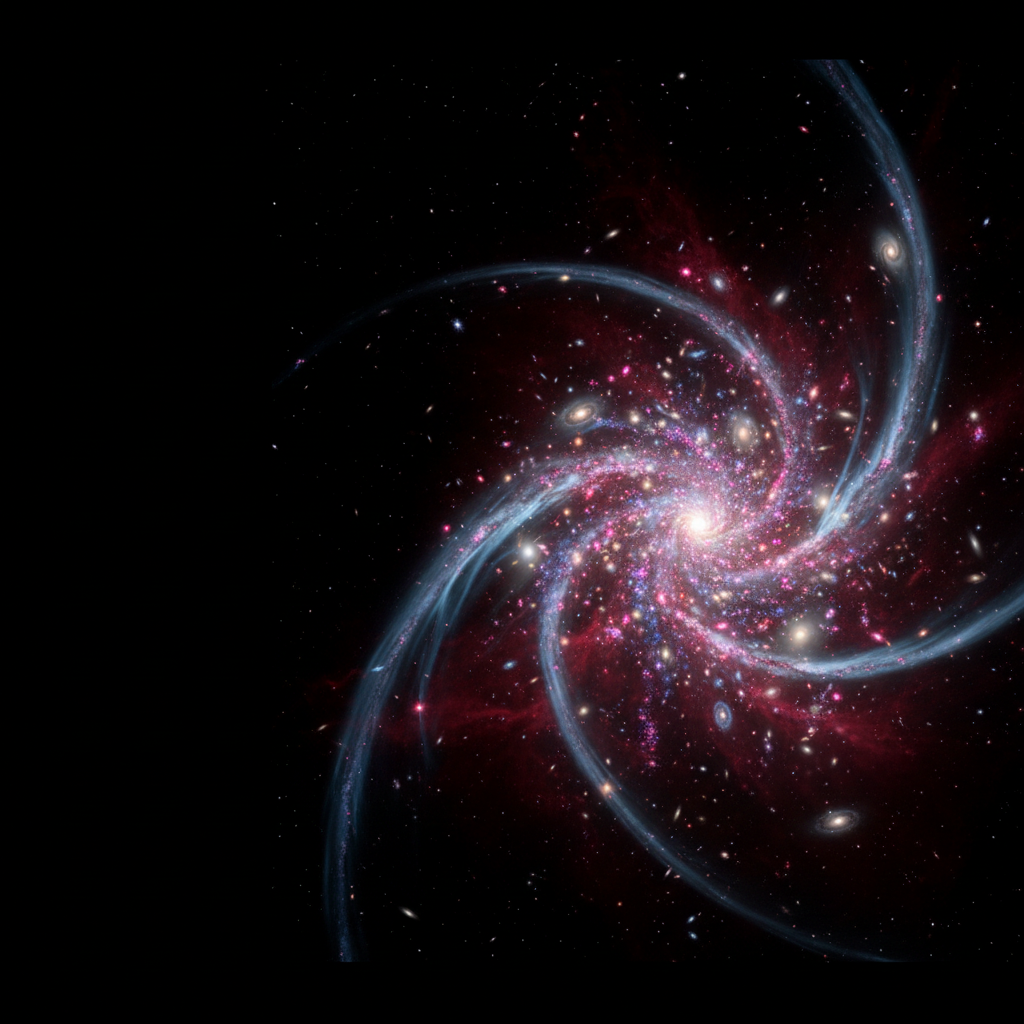
Introduction to Galaxy Clusters
At the top of the cosmic hierarchy of structure sit galaxy clusters — massive gravitational cities of hundreds to thousands of galaxies bound together across millions of light-years. They are the most massive, gravitationally collapsed objects in the universe, representing the endpoints of hierarchical structure formation on the largest scales accessible to observation. From a cosmologist's perspective, galaxy clusters are among the most valuable objects in the sky: their abundance, mass, and spatial distribution encode the fundamental parameters of the universe.
The first galaxy cluster to be recognized as such was the Virgo Cluster, noted by Charles Messier and William Herschel in the 18th century as a remarkable concentration of "nebulae" in the constellation Virgo. As photographic surveys improved in the 20th century, catalogues of galaxy clusters grew rapidly. Fritz Zwicky's 1933 observation of the Coma Cluster led him to calculate that the galaxies were moving far too fast for gravity from the visible matter alone to hold them together — the first clear evidence for what would eventually be called dark matter.
Galaxy clusters are not merely collections of galaxies. They contain more mass in hot diffuse gas — the intracluster medium — than in all their stars combined. This gas, heated to tens of millions of degrees by gravitational compression and merger shocks, glows brilliantly in X-rays and was first detected by the Uhuru satellite in the 1970s. Understanding the physics of this gas is crucial to using clusters as cosmological tools.
Modern cluster science combines X-ray observations from Chandra and XMM-Newton, optical imaging from ground-based surveys, radio observations of the Sunyaev-Zel'dovich effect, and gravitational lensing to build comprehensive maps of cluster mass, gas, and galaxies. These multi-wavelength portraits reveal clusters as dynamic, evolving systems — not the static structures once imagined.
Structure and Properties
Galaxy clusters are complex systems with several distinct components, each probing different aspects of the cluster's physics and history.
Galaxy Cluster Quick Facts
- Galaxy Count: Hundreds to thousands of member galaxies
- Total Mass: 10¹⁴ to 10¹⁵ solar masses
- Diameter: Typically 2–10 million light-years
- Dark Matter Fraction: ~80–85% of total mass
- ICM Temperature: 10–100 million degrees Kelvin
- Nearest Cluster: Virgo Cluster — 53 million light-years
Data: NASA Galaxies
Galaxy Population
The galaxy population in a cluster is markedly different from the field. Elliptical and lenticular galaxies dominate rich clusters, accounting for 80–90% of bright members, while spiral galaxies make up less than 10%. This morphology-density relation reflects the transformation of spirals into lenticulars by environmental processes — ram-pressure stripping, tidal harassment, and strangulation — as they fall into the cluster potential well. The central regions of clusters are often dominated by one or two giant ellipticals (Brightest Cluster Galaxies, BCGs) that have grown to enormous size through galactic cannibalism.
The Hot Intracluster Medium
The intracluster medium (ICM) is the single largest reservoir of baryons (normal matter) in a galaxy cluster. It is a fully ionized plasma heated to 10–100 million Kelvin by shocks during cluster mergers and the gravitational compression of infalling gas. At these temperatures, the plasma emits primarily through bremsstrahlung (free-free emission) in X-rays. The ICM density profile typically follows a "beta model" — dense in the center and declining steeply outward. X-ray observations reveal the cluster's mass distribution, gas temperature structure, and any disturbances from recent mergers.
Galaxy Velocity Dispersions
Galaxies in a cluster move at hundreds to over 1,000 km/s relative to the cluster mean. By measuring the velocities of many cluster galaxies spectroscopically, astronomers can estimate the cluster's total mass through the virial theorem (the balance between kinetic energy and gravitational potential energy). Fritz Zwicky's 1933 calculation showing the Coma Cluster needed 400 times more mass than visible galaxies provided was the first application of this method — and the first evidence for dark matter.
Dark Matter and Gravitational Lensing
Galaxy clusters are among the most powerful tools for studying dark matter — both its distribution within individual clusters and its role in the large-scale structure of the universe.
Mapping Dark Matter with Gravitational Lensing
The total mass of a galaxy cluster — including invisible dark matter — can be mapped through its gravitational lensing effect on background sources. Strong lensing near the cluster core produces dramatic arcs and multiple images of the same background galaxy; these arcs constrain the mass distribution in the inner region. Weak lensing in the cluster outskirts produces subtle statistical distortions of background galaxy shapes (coherent tangential ellipticity), which can be analyzed over large areas to build complete mass maps. Combined strong+weak lensing analyses have revealed that dark matter halos in clusters are smooth, roughly spherical distributions that extend well beyond the luminous matter.
Sunyaev-Zel'dovich Effect
The Sunyaev-Zel'dovich (SZ) effect is a distortion in the cosmic microwave background (CMB) caused by inverse Compton scattering of CMB photons off the hot electrons in the ICM. High-frequency CMB photons gain energy, shifting the CMB spectrum in the direction of the cluster. The SZ signal is proportional to the ICM pressure integrated along the line of sight and does not fade with distance — making it a powerful tool for finding galaxy clusters at high redshift. The South Pole Telescope (SPT) and Atacama Cosmology Telescope (ACT) have used the SZ effect to discover thousands of clusters.
Clusters as Cosmological Probes
The mass function of galaxy clusters — the number of clusters per unit volume as a function of mass — is exquisitely sensitive to cosmological parameters, especially the matter density Ω_m and the amplitude of matter fluctuations σ₈. Counting clusters as a function of redshift traces how structure grew over cosmic time, providing constraints on dark energy and modified gravity theories. Cluster cosmology has been one of the primary methods confirming the existence of dark energy, alongside Type Ia supernovae and CMB measurements.
Notable Galaxy Clusters
Virgo Cluster: The nearest galaxy cluster at 53 million light-years, the Virgo Cluster contains over 1,300 confirmed member galaxies including the giant elliptical M87, which hosts a 6.5 billion solar mass black hole and was the subject of the first Event Horizon Telescope image. The Virgo Cluster is the gravitational center of the Virgo Supercluster (also called the Local Supercluster), to which the Milky Way's Local Group belongs as an outlying member.
Coma Cluster: One of the nearest rich galaxy clusters at 320 million light-years, the Coma Cluster contains over 1,000 bright galaxies dominated by two giant ellipticals at its center, NGC 4874 and NGC 4889. Fritz Zwicky's 1933 dark matter inference was based on the Coma Cluster. Modern observations confirm a mass-to-light ratio ~300 times solar — definitively requiring dark matter. The cluster also shows a prominent radio halo powered by cluster-wide turbulence from recent mergers.
Bullet Cluster (1E 0657-558): At 3.7 billion light-years, the Bullet Cluster is the aftermath of a high-velocity collision between two clusters. Gravitational lensing maps show that the total mass (dark matter + galaxies) is offset from the X-ray emitting gas, providing one of the strongest observational arguments for particle dark matter over modified gravity theories. The "bullet" is the smaller subcluster's stripped hot gas, forming a bow shock in front of it.
Perseus Cluster (Abell 426): One of the brightest X-ray clusters in the sky at 240 million light-years, Perseus hosts NGC 1275, an active galaxy with powerful radio jets heating the surrounding ICM. Deep Chandra X-ray observations revealed remarkable "ripple" structures — sound waves and cavities inflated by NGC 1275's jets — providing direct evidence of AGN feedback preventing ICM cooling flows.
El Gordo (ACT-CL J0102−4915): Discovered via the SZ effect and confirmed at a redshift of z=0.87 (about 7 billion light-years), El Gordo ("the fat one" in Spanish) is the most massive cluster known at its distance — a major merger between two clusters with a combined mass of about 2 × 10¹⁵ solar masses. Its existence at such high redshift and mass challenges some cosmological models.
Interesting Facts About Galaxy Clusters
- Cosmic Web Nodes: Galaxy clusters do not form in isolation — they sit at the densest intersections of the cosmic web, where filaments of dark matter and gas meet. This large-scale structure was predicted by inflationary cosmology and confirmed by galaxy surveys. Clusters are connected to each other by filaments along which galaxies stream like beads on a wire. Supercluster complexes like the Shapley Supercluster (at 650 million light-years) contain dozens of clusters spanning hundreds of millions of light-years.
- Cooling Flows and AGN Heating: In the centers of relaxed clusters, the ICM density is high enough that it should cool and flow inward — a "cooling flow" producing stars at thousands of solar masses per year. But observations show much lower cooling rates than predicted. The solution: AGN jets from the central BCG heat the ICM through repeated outbursts, maintaining thermal balance. This AGN-cluster ICM feedback loop is one of the best-studied examples of galaxy-scale feedback in astrophysics.
- Intracluster Light: Not all the stars in a cluster are gravitationally bound to individual galaxies. Tidal interactions and galaxy mergers liberate stars from their parent galaxies, creating a diffuse "intracluster stellar population" or "intracluster light" (ICL) that fills the cluster potential. ICL can constitute 10–50% of the total cluster optical luminosity and is enriched with heavy elements, reflecting the complex stellar evolutionary history of the cluster's galaxies over billions of years.
- Radio Halos and Relics: Many merging galaxy clusters harbor extended radio sources — radio halos (at the cluster center) and radio relics (at the outskirts). These structures, sometimes spanning millions of light-years, arise when merger-driven turbulence and shocks re-accelerate electrons to relativistic energies, causing them to emit synchrotron radiation. Radio relics trace merger shock fronts and provide evidence for cosmic ray acceleration in cluster environments. The discovery of these structures revealed that cluster mergers are highly energetic events.
- Cluster Masses from Multiple Methods: Galaxy cluster masses can be estimated by four independent methods: (1) X-ray observations of the ICM temperature and density profile, (2) galaxy velocity dispersions via the virial theorem, (3) gravitational lensing, and (4) the SZ effect. When all four methods agree, they provide one of the most robust mass measurements in astronomy. Tension between these methods in some clusters points to complex physics — non-equilibrium gas, projection effects, or cluster dynamical youth — and drives refinements in cluster mass calibration.
- Galaxy Transformation in Clusters: Galaxies falling into clusters for the first time are transformed by multiple environmental processes simultaneously. Ram-pressure stripping removes their gas, tidal forces from the cluster potential and from galaxy-galaxy encounters reshape their structure, and strangulation cuts off their cosmic gas supply. A spiral galaxy that enters a rich cluster may emerge as a lenticular galaxy 1–2 billion years later, having exhausted or lost all its star-forming gas. This environmental transformation is one of the primary drivers of the observed morphology-density relation.
- Fossil Clusters: Some X-ray bright elliptical galaxies are surrounded by an extended, luminous X-ray halo that once belonged to a whole galaxy group or poor cluster. In a "fossil cluster," the central BCG has consumed all its companions, leaving only one bright galaxy embedded in the hot gas of the former group. These systems provide snapshots of the endpoint of galaxy group evolution and the extreme efficiency of galactic cannibalism in the densest environments.
- Cluster Cosmology: The abundance of galaxy clusters as a function of mass and redshift constrains the cosmological parameters σ₈ (amplitude of matter fluctuations) and Ω_m (matter density). Current cluster surveys from SPT, ACT, eROSITA, and gravitational lensing surveys are pushing cluster cosmology to percent-level precision, providing independent constraints on the dark energy equation of state and possible extensions of general relativity on cosmological scales.
External Resources
- NASA Galaxies — NASA overview including galaxy clusters and large-scale structure
- Chandra — Galaxy Clusters — X-ray observations of galaxy clusters from the Chandra Observatory
- Galaxy Cluster on Wikipedia — Comprehensive overview of cluster properties, formation, and famous examples
- Bullet Cluster — The most famous evidence for dark matter from a cluster collision
Frequently Asked Questions
What is a galaxy cluster?
A galaxy cluster is a gravitationally bound collection of hundreds to thousands of galaxies, hot gas (the intracluster medium), and dark matter — all held together by their mutual gravity. Clusters are the largest gravitationally bound structures in the universe, spanning several million light-years and containing total masses of 100 trillion to 1 quadrillion solar masses. They sit at the nodes of the cosmic web — vast filaments of matter that cross the largely empty voids of the universe.
What is the intracluster medium?
The intracluster medium (ICM) is the hot, diffuse gas that fills the space between galaxies within a cluster. Heated to tens of millions of degrees by the gravitational compression of infalling gas and merger shocks, the ICM glows brightly in X-rays. Despite being extremely diffuse (only about 1,000 atoms per cubic meter — far better vacuum than any achievable on Earth), the ICM contains more total baryonic (normal) mass than all the visible stars in the cluster combined. The Chandra X-ray Observatory has mapped ICM structure in hundreds of clusters.
How much dark matter do galaxy clusters contain?
Galaxy clusters are dominated by dark matter, which typically constitutes about 80–85% of their total mass. Visible stars in galaxies make up only about 2–3%, while the hot intracluster medium contains another 12–15%. This breakdown was one of the earliest and clearest demonstrations that most of the universe's matter is dark. The dark matter in clusters is mapped through gravitational lensing — the bending of background light — which traces total mass regardless of whether it emits radiation.
What is gravitational lensing in galaxy clusters?
Galaxy clusters act as gravitational lenses — the enormous mass of the cluster bends and distorts light from background galaxies far beyond the cluster. This creates spectacular arcs, Einstein rings, and multiple images of the same background source. Strong lensing (close to the cluster center) produces dramatic arcs and multiple images, while weak lensing (in the outskirts) produces subtle statistical distortions of background galaxy shapes. Lensing allows astronomers to map the total mass distribution of clusters — including the invisible dark matter — without any assumptions about the mass-to-light ratio.
What is the difference between a galaxy group and a galaxy cluster?
Galaxy groups contain fewer than about 50 galaxies and have total masses of 100 billion to 10 trillion solar masses, while clusters are larger systems with hundreds to thousands of galaxies and total masses of 100 trillion to 1 quadrillion solar masses. Groups are more common than clusters — the Milky Way and Andromeda belong to the Local Group, a modest collection of about 80 galaxies. Groups also tend to have cooler intracluster gas and lower velocity dispersions. The boundary between groups and clusters is not sharp and many astronomers distinguish them simply by X-ray luminosity and gas temperature.
What is the Bullet Cluster?
The Bullet Cluster (1E 0657-558) is a pair of galaxy clusters in the aftermath of a violent collision about 150 million years ago. As the clusters passed through each other, the hot gas (ICM) of each cluster was slowed by electromagnetic interactions and lagged behind, while the dark matter and galaxies (which interact only gravitationally) passed through unimpeded. Gravitational lensing maps of the total mass show that the mass peaks (dark matter + galaxies) are spatially offset from the X-ray emission peaks (ICM). This offset is considered one of the most direct observational pieces of evidence for the existence of dark matter as a separate component from baryonic matter.
How do galaxy clusters form?
Galaxy clusters form at the intersections of the cosmic web — the large-scale structure of the universe where dark matter filaments meet. In the hierarchical structure formation model, small overdensities in the early universe grow through gravitational attraction, first forming individual galaxies and galaxy groups, then collapsing into larger clusters through mergers and accretion along filaments. This process is ongoing: clusters continue to grow today by accreting groups and individual galaxies along the filaments that connect them. The most massive clusters we observe today are still forming.