Introduction to Lenticular Galaxies
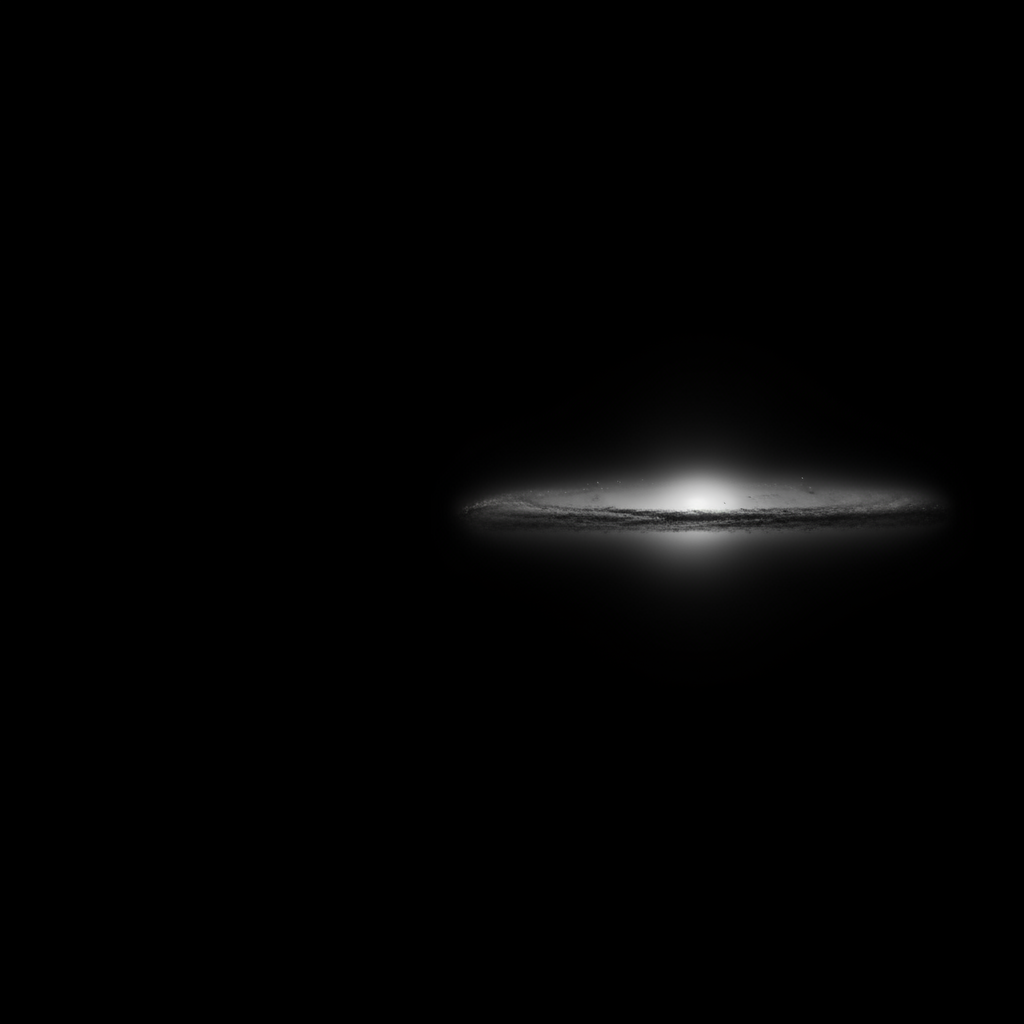
Lenticular galaxies occupy a fascinating middle ground in the galaxy zoo. They combine the disk structure of spiral galaxies with the old stellar populations and gas-poor quiescence of ellipticals, making them critical pieces in understanding how galaxies transform over cosmic time. The name "lenticular" comes from the Latin for lens — when viewed edge-on, these galaxies display the distinctive lens shape of a biconvex optical lens, with a bright central bulge tapering smoothly into a thin outer disk.
Edwin Hubble placed S0 galaxies at the junction of his famous tuning fork diagram, where the elliptical sequence meets the split into spirals and barred spirals. He recognized them as intermediate morphological types but their exact origin and evolutionary relationship to other galaxy types remained debated for decades. Modern observations have largely confirmed that many lenticulars are spirals that have been quenched — their star formation switched off by environmental stripping or starvation of their gas supply.
Lenticular galaxies are particularly common in dense environments. In rich galaxy clusters like Virgo and Coma, they can account for 40–60% of all bright galaxies, far exceeding their ~20% prevalence in the field. This strong environmental dependence is a key clue to their origin and provides direct evidence for the role of the cluster environment in transforming spiral galaxies.
Despite their apparently passive nature, lenticular galaxies are scientifically rich. Their thin dust lanes offer a unique probe of the stellar and dark matter mass distribution. Their disk kinematics encode the history of their transformation. And in some cases, residual gas and even mild star formation reveal that the quenching process was not complete.
Structure and Properties
Lenticular galaxies share structural components with both spirals and ellipticals, making them morphologically distinctive and scientifically interesting as transitional objects.
Lenticular Galaxy Quick Facts
- Hubble Type: S0 (unbarred), SB0 (barred)
- Key Feature: Disk + bulge, but no spiral arms
- Gas Content: Very little cold HI or molecular gas
- Star Formation: Minimal to none
- Stellar Populations: Predominantly old, red stars
- Environment: Most common in dense galaxy clusters
Data: NASA Galaxies
The Disk and Bulge
Like spiral galaxies, lenticulars have a distinct disk component and a central bulge. The bulge is typically more prominent relative to the disk than in late-type spirals but less dominant than in giant ellipticals. The disk extends smoothly outward with a brightness profile that follows an exponential decline — similar to the inter-arm regions of spiral disks. There are no density wave patterns, no knots of star formation, and no bright nebulae to break the smooth gradient.
Dust Lanes
Many lenticular galaxies retain a thin dust lane along the plane of their disk — the remnant of their past spiral life. These dust lanes are particularly striking when a lenticular is viewed edge-on, appearing as a dark band cutting across the galaxy's bright nucleus. The dust is typically cold and relatively quiescent, without the star-forming activity seen in spiral arm dust lanes. In some lenticulars, the dust has settled into a smooth ring or is distributed in patchy clouds.
Kinematics and Rotation
Despite their gas-poor, quiescent appearance, lenticular galaxies retain the ordered disk rotation characteristic of spirals. The rotation curves of lenticulars are similar to those of spirals of comparable luminosity, confirming that they formed from disk systems. This kinematic signature distinguishes them from elliptical galaxies, which are supported by random stellar motions rather than ordered rotation.
Formation and Evolution
Lenticular galaxies are now thought to form primarily through the environmental transformation of spiral galaxies, though other pathways may also contribute.
Ram-Pressure Stripping
The most powerful transformation mechanism in galaxy clusters is ram-pressure stripping. As a spiral galaxy falls into a cluster at high speed (typically 1,000–2,000 km/s), it encounters the hot, diffuse intracluster medium. The resulting hydrodynamic pressure sweeps gas out of the disk — sometimes dramatically, creating "jellyfish galaxies" with visible tails of stripped gas. Once the cold gas supply is removed, star formation fades and the spiral arms fade to invisibility, leaving a lenticular disk.
Starvation and Strangulation
Even without dramatic stripping, a galaxy entering a cluster can be "starved" of new gas. Infalling cosmic filaments that normally replenish a galaxy's gas supply are disrupted or heated in the cluster environment. Without fresh cold gas, the existing fuel is consumed by star formation and stellar evolution over a few billion years, naturally quenching the galaxy. This gradual process, called strangulation, may be responsible for the transformation of spirals at the outskirts of clusters.
Galaxy Mergers as a Pathway
Minor mergers — where a large spiral accretes a smaller companion — can deposit gas and trigger star formation, but can also accelerate gas consumption and eventually lead to a more gas-poor, lenticular-like system. Some simulations show that a sequence of minor mergers can transform a spiral into a lenticular over several Gyr without requiring the dramatic major mergers needed to form ellipticals.
Notable Lenticular Galaxies
NGC 5866 (Spindle Galaxy): One of the most visually striking lenticulars, viewed almost exactly edge-on at 44 million light-years in Draco. Hubble images show a razor-thin disk with a perfectly bisecting dark dust lane and wisps of dust extending above and below the plane. The nucleus is brilliantly white and sharp. Whether NGC 5866 is a true S0 or a highly inclined Sa spiral is debated, but it exemplifies the lenticular form.
M84 and M86: Two large lenticular galaxies at the heart of the Virgo Cluster, 53 million light-years away. M84 (NGC 4374) is a massive S0 with a 1.5 billion solar mass black hole producing visible radio jets. M86 is notable for its high blueshift — it is actually moving toward us at 244 km/s as part of the Virgo Cluster's complex dynamics. Both are beautiful objects through amateur telescopes.
NGC 4526: A classic barred lenticular (SB0) in the Virgo Cluster, often called the "Lost Galaxy" from its ability to be misidentified on early charts. It hosted SN 1994D, one of the most photometrically studied Type Ia supernovae, making NGC 4526 important for the cosmological distance scale.
NGC 2787: A nearby barred lenticular at about 24 million light-years, notable for its well-defined bar and faint ring of dust surrounding the core. It contains a relatively massive central black hole and shows mild LINER (Low-Ionization Nuclear Emission-line Region) activity. Small telescopes show the bright nucleus; larger apertures reveal the bar.
Sombrero Galaxy (M104): Though often classified as Sa (the most tightly wound spiral type), M104 shares many lenticular characteristics — its dark dust lane and smooth disk are classic S0 features. Some researchers prefer to classify it as an Sa/S0 transition object. At 28 million light-years in Virgo, it is one of the most photographed galaxies and a showpiece through moderate-sized telescopes.
Interesting Facts About Lenticular Galaxies
- Morphology-Density Relation: One of the strongest empirical trends in extragalactic astronomy is the morphology-density relation: elliptical and lenticular galaxies are more common in denser environments, while spirals dominate in lower-density regions like the field. Lenticulars show the strongest environmental dependence of any galaxy type, making them the clearest evidence for the role of environment in galaxy transformation.
- Stellar Streams: Deep imaging of lenticular galaxies often reveals faint stellar streams, shells, and tidal debris in their outer halos — evidence of past minor mergers and satellite accretion. These ghostly features, visible only in extremely deep exposures, encode the assembly history of the galaxy over billions of years.
- Ultracompact Dwarfs Connection: Some of the most compact stellar systems known — ultracompact dwarf galaxies (UCDs) — may be the stripped nuclei of lenticular or elliptical galaxies. When tidal forces in a dense cluster strip away a galaxy's outer disk and halo, the bare nucleus can survive as a compact stellar system, reclassified as an UCD. M60-UCD1 is a famous example.
- Polar Ring Lenticulars: Some lenticular galaxies have acquired a ring of gas and stars orbiting perpendicular to the main disk — a polar ring. These exotic systems form when a second galaxy is accreted at a perpendicular angle. They allow astronomers to measure the three-dimensional dark matter distribution of the galaxy from the rotation curves in both the disk and the ring planes.
- Rejuvenation: Not all lenticulars are permanently quenched. When a lenticular galaxy captures a gas-rich companion or passes through a region of dense intergalactic medium, it can acquire new gas and temporarily reignite star formation. These "rejuvenated" lenticulars may show blue star clusters in their otherwise old, red disks, and can appear as "E+A" or "post-starburst" galaxies in spectroscopic surveys.
- Virgo Cluster Dominance: In the Virgo Cluster, the nearest major galaxy cluster at 53 million light-years, lenticular galaxies are the dominant morphological type by number. Studies by the HST ACS Virgo Cluster Survey confirmed that S0 and SB0 galaxies outnumber spirals at all but the lowest luminosities. This cluster serves as the primary laboratory for studying how the cluster environment transforms galaxies.
- Dark Matter in Lenticulars: Studies of lenticular galaxy kinematics have been important for mapping dark matter profiles. Because lenticulars have low-luminosity stellar disks that extend to large radii without confusing spiral arm structure, they are relatively clean systems for measuring rotation curves and inferring dark matter content. The dark matter fractions in lenticulars are intermediate between spirals and ellipticals.
- Nuclear Activity: A significant fraction of lenticular galaxies show low-level nuclear activity — LINER or Seyfert emission from a weakly accreting central black hole. Since lenticulars typically lack the abundant cold gas that powers strong AGN in spirals, their nuclear activity is driven by hot gas accretion or stellar mass loss providing a trickle of fuel. Understanding this quiet AGN activity in lenticulars helps calibrate AGN feedback models.
External Resources
- NASA Galaxies — NASA overview of galaxy types and morphology
- Lenticular Galaxy on Wikipedia — Detailed overview of S0 classification, properties, and formation
- NGC 5866 (Spindle Galaxy) — The archetypal edge-on lenticular galaxy
- ESA Hubble Space Telescope — High-resolution imaging of lenticular galaxy structure
Frequently Asked Questions
What is a lenticular galaxy?
A lenticular galaxy (Hubble type S0) is a disk-shaped galaxy that has features of both spiral and elliptical galaxies. Like spiral galaxies, lenticulars have a prominent disk and bulge. Like ellipticals, they have little gas or dust, no prominent spiral arm structure, and minimal ongoing star formation. The name "lenticular" refers to their lens-like appearance when viewed edge-on. They occupy the junction of Hubble's tuning fork diagram, classified as S0 between ellipticals and spirals.
Why don't lenticular galaxies have spiral arms?
Lenticular galaxies are thought to have lost their spiral arm structure because they ran out of the cold gas needed to sustain density waves and star formation in the arms. Without ongoing star formation to light up the arms with brilliant blue clusters and HII regions, any pre-existing arm pattern fades and becomes invisible. The mechanisms that stripped the gas include ram-pressure stripping as the galaxy moves through hot intracluster gas, starvation (cutting off the gas supply from cosmic filaments), and possibly AGN feedback.
How do you tell a lenticular galaxy from an elliptical?
Edge-on lenticular galaxies show a clear disk component and often a thin dark dust lane bisecting the nucleus — features not seen in ellipticals. Face-on, lenticulars and ellipticals can look similar, but lenticulars typically show a steeper brightness gradient from disk to bulge. Kinematically, lenticulars show ordered disk rotation, unlike the random stellar orbits in ellipticals. The presence of any disk structure, even without spiral arms, is the key diagnostic.
Are lenticular galaxies common?
Lenticular galaxies are moderately common — they make up roughly 20% of all bright galaxies in the local universe. Their prevalence increases dramatically in dense environments: in galaxy clusters like Virgo or Coma, lenticulars can outnumber spirals. This environmental dependence supports the idea that lenticulars form from spirals that have had their gas stripped by the cluster environment.
What is the relationship between lenticular and spiral galaxies?
Lenticular galaxies are widely thought to be "retired spirals" — spiral galaxies that have been quenched of their star formation by environmental processes. As spiral galaxies fall into dense galaxy clusters, ram-pressure stripping removes their gas, star formation fades, and the arms become invisible. Over billions of years, the galaxy transforms into a lenticular. This picture is supported by the fact that lenticulars are far more common in clusters than in the field, and by observations of spirals in the process of having their gas stripped.
What is the Spindle Galaxy?
NGC 5866 in Draco is often called the Spindle Galaxy — a classic lenticular (or possibly Sa-type spiral) viewed exactly edge-on. The Hubble Space Telescope image shows a razor-thin disk with a prominent dark dust lane bisecting the brilliant white nucleus. The disk extends well beyond the bulge, and wisps of dust are visible above and below the plane. At about 44 million light-years, it is one of the most photographed lenticular galaxies.
Can lenticular galaxies have bars?
Yes — barred lenticular galaxies (SB0) are common and are classified alongside unbarred lenticulars (S0) in the Hubble system. Bars can be retained for billions of years even after the disk gas has been depleted and star formation has ceased. Some surveys suggest that barred lenticulars (SB0) are actually more common than unbarred ones (S0), mirroring the trend seen in spiral galaxies where barred spirals outnumber pure spirals.