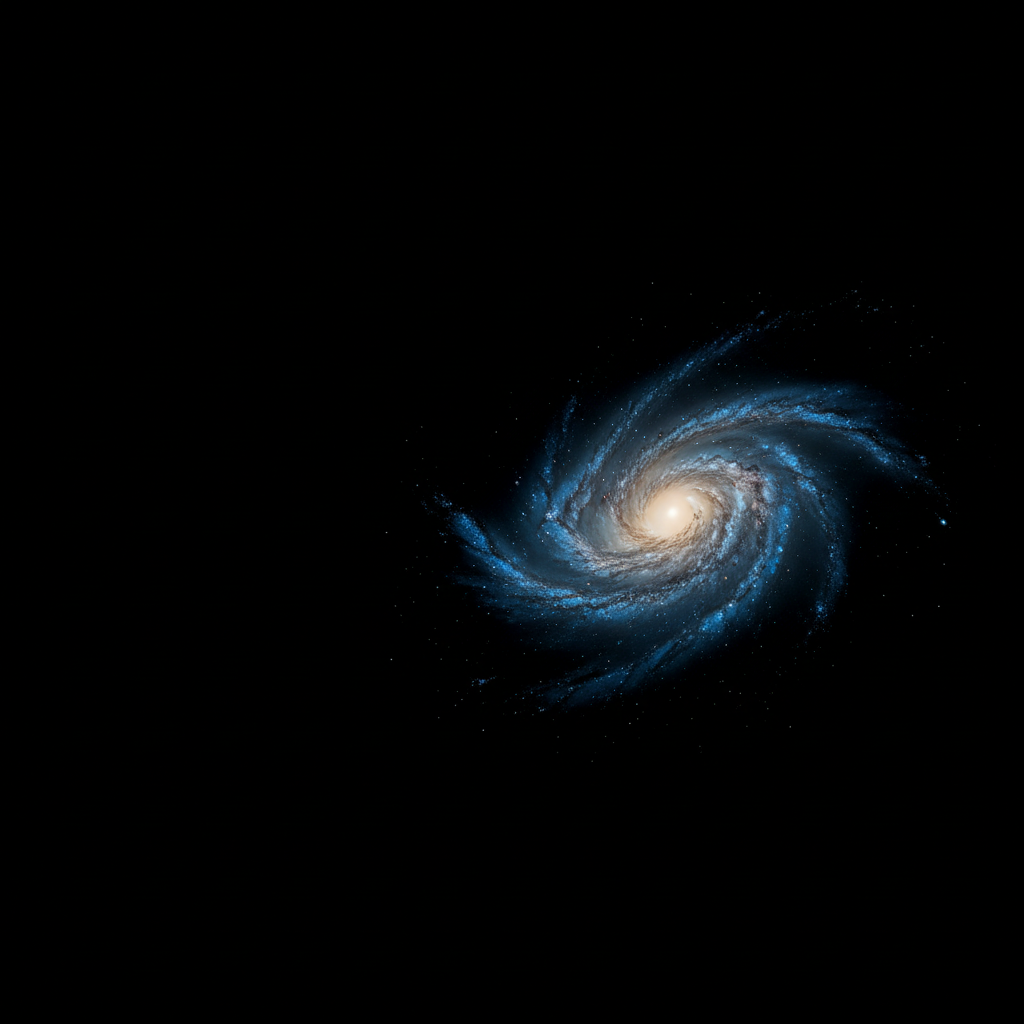
Introduction to the Milky Way
The Milky Way is our home — a vast, rotating disk of stars, gas, dust, and dark matter that contains everything we have ever directly explored. From our vantage point deep inside one of its minor spiral arms, we see the rest of the galaxy as the pale luminous band of the "Milky Way" that arches across the night sky — a view that gave this galaxy its name. Yet despite being surrounded by it, understanding our own galaxy has been one of astronomy's greatest challenges precisely because we cannot step outside it to see its full form.
The Milky Way is a barred spiral galaxy of type SBbc — a moderately wound spiral with a prominent central bar. It is a large galaxy, though not exceptionally so: the Andromeda Galaxy is somewhat larger in terms of disk diameter, and many other spirals exceed it in total stellar mass. Nevertheless, the Milky Way is the dominant galaxy in its immediate neighborhood and anchors a retinue of over 60 confirmed satellite galaxies including the Magellanic Clouds.
The universe looks different from inside the Milky Way than from outside. Looking toward the galactic center (in the direction of Sagittarius), the sky is crowded with stars, dense with dust, and crossed by the bright plane of the disk. Looking away from the center — toward the galactic poles — we peer out of the disk into the clear extragalactic universe, where distant galaxies become visible. This directional asymmetry is our constant reminder that we inhabit a galaxy.
In recent decades, our understanding of the Milky Way has been transformed by all-sky infrared surveys (COBE, Spitzer, WISE), radio mapping of molecular clouds and HI gas, and above all the ESA Gaia mission, which has measured precise distances and motions for over 1.5 billion stars — providing the most detailed three-dimensional map of the Milky Way ever assembled.
Structure and Scale
The Milky Way is structured in several distinct components, each with its own stellar populations, kinematics, and evolutionary history.
Milky Way Quick Facts
- Galaxy Type: Barred spiral (SBbc)
- Diameter (disk): ~100,000 light-years
- Stellar Mass: ~5 × 10¹⁰ M☉ (about 50 billion solar masses)
- Total Mass (incl. dark matter): ~1–2 × 10¹² M☉
- Age: ~13.6 billion years (oldest stars near galaxy's age)
- Central Black Hole (Sgr A*): 4 million M☉
Data: NASA — Milky Way
The Central Bar and Bulge
The innermost region of the Milky Way contains a central bar — a elongated structure of stars about 27,000 light-years end-to-end, oriented at roughly 44 degrees to our line of sight. This bar rotates as a rigid body with a pattern speed distinct from the underlying disk rotation. Surrounding and extending beyond the bar is a boxy/peanut-shaped bulge — the product of disk instabilities that buckled the inner bar over time — containing old, metal-rich stars.
The Four Main Spiral Arms
The Milky Way's four main spiral arms — Norma, Scutum-Centaurus, Sagittarius, and Perseus — emerge from the ends of the central bar. They are traced by star-forming regions (HII regions), young blue stars, and molecular clouds. Our solar system sits in the Orion Spur (or Orion Arm), a smaller inter-arm feature between the Perseus Arm (further from center) and the Sagittarius Arm (closer to center).
The Stellar Halo and Dark Matter Halo
Surrounding the disk is a spherical stellar halo containing old, metal-poor stars (Population II) and over 150 globular clusters. Beyond the stellar halo extends the dark matter halo — invisible but inferred from its gravitational effects on disk rotation and satellite galaxy orbits. The dark matter halo likely extends to 300–600 thousand light-years, and its total mass exceeds that of all visible matter by a factor of 6–10.
Galactic Center and Sagittarius A*
The center of the Milky Way — approximately 26,000 light-years away in the direction of the constellation Sagittarius — is one of the most extreme environments in the known universe. Stellar density is thousands of times higher than near the Sun; young massive stars form there despite conditions seemingly hostile to star formation; and at the very center lies Sagittarius A* (Sgr A*), the Milky Way's supermassive black hole.
Imaging Sagittarius A*
In May 2022, the Event Horizon Telescope collaboration published the first direct image of Sgr A* — a 4-million solar mass black hole surrounded by a bright ring of emission from heated gas spiraling toward the event horizon. The image required combining data from radio telescopes on multiple continents to achieve the resolution of an Earth-sized radio dish. The shadow of Sgr A* was found to match predictions of general relativity, consistent with a Kerr (rotating) black hole.
The Central Molecular Zone
Surrounding Sgr A* within about 1,000 light-years is the Central Molecular Zone — a region of extraordinarily dense, warm molecular gas unlike anything in the outer galaxy. Within this zone are several young massive star clusters (Arches, Quintuplet, and the Central Cluster), hundreds of neutron stars and stellar black holes, and Fermi Bubbles — enormous lobes of high-energy gas extending 25,000 light-years above and below the galactic plane, likely relics of past AGN activity or nuclear starburst episodes.
Fermi Bubbles
Discovered in 2010 from Fermi Gamma-ray Space Telescope data, the Fermi Bubbles are two symmetric lobes of gamma-ray and microwave emission extending 25,000 light-years above and below the galactic plane. Their origin is debated: they may represent the remnant of a jet launched by Sgr A* millions of years ago when it was more actively accreting, or the relic of an intense starburst in the galactic center region. The bubbles contain hot, magnetized plasma and are expanding at several hundred km/s.
Our Place in the Galaxy
The solar system orbits the galactic center at a speed of about 230 km/s and takes approximately 225–250 million years to complete one orbit — a period called the galactic year or cosmic year. This means Earth has completed about 18–20 orbits since the solar system formed. The Sun is currently about 26,000 light-years from the galactic center, placing it in the mid-outer regions of the disk — not in any particularly special location.
Observing the Milky Way
The Milky Way is visible to the naked eye from dark locations as a luminous band crossing the sky. The brightest, most structured part — the galactic center region toward Sagittarius — is best viewed from the southern hemisphere or tropical latitudes. From mid-northern latitudes, the Milky Way is most prominent in summer when Sagittarius and Scorpius are well above the horizon. The dark lanes (dark nebulae) and bright regions (star clusters and nebulae) within the band are visible without optical aid under truly dark skies.
Binoculars and small telescopes reveal enormous detail: star clusters like M6 and M7 in Scorpius, nebulae like M8 (Lagoon) and M20 (Trifid) in Sagittarius, and the dense star fields of the galactic nucleus region. The galactic center itself is invisible in optical light due to 30 magnitudes of dust extinction — but blazes in infrared and radio wavelengths observed by space telescopes.
Galactic Coordinates
Astronomers use a galactic coordinate system centered on the Sun, with the galactic equator aligned with the Milky Way plane. Galactic longitude (l) increases in the direction of galactic rotation from l=0° (toward the galactic center), and galactic latitude (b) measures angular distance above (+) or below (−) the galactic plane. The galactic poles, at b=+90° and b=−90°, offer the clearest views out of our galaxy into the intergalactic universe.
Interesting Facts About the Milky Way
- Warp in the Disk: The Milky Way's outer disk is not flat. Beyond about 60,000 light-years from the center, the disk bends upward on one side and downward on the other, forming an S-shape when viewed edge-on. This warp is likely caused by gravitational interactions with the Large and Small Magellanic Clouds, which tug on the outer disk as they orbit. A 2019 study using Cepheid variable stars mapped the warp in three dimensions for the first time.
- The Gaia Revolution: The ESA Gaia spacecraft, launched in 2013, has measured positions, distances, and proper motions for over 1.5 billion stars — transforming our understanding of the Milky Way's structure, kinematics, and history. Gaia revealed multiple previously unknown stellar streams from disrupted galaxies, confirmed the nature of the galactic bar, and provided evidence for a major merger event ("Gaia-Enceladus") that shaped the galaxy about 8–10 billion years ago.
- Gaia-Enceladus Merger: Analysis of stellar kinematics and chemistry from Gaia data revealed that the Milky Way experienced a major merger with a dwarf galaxy called Gaia-Enceladus (or Gaia-Sausage) approximately 8–10 billion years ago. Stars from this disrupted galaxy now make up a significant fraction of the inner stellar halo. The merger may have triggered the thick disk population and contributed many of the globular clusters currently in the halo.
- Stellar Nurseries: The Milky Way is actively forming new stars, predominantly in its spiral arms. The total star formation rate is about 1–3 solar masses per year — modest compared to starburst galaxies, but enough to have produced its current stellar population over 13 billion years. Major nurseries include the Cygnus OB2 association, the W51 complex, and the giant molecular cloud W3 in Perseus.
- Satellite System: The Milky Way has at least 61 confirmed satellite galaxies as of 2025, spanning from the Large Magellanic Cloud (one of the largest known satellite galaxies in the universe) to ultra-faint dwarfs containing only a few hundred stars. New satellites continue to be discovered — the Vera Rubin Observatory is expected to reveal hundreds more in the coming years.
- Past Mergers Encoded in Stars: The Milky Way's chemical and kinematic archaeology reveals its merger history. Different populations of halo stars trace different accreted galaxies. In addition to Gaia-Enceladus, structures like the Helmi Streams, the Sequoia Galaxy, and Thamnos have been identified as remnants of ancient mergers. The Milky Way is effectively a palimpsest of its entire accretion history.
- The Local Standard of Rest: The solar system orbits the Milky Way at about 230 km/s but has a peculiar velocity of about 20 km/s relative to the Local Standard of Rest (the average motion of nearby stars). This peculiar motion means the Sun oscillates up and down through the galactic plane with a period of about 30 million years — a coincidence sometimes invoked in connection with periodic mass extinction events on Earth, though the connection remains speculative.
- Radio Perspective: The Milky Way's radio emission reveals structures invisible at optical wavelengths. The 21 cm hydrogen line maps the neutral gas spiral structure throughout the disk, including far side of the galaxy obscured by dust. Radio telescopes have discovered hundreds of supernova remnants, hundreds of pulsars, giant molecular clouds, and the Galactic Center Radio Arc — a remarkable structure of parallel radio filaments perpendicular to the galactic plane near Sgr A*.
External Resources
- NASA — Milky Way Galaxy — NASA's comprehensive guide to our home galaxy
- ESA Gaia Mission — The mission mapping over 1.5 billion Milky Way stars in 3D
- Event Horizon Telescope — First image of Sagittarius A* published May 2022
- Milky Way on Wikipedia — Comprehensive overview of structure, history, and observations
Frequently Asked Questions
What type of galaxy is the Milky Way?
The Milky Way is a barred spiral galaxy, classified as type SBbc in the Hubble morphological sequence. It has a central bar structure roughly 27,000 light-years long from which four main spiral arms emerge: the Norma, Scutum-Centaurus, Sagittarius, and Perseus Arms. Our solar system sits in the Orion Spur, a minor arm or spur between the Perseus and Sagittarius Arms, about 26,000 light-years from the galactic center.
How big is the Milky Way?
The Milky Way's stellar disk spans approximately 100,000 light-years in diameter and is about 1,000 light-years thick. However, a "warp" in the outer disk means it is not perfectly flat — the far outer regions are tilted significantly above and below the plane. Including the dark matter halo, which extends far beyond the visible disk, the Milky Way's total gravitational influence reaches perhaps 600,000 light-years. Recent studies suggest the disk may extend further than previously thought, potentially to 200,000 light-years.
What is at the center of the Milky Way?
At the center of the Milky Way lies Sagittarius A* (Sgr A*), a supermassive black hole with a mass of approximately 4 million solar masses. The galactic center is about 26,000 light-years from Earth. In 2022, the Event Horizon Telescope collaboration published the first image of Sgr A*'s shadow — a dark circle surrounded by a bright ring of heated gas — confirming that our galaxy's center harbors a supermassive black hole. Despite its enormous mass, Sgr A* is relatively quiet compared to AGN in other galaxies.
How many stars does the Milky Way contain?
Estimates of the Milky Way's stellar population typically range from 100 billion to 400 billion stars, with most modern estimates converging on about 100–200 billion. The uncertainty arises from the difficulty of counting faint, low-mass red dwarf stars (which make up the vast majority by number) and stars obscured by dust in the galactic plane. In addition to stars, the Milky Way contains tens of billions of brown dwarfs and an unknown number of free-floating planets.
Will the Milky Way and Andromeda collide?
Yes — the Milky Way and the Andromeda Galaxy (M31) are approaching each other at roughly 110 km/s and are expected to make their first close pass in about 4.5 billion years. However, because galaxies are mostly empty space, the collision will not be a violent crash — individual stars will almost never collide. Instead, the two galaxies will interpenetrate, distort each other gravitationally, and eventually merge into a single large elliptical or lenticular galaxy after several billion years of interaction. Earth will likely survive, but the night sky will be dramatically transformed.
How do we know the shape of the Milky Way if we're inside it?
Determining the Milky Way's structure from our vantage point inside it is one of astronomy's great challenges. Astronomers use several techniques: radio observations of hydrogen gas at 21 cm wavelength (which passes through dust) to map the gas distribution, infrared observations that penetrate the galactic dust, the distribution of star-forming regions and pulsars which trace the arms, parallax measurements of masers in star-forming regions, and the kinematics of stars throughout the disk. The ESA Gaia mission has provided unprecedented three-dimensional mapping of over a billion stars, revealing the Milky Way's structure in stunning detail.
What is the Milky Way's dark matter halo?
The visible Milky Way — stars, gas, and dust — is enveloped in a vast spherical dark matter halo extending to perhaps 600,000 light-years or more. This dark matter halo contains roughly 6–10 times more mass than all the visible matter in the galaxy. Its existence is inferred from the flat rotation curve of the Milky Way (stars in the outer disk orbit too fast to be explained by visible matter alone), gravitational lensing, and the motions of satellite galaxies. The nature of dark matter particles themselves remains one of the biggest open questions in physics.