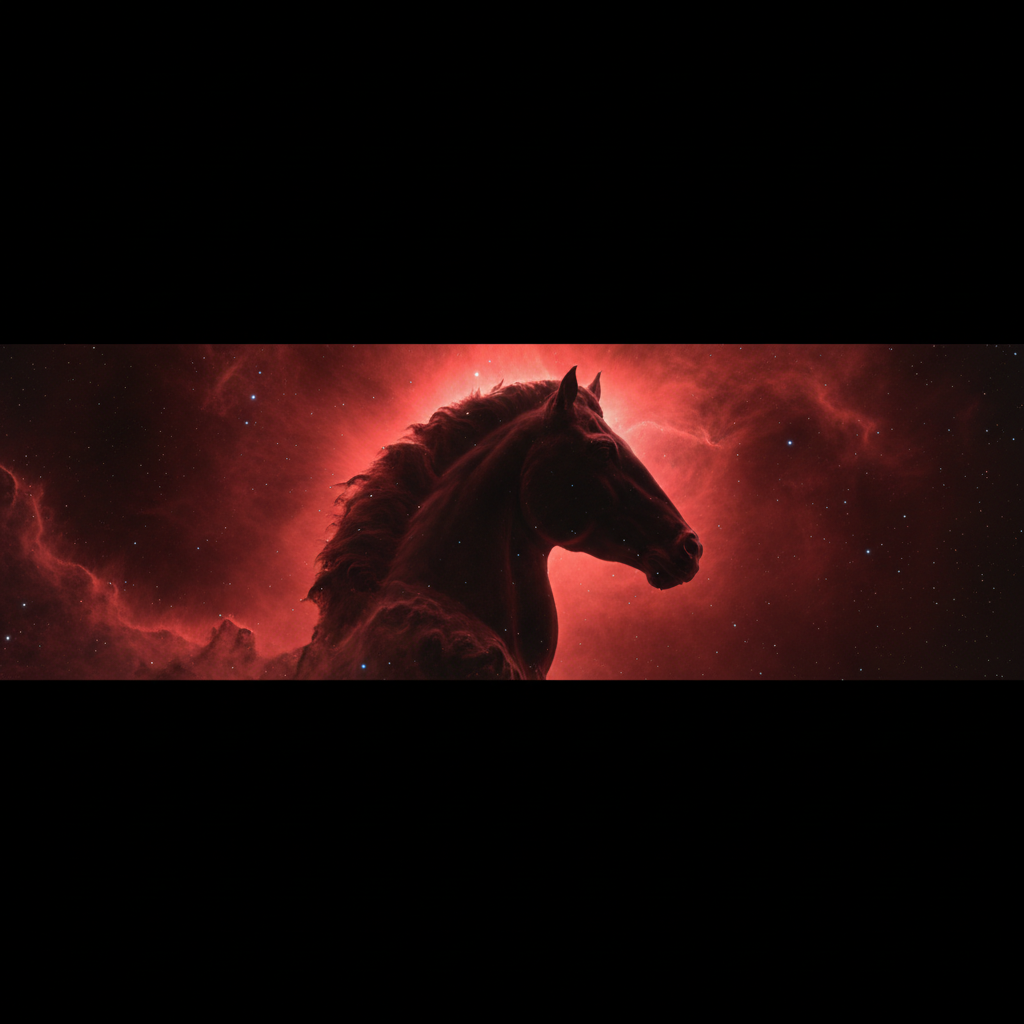
Introduction to Dark Nebulae
Among all the spectacular objects in the universe, dark nebulae are perhaps the most counterintuitive: they are defined not by what they emit, but by what they conceal. A dark nebula is a cold, dense cloud of gas and dust so opaque that it blocks virtually all light from the stars, galaxies, and glowing gas clouds behind it. The result is a dark silhouette against the brilliance of the Milky Way — a cosmic hole where stars seem absent.
The darkness of these clouds is caused by interstellar dust — tiny solid particles composed of carbon and silicate minerals, typically 0.1 to 1 micrometers in diameter. These grains absorb and scatter visible light with extraordinary efficiency. A cloud dense enough to qualify as a dark nebula may require hundreds of magnitudes of extinction — meaning that a background star would need to be 10^20 times intrinsically brighter just to be visible through the cloud at optical wavelengths. In practical terms, these clouds are completely opaque to visible light.
Dark nebulae represent the coldest environments in the universe outside of laboratory experiments. Deep within them, temperatures drop to just 10–20 Kelvin — colder than liquid nitrogen, only 10 degrees above absolute zero. At these temperatures, atoms and molecules move slowly enough to stick together on dust grain surfaces, building up icy mantles of water, methanol, formaldehyde, and more complex organic molecules. Over 200 different molecular species have been detected in dark clouds, making them the most chemically complex environments in the cosmos.
Physical Characteristics
Dark Nebula Quick Facts
- Temperature: 10 – 30 Kelvin (among the coldest places in the universe)
- Density: 10³ – 10⁶ particles per cubic centimeter (vs ~1 for average ISM)
- Composition: Molecular hydrogen (H₂), helium, CO, and over 200 molecular species
- Size Range: 0.1 light-years (Bok globules) to 100+ light-years (giant clouds)
- Detection: Absorption of background starlight, infrared, radio (CO emission)
- Optical Extinction: 1–100+ magnitudes (completely opaque to visible light)
The opacity of dark nebulae scales with the column density of dust along the line of sight. Astronomers measure this as visual extinction (Av) in magnitudes. A typical dark cloud might have Av = 5–10 magnitudes (the background stars appear 100–10,000 times fainter). Dense Bok globules can reach Av > 50 magnitudes — functionally impenetrable to optical telescopes but transparent to radio and far-infrared wavelengths.
Bok Globules
Bok globules — named after Bart Bok, who first catalogued them in the 1940s — are small, dense, roughly spherical dark nebulae found either isolated against bright backgrounds or embedded within larger molecular clouds. They are among the simplest star-forming environments, providing relatively clean laboratories for studying the initial conditions of stellar birth.
Properties and Structure
A typical Bok globule spans 0.1 to 1 light-year and contains 1 to 50 solar masses of gas and dust. They are characteristically round or slightly elliptical, bounded by a sharp edge where the cloud density drops sharply. Their inner temperatures reach as low as 8 Kelvin. Many are surrounded by a photodissociation region — a thin shell where ultraviolet radiation from surrounding stars dissociates molecules at the cloud surface while the interior remains shielded.
Embedded Protostars
Infrared observations have revealed that many Bok globules contain embedded protostars — young stellar objects that have not yet cleared enough surrounding dust to become visible optically. The young star Barnard 68 is an isolated Bok globule that appears perfectly opaque to optical telescopes but shows no embedded sources yet — it may be on the verge of gravitational collapse. In contrast, CB 34 and many others contain confirmed embedded protostars detectable only in infrared and millimeter wavelengths.
Dark Nebulae as Stellar Nurseries
The high density and low temperature of dark nebulae create ideal conditions for star formation. Understanding why requires the Jeans instability criterion — the fundamental physics governing when a gas cloud collapses.
The Jeans Instability
A gas cloud becomes gravitationally unstable — and begins to collapse — when gravity exceeds the thermal pressure that supports it. The critical mass at which this occurs, the Jeans mass, decreases with lower temperature and higher density. Because dark nebulae are extremely cold and dense, their Jeans mass can be as small as a fraction of a solar mass, meaning even small density fluctuations can trigger collapse into individual stellar-mass objects.
Triggered vs Spontaneous Formation
Star formation in dark nebulae can be spontaneous (driven by internal gravitational instability) or triggered by external events. A passing supernova shock wave can compress a dark cloud above its Jeans threshold, initiating a burst of star formation. The sequential star formation seen in many OB associations — where waves of star formation propagate outward through a molecular cloud — is evidence of this triggered mechanism. The density wave from one generation of stars compresses the surrounding dark cloud to form the next.
Dark Nebulae vs Other Nebula Types
Dark nebulae, emission nebulae, and reflection nebulae often coexist in the same star-forming regions, each illuminated — or not — differently depending on their density and proximity to hot stars.
The Continuum of Illumination
A molecular cloud complex can simultaneously contain all three types. The surface of the cloud, illuminated by UV radiation, may form an emission nebula. Slightly deeper, where the UV cannot fully ionize the gas but visible light can still penetrate, a reflection nebula may form. Deeper still, the cloud becomes dark and opaque — a dark nebula. The Horsehead Nebula illustrates this: a dark protrusion from a larger dark cloud, silhouetted against the IC 434 emission nebula in front of it, with the Orion Molecular Cloud providing the dark background structure.
Notable Dark Nebulae
- Horsehead Nebula (Barnard 33) — 1,500 light-years: The most iconic dark nebula, projecting from a dense molecular cloud as a distinctive horse-head silhouette against the bright emission nebula IC 434. The Horsehead is about 3.5 light-years tall and is gradually being eroded by UV radiation from the nearby O-type star Sigma Orionis.
- Barnard 68 — 500 light-years: A small, perfectly round Bok globule so dense that it appears as a starless hole against the rich Milky Way background. No background stars shine through it. At a distance of only 500 light-years, it is one of the nearest dark nebulae and is extensively studied as a pre-stellar core on the verge of collapse.
- Coalsack Nebula — 600 light-years: The most prominent dark nebula visible to the naked eye, appearing as a conspicuous dark patch adjacent to the Southern Cross (Crux). Covering about 7 degrees of sky, it was long known to Indigenous Australians as the "Dark Emu" head. It spans roughly 65 light-years and contains several Bok globules.
- Snake Nebula (Barnard 72) — 650 light-years: A dark, winding S-shaped cloud in Ophiuchus, part of the Ophiuchus dark cloud complex. Its sinuous shape and dramatic silhouette against the rich Milky Way star field make it a popular astrophotography target. It is part of a larger complex of Barnard dark nebulae including B68, B69, B70, and B74.
Observing Dark Nebulae
Dark nebulae are best appreciated visually or photographically as dark patches against rich star fields or bright glowing nebulae. They require no special equipment beyond dark skies and wide fields of view.
Visual Observation
The best dark nebulae for visual observation are those silhouetted against bright backgrounds. The Horsehead Nebula requires a large telescope (8 inches or more) and a H-beta filter to reveal the bright IC 434 emission nebula that serves as the background. Without this filter, the background emission is too faint for the dark silhouette to be apparent. The Coalsack and Great Rift are naked-eye objects best seen from dark sites in the southern hemisphere and mid-latitudes respectively.
Astrophotography
Wide-field astrophotography with camera lenses reveals extensive dark nebula complexes invisible in telescopes. The Cygnus, Aquila, and Ophiuchus regions are particularly rich in overlapping dark clouds that create the complex structure of the summer Milky Way.
Interesting Facts About Dark Nebulae
- Cold as Deep Space: The interior of a Bok globule can reach 8 Kelvin — just 8 degrees above absolute zero. This makes dark nebulae among the coldest naturally occurring environments in the observable universe, colder than the cosmic microwave background radiation (2.7 K) in the densest cores.
- Molecular Chemistry Lab: Over 200 different molecules have been detected in dark molecular clouds, including glycine precursors, formaldehyde, methanol, and polycyclic aromatic hydrocarbons. The low temperatures and dust-grain surfaces make dark nebulae the most chemically complex natural environments known.
- Naked-Eye Dark Constellations: The Inca and Aboriginal Australians developed constellation systems based on dark nebulae — the dark patches in the Milky Way — rather than individual stars. The Emu in the Sky, a dark constellation formed by the Coalsack and connected dark clouds, is still recognized in Aboriginal Australian astronomy today.
- Invisible to Optical Telescopes: The densest Bok globules absorb so much light that a background star 100 billion times brighter than the Sun would appear invisible through them at optical wavelengths. Only radio and infrared telescopes can peer inside.
- The Horsehead Is Temporary: UV radiation from the star Sigma Orionis is slowly eroding the Horsehead Nebula at a rate of about 200 AU per century. In roughly five million years, the iconic horse-head shape will have been completely dispersed into the surrounding medium.
- Barnard Catalogue: E.E. Barnard catalogued dark nebulae systematically in the early 20th century, publishing his famous catalogue of dark markings of the sky in 1919. Many dark nebulae still carry their Barnard number (B1, B33, B68, etc.) as their primary designation.
- Magnetic Support: Dark nebulae are partly supported against gravity by magnetic pressure from tangled magnetic field lines threading the cloud. The slow drift of ions across field lines — ambipolar diffusion — gradually removes this magnetic support over millions of years, allowing the cloud to contract and eventually form stars.
- Water Ice Factory: Interstellar ice forms on dust grains in dark nebulae, where water molecules freeze onto grain surfaces at temperatures below 100 K. This ice is the reservoir of water that eventually ends up in protoplanetary disks, comets, and potentially the oceans of rocky planets like Earth.
External Resources
- Hubble — Horsehead Nebula - Hubble anniversary image of Barnard 33
- NASA — Barnard 68 - VLT image of the isolated Bok globule
- Dark Nebula — Wikipedia - Detailed scientific overview
- ESO Nebula Images - ESO deep imaging of dark cloud regions
Frequently Asked Questions
What is a dark nebula?
A dark nebula is a dense cloud of gas and dust that blocks the light from background stars, emission nebulae, or galaxies, appearing as a dark patch against the brighter sky behind it. Unlike emission or reflection nebulae, dark nebulae produce no light of their own — they are only visible by the absence of background light. They are among the coldest and densest structures in the interstellar medium, with temperatures as low as 10 Kelvin and densities millions of times higher than the average interstellar medium.
Are dark nebulae related to star formation?
Yes — dark nebulae are the primary birthplaces of stars. Their high density and low temperature make them gravitationally unstable, so small perturbations can trigger collapse. When a dense region within a dark nebula reaches the Jeans mass — the critical mass at which gravity overcomes thermal and magnetic pressure — it begins to contract. Fragmentation then produces dozens to thousands of individual protostars. The Bok globules scattered throughout dark nebulae are particularly dense knots thought to be forming individual stars or binary systems.
Why does the Horsehead Nebula look like a horse?
The Horsehead Nebula (Barnard 33) appears as a horse-head silhouette because it is a dense column of dark dust extending from a larger molecular cloud, set against the bright emission nebula IC 434 glowing behind it. The "horse head" shape is defined by the boundary between the dark opaque cloud and the luminous background. The shape is not intrinsically horse-like — it is the result of the three-dimensional structure of the cloud viewed from our particular angle. Over tens of thousands of years, stellar winds and radiation will erode the shape, and the silhouette will gradually change.
What are Bok globules?
Bok globules are small, isolated, roughly spherical dark nebulae named after astronomer Bart Bok, who first studied them systematically in the 1940s. They typically measure 1 light-year or less in diameter and contain 1–50 solar masses of gas and dust. Their compact size and high density make them prime candidates for isolated low-mass star formation, bypassing the complex clustered star formation of giant molecular clouds. Many Bok globules have been confirmed to contain embedded protostars through infrared observations.
Can you see dark nebulae with the naked eye?
Yes — several dark nebulae are visible to the naked eye from dark sites. The most prominent is the Coalsack Nebula near the Southern Cross, which appears as a conspicuous dark hole in the dense Milky Way star field. It is so obvious that indigenous Australians included it in their constellation lore as the "Dark Constellation." In the northern hemisphere, the Great Rift — a series of dark clouds running along the summer Milky Way from Cygnus to Sagittarius — is easily visible as a dark lane splitting the bright star band.
How do astronomers study dark nebulae if they emit no light?
Astronomers use several techniques. Infrared astronomy penetrates the dust that blocks visible light, allowing observation of embedded protostars and young stellar objects. Radio astronomy detects molecular emission lines — carbon monoxide (CO) is the primary tracer of cold molecular gas. X-ray observations can reveal embedded young stars. Star counting — comparing the number of background stars in different regions — maps the opacity of dark clouds. Polarimetry of background starlight reveals how the cloud aligns with the galactic magnetic field.