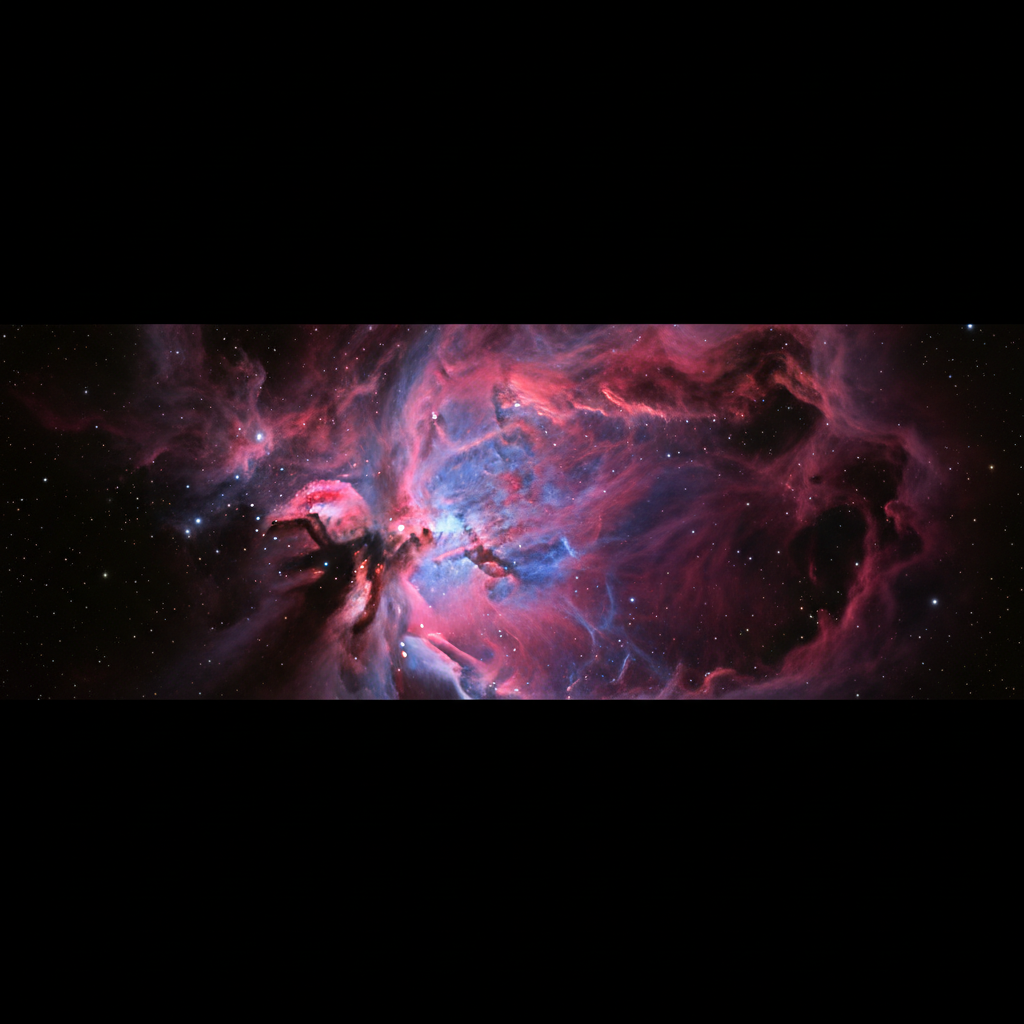
Introduction to Emission Nebulae
Emission nebulae are the most visually striking objects in the night sky — vast glowing clouds of ionized gas lit from within by the intense radiation of young, massive stars. Unlike reflection nebulae that simply scatter starlight, emission nebulae are active: their gas absorbs high-energy ultraviolet photons and re-emits that energy as visible light at specific wavelengths, creating the vivid colors that make these clouds so recognizable in astronomical photographs.
The process that lights an emission nebula is called photoionization. When a massive O or B-type star ignites within a molecular cloud, its prodigious output of ultraviolet radiation strips electrons from the surrounding hydrogen atoms. The region of ionized gas — called an HII region because it contains ionized hydrogen — can extend dozens or even hundreds of light-years from the ionizing stars. When electrons recombine with hydrogen ions, they cascade down through energy levels, emitting photons at precise wavelengths that astronomers can use to study the nebula's composition, temperature, density, and velocity.
Emission nebulae are intimately connected to star formation. They trace the regions where giant molecular clouds have fragmented and collapsed to form new stellar generations. The very stars that illuminate the nebula were born within it, and their radiation and winds are now sculpting and ultimately destroying the gas cloud that gave them birth. This feedback process — stellar birth followed by stellar destruction of the birthplace — drives the evolution of the interstellar medium throughout the galaxy.
Physical Characteristics
Emission nebulae share a set of defining physical properties that distinguish them from other nebula types, though they vary enormously in size, luminosity, and morphology.
Emission Nebula Quick Facts
- Power Source: Ultraviolet radiation from O and B-type stars (surface temperature > 25,000 K)
- Temperature: 8,000 – 10,000 Kelvin (electron temperature)
- Density: 10 – 10,000 particles per cubic centimeter
- Size Range: A few light-years to over 1,000 light-years
- Primary Emission: H-alpha (red, 656.3 nm), [OIII] (blue-green), [SII] (deep red)
- Mass: Hundreds to hundreds of thousands of solar masses
Despite the extreme conditions by human standards, the gas in an emission nebula is an extraordinarily dilute plasma — millions of times less dense than the best laboratory vacuum achievable on Earth. The luminosity comes not from density but from the sheer volume of gas involved. Emission nebulae contain enough material to form thousands of stars, and in the most massive examples like the Tarantula Nebula, entire star clusters are actively forming within the glowing gas.
Emission nebulae often show complex internal structure. Dense pillars and globules of gas resist the ionizing radiation from young stars, creating silhouetted dark structures against the glowing background. These pillars are sites of active star formation — the dense tips, called evaporating gaseous globules (EGGs), contain protostars shielded from the destructive radiation by the surrounding gas.
The Ionization Process
The physics of emission nebulae centers on the interaction between ultraviolet photons from massive stars and the hydrogen gas of the surrounding interstellar medium. This process — photoionization — creates and sustains the glowing plasma we observe.
Stromgren Spheres
The Danish astronomer Bengt Stromgren showed in 1939 that the boundary between ionized and neutral hydrogen is remarkably sharp. Within a critical radius (the Stromgren radius), essentially all hydrogen is ionized; beyond it, the gas is almost entirely neutral. The size of this ionized bubble depends on the luminosity of the ionizing stars and the density of the surrounding gas. A single O5-type star can ionize a region several hundred light-years across; a cluster of dozens of massive stars creates a giant HII region visible across an entire galaxy.
Recombination and Emission
The glow of an emission nebula is produced when ionized hydrogen recombines. A free electron is captured by a proton and cascades down through a series of energy levels, emitting a photon at each step. The most probable transitions produce the Balmer series of hydrogen emission lines: H-alpha (red, 656.3 nm), H-beta (blue-green, 486.1 nm), H-gamma (violet, 434.0 nm). H-alpha is by far the strongest and gives emission nebulae their characteristic red hue in photographs.
Forbidden Lines
The low densities in emission nebulae allow atoms to remain in metastable excited states long enough to emit "forbidden" transitions that never occur in laboratory conditions. The green [OIII] doublet at 495.9 and 500.7 nm and the red [SII] doublet at 671.6 and 673.1 nm are the most important forbidden lines in nebular spectra. These lines are impossible to reproduce in terrestrial labs but dominate the spectra of emission nebulae, providing crucial diagnostics of temperature and density.
Spectral Emission Lines
The spectrum of an emission nebula is a fingerprint of its chemical composition and physical conditions. By analyzing which wavelengths of light are emitted and their relative intensities, astronomers can determine temperature, density, chemical abundances, and even the velocity of the gas.
The Hubble Palette
Many famous astronomical images use the "Hubble palette" or SHO color mapping, where [SII] emission is mapped to red, H-alpha to green, and [OIII] to blue. This false-color technique, developed to distinguish different elements, produces the vivid golden and teal structures seen in images like the Pillars of Creation. Natural-color images (where H-alpha maps to red and [OIII] to blue-green) tend to show red-pink clouds with blue-green knots.
Temperature and Density Diagnostics
The ratio of certain emission lines acts as a precise thermometer and pressure gauge. The ratio of the [OIII] lines at 4959 and 5007 angstroms to the line at 4363 angstroms gives the electron temperature. The ratio of the [SII] lines at 6716 and 6731 angstroms indicates the electron density. Typical emission nebulae have electron temperatures of 8,000–10,000 K and electron densities of 100–1,000 per cubic centimeter.
Notable Emission Nebulae
- Orion Nebula (M42) — 1,350 light-years: The nearest and brightest emission nebula, visible to the naked eye. The central Trapezium cluster of four massive O-type stars ionizes the surrounding nebula. Hubble images reveal hundreds of protoplanetary disks (proplyds) around young stars — solar systems in the making.
- Eagle Nebula (M16) — 7,000 light-years: Famous for the "Pillars of Creation" — towering columns of gas and dust sculpted by radiation from the NGC 6611 star cluster. The pillars contain embedded protostars in their dense tips. Infrared observations suggest the pillars may already be largely destroyed by a nearby supernova that occurred 8,000 years ago — we will see the destruction in about 1,000 years when the light arrives.
- Lagoon Nebula (M8) — 4,100 light-years: Large summer emission nebula in Sagittarius containing the young open cluster NGC 6530. Named for a dark lane of obscuring dust that gives it a lagoon-like appearance. Contains numerous Bok globules — small dark clouds in the process of collapsing to form stars.
- Carina Nebula (NGC 3372) — 7,500 light-years: One of the largest and most luminous nebulae in the Milky Way, containing the hyperluminous star Eta Carinae — one of the most massive and unstable stars known, expected to explode as a supernova or hypernova within the next million years. Spans over 300 light-years.
Observing Emission Nebulae
Emission nebulae offer some of the most rewarding targets for amateur astronomers. The brightest examples are accessible in binoculars, while telescopes reveal intricate structure and dark lanes within the glowing gas.
Equipment and Filters
A dark sky site dramatically improves emission nebula visibility. Light pollution washes out the faint outer regions and reduces contrast. Narrowband filters are the single biggest upgrade for visual observation: UHC (ultra-high contrast) filters pass H-beta and [OIII] emission while blocking city glow, and dedicated H-alpha filters reveal stunning filamentary structure invisible without filtration. At the eyepiece, emission nebulae appear gray-green rather than red — the eye sees the [OIII] emission more readily than H-alpha in dim light.
Best Seasonal Targets
- Winter (Orion): M42 Orion Nebula, M43, NGC 2024 Flame Nebula — finest constellation for emission nebulae
- Summer (Sagittarius/Scorpius): M8 Lagoon, M20 Trifid, M17 Omega — densest concentration of bright nebulae
- Year-round (astrophotography): Cygnus region — Heart and Soul Nebulae, North America Nebula, Cygnus Wall
Interesting Facts About Emission Nebulae
- Stellar Nurseries in Action: The Orion Nebula contains over 700 stars in various stages of formation, including hundreds of protoplanetary disks captured by Hubble — direct evidence of solar system formation happening right now, 1,350 light-years away.
- Impossible Colors: The brilliant colors in nebula photographs are often invisible at the eyepiece. The deep red H-alpha glow requires long-exposure photography to detect because the human eye is relatively insensitive to that wavelength in dim light. Visually, nebulae appear gray-green.
- Vacuum Far Better Than Any Lab: The "dense" cores of emission nebulae contain about 10,000 hydrogen atoms per cubic centimeter — a vacuum far more perfect than anything achievable on Earth, where the best laboratory vacuums contain billions of molecules per cubic centimeter.
- Forbidden Light: Many of the bright emission lines in nebulae — including the [OIII] green lines — are "forbidden" transitions that can never occur in a laboratory because any gas dense enough to generate them would suppress the emission through collisional de-excitation. Only the extreme rareness of interstellar gas allows these transitions to occur.
- The Pillars May Already Be Gone: Infrared Spitzer observations suggest a supernova blast wave is heading toward the Pillars of Creation in M16. The pillars as we see them today may have been destroyed 6,000 years ago — we will not see the destruction until the light reaches us around the year 3000.
- Star Formation Efficiency Is Low: Despite being called stellar nurseries, emission nebulae convert only about 1–5% of their gas mass into stars before radiation and winds from the newly formed stars disperse the remaining cloud. Star formation is remarkably inefficient.
- The Trapezium Powers the Orion Nebula: Just four stars in the Trapezium cluster — the central heart of the Orion Nebula — provide virtually all the ionizing radiation that lights up the entire 24-light-year-wide nebula. The brightest, Theta-1 Orionis C, is 210,000 times more luminous than the Sun.
- Emission Nebulae Trace Spiral Arms: Bright HII regions are concentrated in spiral arms of galaxies, where star formation is most active. They are used as tracers of spiral structure in distant galaxies where individual stars cannot be resolved — the glowing clouds betray the locations of young massive stellar populations.
External Resources
- Hubble Nebula Gallery - Spectacular HST images of emission nebulae
- NASA Messier Catalog - Hubble images of Messier emission nebulae
- ESO Nebula Images - European Southern Observatory deep nebula photography
- Emission Nebula — Wikipedia - Comprehensive scientific overview
Frequently Asked Questions
What makes an emission nebula glow?
Emission nebulae glow because nearby hot, young stars emit intense ultraviolet radiation that ionizes the surrounding hydrogen gas. When electrons recombine with hydrogen ions, they release energy as photons at specific wavelengths — most prominently the red H-alpha line at 656.3 nm. This process, called photoionization and recombination, produces the vivid colors seen in nebula photographs.
Why are emission nebulae red or pink in photographs?
The characteristic red or pink color comes from hydrogen-alpha (H-alpha) emission at 656.3 nanometers — the strongest emission line produced when ionized hydrogen recombines. Photographs often also capture [OIII] (doubly ionized oxygen) emission in blue-green, and [SII] (singly ionized sulfur) in deep red. The Hubble palette maps these lines to visible colors, producing the vivid false-color images familiar from space photography.
What is the difference between an emission nebula and an HII region?
HII regions are a subset of emission nebulae — specifically, large regions of ionized hydrogen (H II = ionized hydrogen) surrounding clusters of massive O and B-type stars. All HII regions are emission nebulae, but not all emission nebulae qualify as HII regions. Planetary nebulae, for instance, are emission nebulae powered by a single dying star rather than a cluster of young massive stars.
Can emission nebulae be seen with the naked eye?
The Orion Nebula (M42) is visible to the naked eye as the fuzzy middle "star" in Orion's sword, appearing as a pale gray-green smudge. The Lagoon Nebula (M8) and Omega Nebula (M17) are glimpsed from dark locations. In small telescopes, dozens of emission nebulae become visible. However, the vivid colors seen in photographs are invisible to the eye — human color vision is too insensitive in dim light to detect the red H-alpha glow.
How big are emission nebulae?
Emission nebulae range enormously in size. Small examples like NGC 1931 span just a few light-years, while giant HII regions like the Tarantula Nebula (30 Doradus) extend nearly 1,000 light-years and would span 60 degrees across our sky if it were as close as the Orion Nebula. The Orion Nebula itself is about 24 light-years across. Giant molecular cloud complexes associated with emission nebulae can span hundreds of light-years.
What happens to an emission nebula over time?
Emission nebulae evolve over millions of years. The energetic radiation and stellar winds from the young massive stars that power the nebula gradually erode and disperse the surrounding gas, carving cavities and sculpting pillars. As the most massive stars exhaust their fuel and explode as supernovae, the shock waves further disrupt the nebula. Eventually the gas disperses into the interstellar medium, leaving behind the young star cluster that originally illuminated it.