Introduction to Molecular Clouds
Every star you see in the night sky was born inside a molecular cloud. These cold, dark, chemically complex regions of the interstellar medium are the fundamental building blocks of stellar populations. Without molecular clouds, there would be no new stars, no planetary systems, and ultimately no conditions for the chemistry of life. They are, in the most literal sense, the factories of the universe.
Molecular clouds occupy a particular niche in the interstellar medium — cold enough (10–30 K) and dense enough (100–10,000 molecules per cubic centimeter) for hydrogen to exist as molecules (H2) rather than atoms. This molecular state is critical: the lower temperatures allow gravity to overcome the thermal pressure that normally supports gas against collapse, enabling the formation of the dense cores that eventually become stars. The molecular state is also fragile — it requires sufficient column depth to self-shield from the ultraviolet radiation that would otherwise dissociate the molecules.
Molecular clouds are not simple, uniform structures. They are turbulent, hierarchical, magnetically supported systems with complex internal motions, density structures spanning many orders of magnitude, and active chemical networks producing hundreds of different molecular species. Understanding molecular clouds requires physics ranging from magnetohydrodynamics to astrochemistry to radiative transfer — making them among the most challenging and rewarding subjects in modern astrophysics.
Physical Characteristics
Molecular Cloud Quick Facts
- Temperature: 10–30 K (giant clouds); as low as 8 K in dense cores
- Density: 100–10,000 H2 molecules per cubic centimeter
- Composition: ~70% H2, ~28% He, ~2% CO and other molecules
- Size Range: 0.1 ly (Bok globules) to 300+ ly (giant molecular clouds)
- Mass Range: 1–10,000,000 solar masses
- Detection: Radio (CO 2.6mm line), infrared, mm-wave continuum
Molecular clouds are thermally cold but not dynamically quiet. Their internal motions — observed as line broadening in molecular emission spectra — are largely supersonic, driven by turbulence injected at large scales by supernovae, galactic shear, and feedback from newly formed stars. This turbulence is crucial: it provides additional pressure support against global collapse while simultaneously creating local density enhancements where star formation can proceed.
The structure of molecular clouds is fractal — self-similar across a vast range of scales. Large clouds contain clumps that contain cores that contain dense prestellar condensations. This hierarchical structure reflects the turbulent nature of the interstellar medium and determines the efficiency and timescale of star formation within the cloud.
Types and Scale of Molecular Clouds
Giant Molecular Clouds
Giant molecular clouds (GMCs) are the largest self-gravitating structures in the galaxy. They range in size from 50 to 300 light-years and contain 10,000 to several million solar masses of gas. The Milky Way contains roughly 5,000 GMCs, concentrated in the spiral arms. They are the primary sites of star formation in the galaxy and often contain multiple generations of forming stars simultaneously. The Orion Molecular Cloud Complex, visible to the naked eye as the Orion Nebula region, is one of the nearest GMCs at about 1,350 light-years.
Dark Clouds
Smaller molecular clouds — dark clouds — span a few light-years and contain hundreds to thousands of solar masses. They appear as dark patches silhouetted against background star fields or emission nebulae. Many contain one or a few low-mass star-forming cores. The Taurus-Auriga complex, Rho Ophiuchi cloud, and Lupus clouds are nearby examples actively forming low-mass stars.
Prestellar Cores
Within molecular clouds, gravitationally bound dense cores — prestellar cores — represent the immediate precursors to individual stars. They are roughly 0.1 light-years across, contain 0.1 to a few solar masses, and have temperatures as low as 7–8 K. The transition from prestellar core to protostar marks the beginning of stellar evolution.
Interstellar Chemistry
Molecular clouds are the most chemically complex natural environments in the universe. Despite their extreme cold and low density, over 200 different molecular species have been detected in these clouds, including complex organic molecules that are relevant to the origin of life.
Gas-Phase and Grain-Surface Chemistry
Two main reaction pathways operate in molecular clouds. Gas-phase chemistry proceeds through ion-molecule reactions — cosmic ray ionization of H2 creates H3+, which drives a chain of proton-transfer reactions that build up molecular complexity. Grain-surface chemistry occurs when atoms and radicals adsorb onto cold dust grain surfaces, where they have sufficient time to react and form more complex species. Water ice, methanol, formaldehyde, and other complex molecules form primarily through grain-surface reactions at temperatures below 100 K.
Prebiotic Molecules
Several prebiotic molecules — building blocks relevant to the origin of life — have been detected in molecular clouds. Glycine precursors, amino acetonitrile, glycolaldehyde (a simple sugar), and phosphorus-bearing molecules have all been identified in dense cloud regions. The Sagittarius B2 cloud near the galactic center is particularly rich in complex organic molecules, earning it the informal title of "the cosmic chemistry lab." This prebiotic chemistry means the raw materials for life are present throughout the galaxy from the earliest stages of stellar evolution.
Star Formation in Molecular Clouds
All stars form in molecular clouds. The process begins with the gravitational collapse of a dense core and ends with a fully formed star on the main sequence — a journey spanning roughly a million years.
The Jeans Instability
A molecular cloud core becomes unstable and begins to collapse when its mass exceeds the Jeans mass — the critical mass at which gravitational energy exceeds thermal energy. The Jeans mass depends inversely on the square root of density and on the square of temperature. Because molecular clouds are cold and dense, their Jeans masses can be as small as a fraction of a solar mass — meaning small perturbations can trigger collapse into stellar-mass objects.
The Protostellar Phase
As a core collapses, it heats up through gravitational compression. A central protostar forms — a dense, hot object that is not yet undergoing nuclear fusion but is radiating energy from gravitational contraction. The surrounding infalling envelope of gas and dust forms a rotating disk — the protoplanetary disk — from which planets eventually assemble. The protostellar phase lasts roughly 100,000 years before the surrounding envelope is dispersed by the young star's outflows and radiation.
Notable Molecular Clouds
- Orion Molecular Cloud Complex — 1,350 light-years: The nearest giant molecular cloud complex to Earth and one of the most studied regions in astronomy. Contains active star formation across multiple generations — from the young Trapezium cluster (less than 1 million years old) in M42 to older pre-main-sequence stars throughout the complex. The Orion Molecular Cloud 1 (OMC-1) behind the Orion Nebula is one of the most active star-forming regions in the Milky Way.
- Taurus Molecular Cloud — 450 light-years: The nearest low-mass star-forming region, providing the best-studied examples of T Tauri stars (young solar-like stars still contracting toward the main sequence). It is forming stars at a slow, quiescent rate without the spectacular HII region activity seen in Orion. About 400 young stellar objects have been identified within it.
- Sagittarius B2 — 25,000 light-years: One of the largest and most massive molecular clouds in the Milky Way, located near the galactic center. Contains some of the most complex interstellar chemistry detected, including numerous complex organic molecules. A hotspot for radio astronomy molecular line surveys.
- Rho Ophiuchi Cloud Complex — 440 light-years: One of the nearest molecular cloud complexes, forming primarily low-mass stars. Contains numerous young stellar objects in various stages of formation, embedded protostars, and young T Tauri stars. The James Webb Space Telescope imaged this region in 2023, revealing 50 young stars in unprecedented detail.
Observing Molecular Clouds
Molecular clouds are primarily studied at radio, millimeter, and infrared wavelengths since visible light cannot penetrate their dense dust. However, their effects are visible: they appear as dark patches against the bright star fields of the Milky Way and as dark nebulae silhouetted against background emission.
Visual Features
The great dark lane splitting the summer Milky Way — the Great Rift — is the visual manifestation of overlapping molecular clouds in the inner galactic plane. Dark patches like the Coalsack, Snake Nebula, and Barnard 68 are individual molecular clouds or portions of larger complexes visible to the naked eye or in binoculars from dark sites.
Infrared Reveals the Interior
Infrared telescopes like Spitzer and JWST penetrate the dust to reveal embedded young stellar objects, protostellar outflows, and protoplanetary disk systems invisible at optical wavelengths. The JWST image of the Rho Ophiuchi cloud core — released as the telescope's first science image in 2022 — shows 50 young stars in a region previously seen as featureless infrared emission.
Interesting Facts About Molecular Clouds
- We Came From One: The Sun and all the planets in our solar system formed from a molecular cloud 4.6 billion years ago. The dust grains in that cloud — containing carbon, silicon, iron, and other elements forged in previous stellar generations — became the asteroids, comets, and rocky planets of our solar system.
- Invisible to Visible Light: Molecular clouds are essentially transparent to radio waves but highly opaque to visible light. The dust grains that cause this opacity are the same ones that provide surfaces for complex molecule formation — the darkness and the chemistry are intimately linked.
- Cosmic Chemistry Lab: The Sagittarius B2 molecular cloud near the galactic center contains over 50 different molecular species, including ethanol (the alcohol in beverages), acetic acid (vinegar), and glycolaldehyde (a simple sugar). The interstellar medium is a vast organic chemistry lab.
- Magnetic Support: Molecular clouds are threaded by magnetic fields that provide significant support against gravitational collapse. The slow drift of charged particles across field lines — ambipolar diffusion — gradually removes this magnetic support over millions of years, allowing the cloud to eventually form stars.
- Turbulence Rules: The internal motions of molecular clouds are supersonic — gas moves faster than the local sound speed — and turbulent. This turbulence simultaneously prevents the entire cloud from collapsing at once and creates local overdensities where individual stars form.
- Short-Lived Structures: Despite their massive size, GMCs are relatively short-lived — they persist for only 10–30 million years before being dispersed by the feedback from the massive stars they form. Star formation consumes only a few percent of the cloud mass before the cloud is destroyed.
- Pillars of Creation Timing: Spitzer Space Telescope infrared observations suggest that a supernova shock wave from a nearby explosion may already have destroyed the Pillars of Creation. Light from the destruction is estimated to reach Earth around the year 3000 — when we will see the pillars dissolve in real time.
- The Coldest Places Naturally Occurring: Dense prestellar cores in molecular clouds, at 7–8 K, are among the coldest naturally occurring environments in the observable universe. They are colder than the surface of Pluto and approach, but don't reach, the 2.7 K cosmic microwave background temperature.
External Resources
- Webb — Carina Nebula Edge - JWST reveals molecular cloud star formation
- Hubble — Pillars of Creation - Original 1995 iconic HST image
- Molecular Cloud — Wikipedia - Detailed scientific overview
- ESO Nebula Images - ESO deep imaging of molecular cloud regions
Frequently Asked Questions
What is a molecular cloud?
A molecular cloud is a large, cold, dense region of the interstellar medium where hydrogen exists predominantly as molecules (H2) rather than atoms (HI) or ions (HII). They form when hydrogen gas reaches sufficient density and column depth to self-shield from dissociating ultraviolet radiation. Molecular clouds are the birthplaces of all stars — they represent the initial conditions from which gravitational collapse produces protostars and ultimately the full range of stellar masses we observe.
Why is molecular hydrogen hard to detect?
H2 (molecular hydrogen) has no permanent dipole moment, so it cannot emit the rotational and vibrational transitions that make most molecules easily detectable at radio wavelengths. At the cold temperatures of molecular clouds (10–30 K), even the lowest energy H2 transitions cannot be excited. Astronomers therefore use carbon monoxide (CO) as a tracer — CO is the second most abundant molecule after H2 and has easily detectable radio emission lines. The ratio of CO to H2 is assumed to be roughly constant, allowing cloud masses to be estimated from CO observations.
How large are molecular clouds?
Molecular clouds range enormously in size. Small clouds called Bok globules span less than a light-year and contain 1–50 solar masses. Dark clouds span a few light-years with masses of hundreds to thousands of solar masses. Giant molecular clouds (GMCs) are the largest coherent structures in the galaxy, spanning 50–300 light-years and containing 10,000 to several million solar masses. The Orion Molecular Cloud Complex extends over 200 light-years and contains several million solar masses. The Milky Way contains roughly 5,000 known GMCs.
What chemistry happens in molecular clouds?
Molecular clouds host a rich and surprising chemistry. Despite their extreme cold (10–30 K) and low density, over 200 different molecular species have been detected, including water, methanol, formaldehyde, ethanol, glycolaldehyde (a simple sugar), and even amino acid precursors. This chemistry occurs primarily on the surfaces of dust grains, where atoms stick and react. The cold temperatures allow complex molecules to remain stable. This prebiotic chemistry means that the building blocks of life are distributed throughout the galaxy in molecular clouds.
What is the Pillars of Creation?
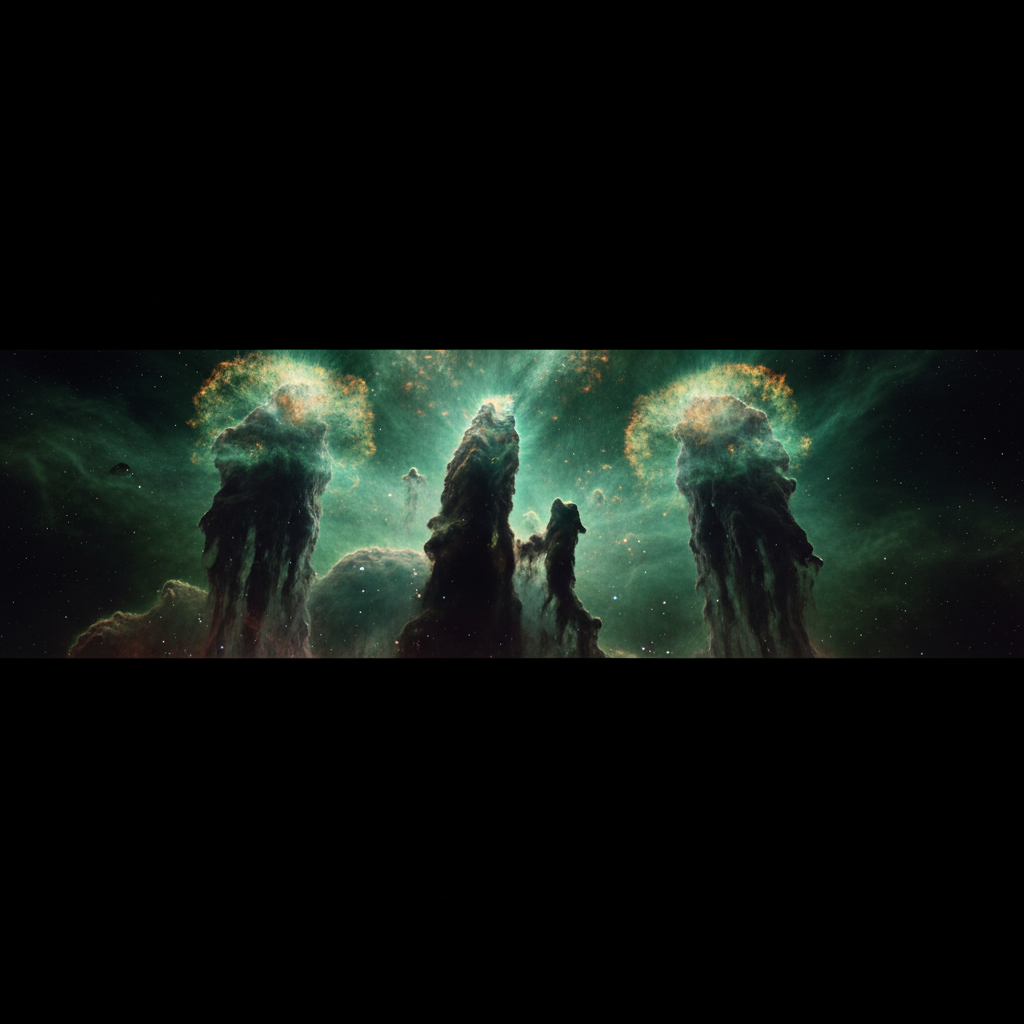
The Pillars of Creation is the name given to a famous Hubble Space Telescope image from 1995 showing towering columns of dense gas and dust in the Eagle Nebula (M16), about 7,000 light-years away. The pillars — the tallest extending about 5 light-years — are elephant-trunk-like protrusions from a larger molecular cloud, sculpted by the intense radiation and stellar winds from the young star cluster NGC 6611 nearby. The tips of the pillars contain evaporating gaseous globules (EGGs) — dense, photoevaporating knots that may contain embedded protostars.
How do stars form in molecular clouds?
Star formation begins when a region within a molecular cloud reaches the Jeans instability criterion — when gravity overcomes thermal pressure and the cloud begins to collapse. The collapse can be spontaneous (from internal gravitational instability) or triggered by an external perturbation such as a supernova shock wave. As a dense core collapses, it heats up through gravitational compression, eventually reaching the temperatures needed for nuclear fusion (about 10 million K in the core). The surrounding disk of gas and dust then forms a protoplanetary disk, from which planets may eventually assemble.