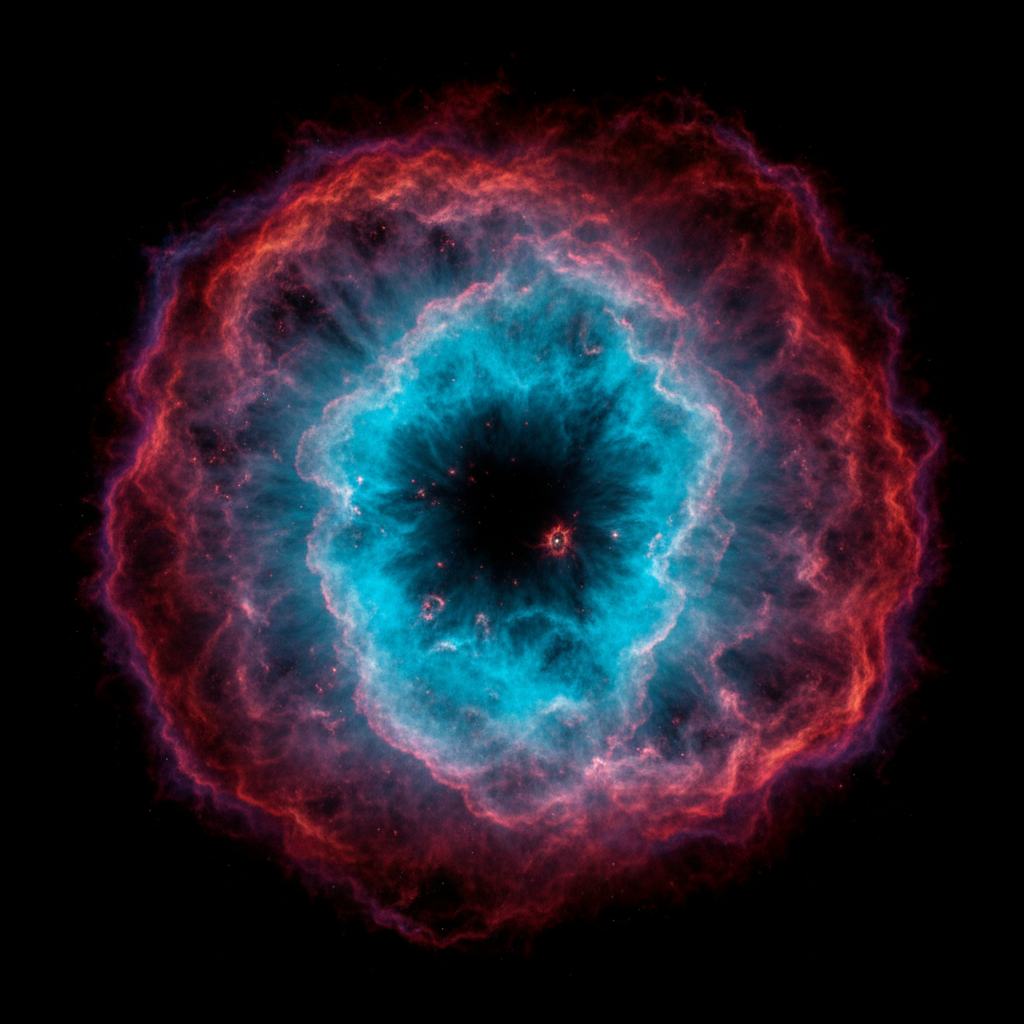
Introduction to Planetary Nebulae
Planetary nebulae occupy a special place in astronomy — they are simultaneously the end of one story and the beginning of another. They mark the death of Sun-like stars, the return of enriched material to the interstellar medium, and the birth of white dwarfs. For a brief 10,000 to 50,000 years — less than a thousandth of a stellar lifetime — these glowing shells produce some of the most visually spectacular objects in the observable universe.
The name "planetary nebula" is entirely misleading and has frustrated astronomers for two centuries. William Herschel coined the term in 1785 because some objects resembled the disk of Uranus in his telescope. In reality, they have nothing to do with planet formation. They are the ejected outer envelopes of stars with masses between roughly 0.8 and 8 solar masses — when these stars exhaust their nuclear fuel, they shed their outer layers in an extended display of light and color.
The study of planetary nebulae has been enormously productive for astrophysics. Their well-defined spectra allow precise measurements of temperature, density, and chemical abundances. Their distances can be estimated from apparent size and luminosity. And their chemical composition carries the signature of nuclear processing deep inside their parent stars — carbon, nitrogen, and other elements synthesized over billions of years, now returned to the galaxy for future stellar generations.
Physical Characteristics
Planetary Nebula Quick Facts
- Origin: Ejected outer envelope of a low-to-intermediate mass star (0.8–8 solar masses)
- Central Star: White dwarf with surface temperature 25,000–200,000 K
- Expansion Velocity: 10–30 km/s typical
- Diameter: 0.1–5 light-years
- Lifespan: 10,000–50,000 years
- Gas Temperature: 8,000–15,000 K
Planetary nebulae are among the most luminous objects per unit mass in the galaxy. A single planetary nebula may radiate 100–1,000 times the total solar luminosity concentrated in just a few emission lines. The [OIII] line at 500.7 nm is so bright that planetary nebulae can be detected as individual points in distant galaxies, where they serve as distance indicators through the "planetary nebula luminosity function" technique — a powerful tool for measuring galactic distances out to about 100 million light-years.
How Planetary Nebulae Form
The formation of a planetary nebula is the final act of a long stellar evolution story playing out over billions of years.
The Asymptotic Giant Branch Phase
When a Sun-like star exhausts its hydrogen, it expands into a red giant. After igniting helium fusion, it settles temporarily before ascending the Asymptotic Giant Branch (AGB) — a phase characterized by thermal pulses: periodic explosive helium-burning events that cause the star to pulsate with periods of months to years. During the AGB phase, the star loses mass at an enormous rate through powerful stellar winds driven by radiation pressure on dust grains forming in the cool outer atmosphere.
Superwind and Ejection
As the AGB star evolves, it develops an increasingly intense "superwind" that strips its remaining outer envelope in just a few thousand years. The ejected gas expands outward at 10–30 km/s, forming a dense circumstellar shell. When the stellar core is exposed — a hot white dwarf — it begins radiating intense UV photons that ionize the previously ejected gas, causing it to glow brilliantly as a planetary nebula.
Multiple Shells
Many planetary nebulae show multiple concentric shells, reflecting the episodic nature of mass loss during the AGB phase. Each thermal pulse drives a new wave of ejected material at slightly different velocities. As faster inner shells catch up with slower outer shells, they create density enhancements visible as rings — a record of the star's pulsation history written in glowing gas.
Shapes and Morphology
One of the most striking features of planetary nebulae is their astonishing morphological diversity. They range from perfect spherical shells to pinched bipolar structures, from simple single rings to complex multi-shell systems with jets and knots.
Classification
Planetary nebulae are broadly classified as round, elliptical, bipolar, or irregular. Round nebulae account for roughly 20% of the total. Elliptical nebulae — the most common — show slightly elongated shapes suggesting asymmetric mass loss. Bipolar nebulae, like the Butterfly Nebula (NGC 6302), display dramatic double-lobed structures with material concentrated in a dense equatorial torus and jets along the polar axis.
Role of Binary Stars
The majority of non-spherical planetary nebulae are thought to result from binary star interactions. When the AGB star expands, it can transfer mass to a companion or engulf it in a "common envelope" phase. The companion's orbital motion then shapes the outflow — channeling material into bipolar jets and equatorial rings. The most complex planetary nebulae with multiple nested structures and precessing jets are almost certainly products of binary interactions.
Chemical Enrichment of the Galaxy
Planetary nebulae play a crucial role in the chemical evolution of the Milky Way. The dying stars that produce them have spent billions of years synthesizing elements through nuclear fusion, and these enriched materials are returned to the interstellar medium through the nebular ejection.
Carbon and Nitrogen
AGB stars are the primary source of carbon in the universe. Through the triple-alpha process, helium is fused into carbon-12 in the stellar interior. Convective mixing events (dredge-ups) bring this carbon to the surface, and mass loss during the AGB and planetary nebula phases distributes it into the interstellar medium. The nitrogen produced via the CNO cycle is also returned. These elements, incorporated into subsequent generations of stars and planets, ultimately provide the building blocks of life as we know it.
Notable Planetary Nebulae
- Ring Nebula (M57) — 2,600 light-years: The most famous planetary nebula, appearing as a colorful smoke ring in Lyra. The ring structure arises because the cylindrical shell of gas appears thicker at the edges than in the center when viewed end-on. The central white dwarf is visible as a 15th-magnitude star in large telescopes.
- Helix Nebula (NGC 7293) — 650 light-years: The nearest planetary nebula to Earth and the largest in angular size — 3 light-years across, appearing larger than the full Moon in the sky. Its multiple shells and comet-like knots reveal the complex mass-loss history of the central star. Often called the "Eye of God" in popular imagery.
- Cat's Eye Nebula (NGC 6543) — 3,300 light-years: Among the most structurally complex planetary nebulae known, with 11 concentric shells, a bright central bubble, jets, and knots. The first planetary nebula to have its spectrum recorded, by William Huggins in 1864.
- Butterfly Nebula (NGC 6302) — 3,800 light-years: A spectacular bipolar planetary nebula with twin lobes extending over 2 light-years, separated by a dense dusty torus. The central star has a surface temperature exceeding 200,000 K. Gas in the lobes moves at 600,000 km/h.
Observing Planetary Nebulae
Planetary nebulae are among the most rewarding targets for amateur astronomers. Unlike extended emission nebulae that spread across large areas, most planetaries are compact — many appear star-like in binoculars.
The Blinking Method
The key test for identifying a planetary nebula is the blinking method: alternately inserting and removing an [OIII] or UHC filter at the eyepiece. Planetaries appear brighter with the filter, while stars dim. This makes identifying faint, star-like planetaries straightforward even in crowded Milky Way fields.
Best Targets by Season
- Summer/Autumn: Ring Nebula (M57) in Lyra, Dumbbell Nebula (M27) in Vulpecula
- Summer: Saturn Nebula (NGC 7009), Blue Snowball (NGC 7662) in Andromeda
- Winter/Spring: Eskimo Nebula (NGC 2392) in Gemini
- Southern hemisphere: Helix Nebula (NGC 7293) in Aquarius
Interesting Facts About Planetary Nebulae
- A Misleading Name: "Planetary nebula" is one of astronomy's most persistent misnomers. William Herschel named them in 1785 for their resemblance to planetary disks in his telescope. They have nothing to do with planets.
- The Sun Will Become One: In about 5 billion years, the Sun will shed its outer layers as a planetary nebula, briefly illuminating the solar system before fading over tens of thousands of years.
- Short-Lived Beauty: Despite taking billions of years to form, a planetary nebula lasts only 10,000–50,000 years — less than 0.001% of the parent star's lifespan.
- Distance Candles: The brightest planetary nebulae in any galaxy reach nearly the same peak [OIII] luminosity — making them standard candles for measuring galactic distances out to ~100 million light-years.
- Carbon Factories: The AGB stars that produce planetary nebulae are the Milky Way's primary source of carbon. Every carbon atom in your body was forged in an AGB star's interior and dispersed by a planetary nebula.
- Record Expansion: Gas in the Butterfly Nebula lobes travels at approximately 600,000 km/h — some of the fastest expanding gas in any planetary nebula known.
- Comet Knots in the Helix: The Helix Nebula contains over 20,000 individual knots of dense gas, each with a bright head and long tail pointing away from the central star. Each knot is roughly the size of our solar system.
- First Spectroscopic Nebula: The Cat's Eye Nebula (NGC 6543) was the first nebula to have its spectrum recorded, by William Huggins in 1864, who discovered it was a hot gas cloud rather than unresolved stars.
External Resources
- Hubble Nebula Gallery - HST images of planetary nebulae
- NASA Nebulae - NASA overview and image collection
- Planetary Nebula — Wikipedia - Comprehensive scientific article
- ESO Nebula Images - European Southern Observatory deep imaging
Frequently Asked Questions
Why are they called planetary nebulae if they have nothing to do with planets?
The name is a historical accident. When William Herschel first described these objects in the late 18th century, some appeared as small, round, greenish disks in early telescopes — similar in appearance to the newly discovered planet Uranus. He coined the term "planetary nebula" based on this visual resemblance alone. The name stuck despite being completely misleading. Planetary nebulae have nothing to do with planets; they are the ejected outer envelopes of dying Sun-like stars.
What star produces a planetary nebula?
Planetary nebulae are produced by stars with initial masses roughly 0.8 to 8 times the mass of the Sun. This encompasses the vast majority of stars, including the Sun itself. Stars outside this range end differently: lower-mass stars cool quietly as white dwarfs without a bright ejection phase, while stars more massive than about 8 solar masses explode as supernovae. In about 5 billion years, our own Sun will shed its outer layers and briefly glow as a planetary nebula before the core fades as a white dwarf.
How long do planetary nebulae last?
Planetary nebulae are remarkably short-lived on astronomical timescales. They expand and fade in just 10,000 to 50,000 years — an eyeblink compared to the billions-of-years lifespan of the parent star. As the nebula expands, its gas becomes increasingly dilute and the central white dwarf cools, eventually losing the ability to ionize the surrounding gas. The nebula fades into the interstellar medium, leaving behind only the cooling white dwarf.
What gives planetary nebulae their vivid colors?
The colors come from specific emission lines of ionized elements. The central white dwarf, with surface temperatures of 25,000–200,000 K, emits intense ultraviolet radiation that ionizes the surrounding gas. Doubly ionized oxygen ([OIII]) produces brilliant blue-green at 500.7 nm, hydrogen produces red (H-alpha, 656.3 nm), and ionized helium, nitrogen, and sulfur each contribute at their characteristic wavelengths. The relative strengths of these lines create the enormous variety of colors seen across different planetary nebulae.
Why do planetary nebulae have such varied shapes?
Planetary nebulae show an astonishing range of morphologies — spherical shells, bipolar lobes, rings, spirals, and complex multi-shell systems. The diversity reflects the rotation rate of the dying star, interactions with a binary companion, the stellar magnetic field, and the varying intensity of stellar winds during the asymptotic giant branch phase. Binary star systems are thought to produce most non-spherical shapes: the companion disrupts the outflow symmetry, channeling material into jets and bipolar lobes.
Will the Sun become a planetary nebula?
Yes. In approximately 5 billion years, the Sun will exhaust its hydrogen fuel, expand into a red giant, then ascend the asymptotic giant branch — pulsating and shedding mass through powerful stellar winds. Over a few thousand years it will eject its remaining outer envelope, creating an expanding shell. The exposed hot white dwarf core will then ionize this shell, producing a brilliant planetary nebula visible from nearby stars for tens of thousands of years before fading.