Introduction to Protoplanetary Nebulae
Protoplanetary nebulae occupy one of the most fleeting and least-observed phases in stellar evolution. They exist in the narrow window between the end of the AGB phase — when a dying Sun-like star has shed most of its outer envelope — and the beginning of the true planetary nebula phase — when the hot exposed core finally ionizes the ejected gas. This transition, lasting only a few centuries to a few millennia, is so brief that fewer than 300 confirmed protoplanetary nebulae are known in the entire Milky Way.
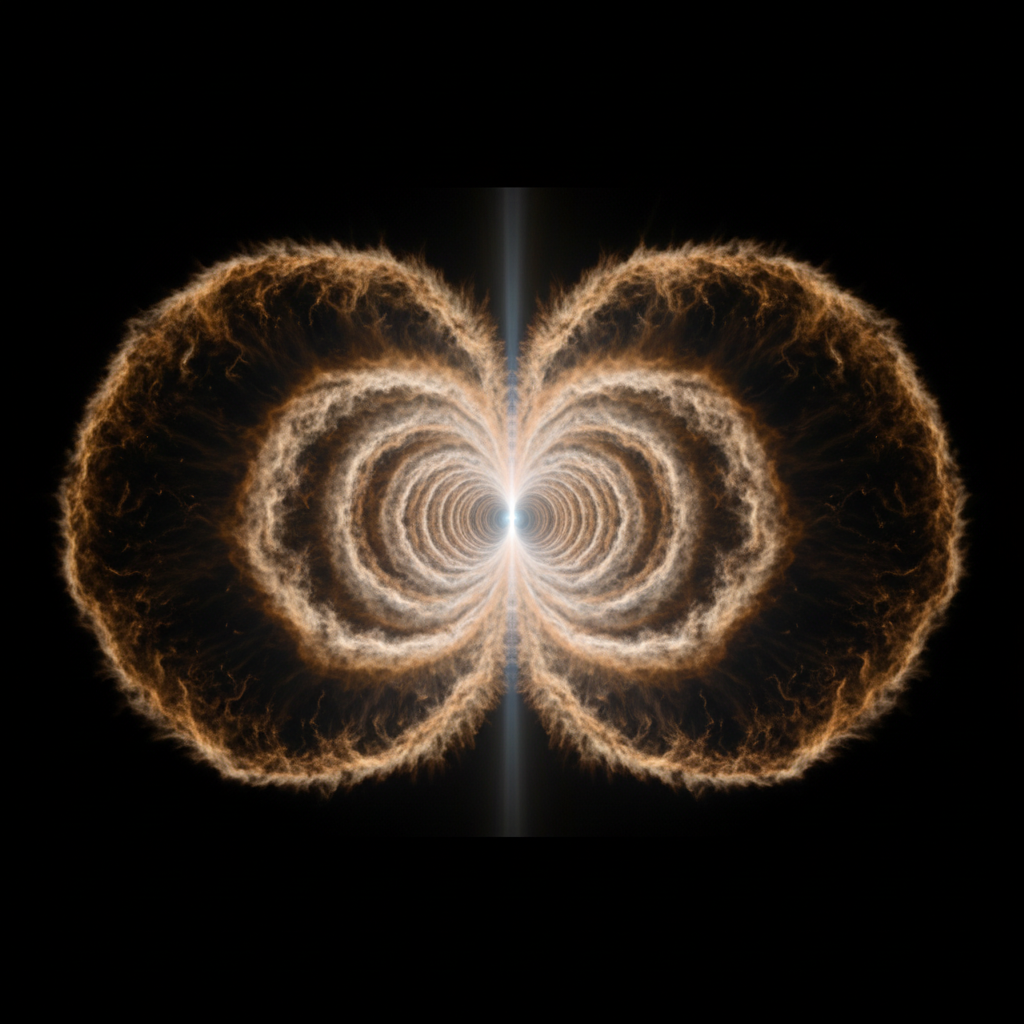
Despite their rarity, protoplanetary nebulae are scientifically invaluable. They preserve a detailed record of the late-stage mass loss process — the mechanism by which dying stars return their enriched material to the interstellar medium — at a moment when this process has just completed and the geometry is still frozen in expanding gas and dust. The concentric dust shells visible in many PPNs are a direct recording of the thermal pulsation cycle of the AGB star, with each shell corresponding to a pulse that occurred every few hundred years during the final millennia of the star's life.
Despite the name "protoplanetary," these nebulae have absolutely nothing to do with planet formation. The term is a historical confusion: early observers noted their visual resemblance to protoplanetary disks around young stars. In fact, PPNs are entirely unrelated — they are the remnants of old, dying stars, not the birthplaces of new planetary systems. The preferred modern term is "post-AGB nebulae" or simply "PPN," though "protoplanetary nebula" remains in common use.
Physical Characteristics
Protoplanetary Nebula Quick Facts
- Phase: Transition between AGB star and planetary nebula
- Central Star Temperature: 5,000–25,000 K (too cool to ionize gas)
- Duration: A few hundred to a few thousand years
- Light Mechanism: Reflected starlight from dust (not ionization)
- Morphology: Often bipolar (two-lobed); some spherical or multipolar
- Size: Typically 0.1–1 light-year across
The central stars of protoplanetary nebulae are in rapid evolution. As the AGB star sheds its envelope, the stellar radius shrinks and the surface temperature rises. The star transitions from a cool (3,000 K), luminous giant to a hot (100,000+ K), compact pre-white dwarf in just a few thousand years. During the PPN phase, the central star typically has a surface temperature between 5,000 and 25,000 K — warm enough to illuminate the surrounding dust by reflection, but not yet hot enough to ionize it.
The surrounding nebula is primarily a reflection nebula during the PPN phase — it shines by scattering starlight off dust grains rather than by emission from ionized gas. This gives PPNs spectra dominated by a continuous reflected continuum from the central star, often with molecular absorption features. As the central star heats up, emission lines gradually appear as the gas begins to ionize, marking the transition to a true planetary nebula.
Formation and Evolution
The protoplanetary nebula phase begins when an AGB star enters the "superwind" phase — a dramatic increase in mass-loss rate that strips the outer envelope in just a few thousand years. What triggers the transition from the slower steady AGB wind to the violent superwind remains one of the key unsolved problems in stellar physics.
The Superwind Phase
During the superwind, the AGB star loses mass at rates of 10^-4 to 10^-3 solar masses per year — orders of magnitude faster than its steady-state AGB wind. This material forms the bulk of the future nebular shell. The superwind typically lasts only a few hundred years before the envelope is largely gone and the stellar core is exposed. At this point, the star is no longer an AGB star — it has become a post-AGB star, still surrounded by its recently ejected shell.
The Post-AGB Heating Track
As the remaining stellar envelope contracts and the core's radiation pressure increases, the post-AGB star begins a rapid leftward traverse of the Hertzsprung-Russell diagram at nearly constant luminosity. The surface temperature rises from ~5,000 K toward 100,000 K and beyond in just a few thousand years — the fastest evolutionary track for any stellar phase. When the temperature reaches ~25,000 K, the star begins to ionize its surrounding shell, and the PPN transitions into a planetary nebula.
Bipolar Shapes and Their Origin
The most striking feature of protoplanetary nebulae is their dominant bipolar morphology — roughly 80% of PPNs show two-lobed structures rather than the spherically symmetric shells that might naively be expected from a dying star shedding its envelope uniformly in all directions.
The Equatorial Density Enhancement
The key to bipolar shapes is a concentration of mass in the equatorial plane. During the late AGB phase, mass loss is often enhanced toward the equator — either through enhanced rotation, magnetic fields, or most likely interaction with a binary companion. This equatorial density enhancement creates a torus of dense gas and dust around the star. When the faster post-AGB wind encounters this torus, it is deflected and collimated into bipolar jets and lobes, creating the characteristic two-lobed structure.
Binary Shaping
Theoretical models and observations increasingly support the binary hypothesis: most non-spherical PPNs are shaped by interaction between the AGB star and a close companion. As the AGB star expands, it can transfer mass to the companion or even engulf it in a common-envelope event. The companion's orbital angular momentum is then deposited into the outflow, creating the equatorial concentration and bipolar geometry. Several PPNs have confirmed binary central stars, supporting this picture.
Concentric Dust Shells
One of the most remarkable features revealed in Hubble Space Telescope images of PPNs is a series of concentric dust shells surrounding the central star. These shells, separated by roughly equal distances, are extraordinarily regular and symmetric — a cosmic fingerprint of the AGB star's pulsation history.
Thermal Pulses Recorded in Gas
Each shell corresponds to a thermal pulse — the periodic explosive helium-burning events that cause the AGB star to brighten and increase its mass-loss rate every few hundred to few thousand years. Each pulse drives an enhanced wind that forms a thin shell of denser material. As the shells expand outward at roughly constant velocity, they maintain their spacing — the time intervals between pulses written in concentric rings of dust. In the Egg Nebula, over 15 shells have been detected, recording more than 3,000 years of pulsation history.
Spacing and Timescales
The shell spacing in the Egg Nebula corresponds to inter-pulse periods of roughly 200–500 years — consistent with theoretical models of thermal pulse frequencies for stars of this mass. This makes PPNs direct observational probes of the thermal pulse cycle, a process too slow to observe in real time but recorded in the expanding geometry of the nebula like annual rings in a tree trunk.
Notable Protoplanetary Nebulae
- Egg Nebula (CRL 2688) — 3,000 light-years: The most studied protoplanetary nebula. Hubble images reveal twin bipolar lobes of reflected light, over 15 concentric dust shells, and a bright central star hidden behind a thick equatorial dust torus. Four searchlight beams of light escape through gaps in the torus, creating a distinctive arc pattern. Named for its egg-like appearance in early infrared observations.
- Red Rectangle Nebula (HD 44179) — 2,300 light-years: An extraordinary X-shaped reflection nebula with distinctive red emission from polycyclic aromatic hydrocarbons and C2 Swan bands — diffuse interstellar band chemistry occurring within the expanding envelope. The X-shape results from outflowing lobes intersected by the equatorial torus. One of the few nebulae showing optical ladder rungs of emission forming the rectangular pattern that gives it its name.
- IRAS 17441-2411 (Silkworm Nebula) — 6,500 light-years: A striking bipolar PPN resembling a silk cocoon, with sharply defined twin lobes and a bright central waist. Its clean, symmetrical structure makes it an excellent example for studying the bipolar shaping mechanism.
- Frosty Leo Nebula (IRAS 09371+1212) — 3,300 light-years: A protoplanetary nebula notable for an unusual triple-lobed structure — a pair of bipolar lobes plus an additional equatorial extension. Contains abundant water ice and carbon-rich molecules in its expanding envelope. Its complex geometry suggests multiple mass-loss episodes at different orientations.
Observing Protoplanetary Nebulae
Protoplanetary nebulae are challenging but rewarding targets for advanced observers. Because they are compact and do not emit bright emission lines like planetary nebulae, standard narrowband filters do not help. They require large apertures, good seeing, and broadband or no filters.
What to Expect
Most PPNs appear as compact, slightly fuzzy "stars" or elongated smudges in amateur telescopes. The Egg Nebula (CRL 2688) appears as a faint oval in a 12-inch telescope under dark skies. The Red Rectangle (HD 44179) shows as a faint unresolved object but is distinguishable from a star by its slightly extended appearance. The finest structural detail — concentric shells, bipolar lobes, searchlight beams — requires Hubble-class resolution.
Finding PPNs
Many PPNs are identified in infrared surveys (IRAS, MSX, Spitzer) as objects with characteristic cool dust emission. Optical counterparts are often faint and heavily obscured. The SIMBAD database and specialized catalogues of post-AGB stars provide finding charts and coordinates for the brightest examples accessible to amateur instruments.
Interesting Facts About Protoplanetary Nebulae
- Not About Planets: Despite the name, protoplanetary nebulae have nothing to do with planet formation. They are dying stars shedding their outer layers — the name is a historical accident from resemblance to protoplanetary disks around young stars in early observations.
- Fastest Evolving Stars: Post-AGB stars crossing the Hertzsprung-Russell diagram during the PPN phase have surface temperatures that rise from 5,000 K to over 100,000 K in just a few thousand years — the fastest evolutionary track in normal stellar evolution. A human civilization could potentially watch a PPN transition into a planetary nebula over historical timescales.
- Only ~300 Known: Despite the Milky Way containing billions of stars that will eventually become PPNs, fewer than 300 confirmed protoplanetary nebulae are known in the entire galaxy. Their brief lifespan of hundreds to thousands of years makes them extraordinarily rare snapshots.
- Thermal Pulse Recorder: The concentric dust shells in PPNs like the Egg Nebula record thousands of years of stellar pulsation history in a single image — each ring a snapshot of a thermal pulse that happened hundreds of years before the next. Counting the rings gives the AGB pulsation period without needing to observe the star over that full timespan.
- Carbon Chemistry: Many PPNs are rich in carbon-bearing molecules — carbon stars that become PPNs distribute their carbon into the shells. The Red Rectangle Nebula produces bands from C2 and C3 molecules — dicarbon and tricarbon — that create a distinctive reddish color visible in telescopes, one of the few cases where molecular emission is optically visible.
- Dust Factories: The superwind phase that creates PPNs is a major source of dust in the interstellar medium. Carbon-rich PPNs contribute graphite and PAH particles; oxygen-rich PPNs contribute silicate dust. Both types contribute the raw material for future generations of stars and planetary systems.
- Water Maser Sources: Many PPNs are detected as water maser sources at radio wavelengths. Water molecules in the dense circumstellar envelope are pumped to produce coherent microwave emission at 22 GHz — the same physical process as laboratory masers but powered by infrared photons from the hot central star. These masers can be detected across the entire Milky Way.
- The Sun Will Become One: In approximately 5 billion years, the Sun will pass through its own protoplanetary nebula phase for a few thousand years. During this time, the remnants of today's solar system — white-dwarf-to-be surrounded by expanding shells — will briefly glow with reflected light before the Sun heats enough to ionize them into a true planetary nebula.
External Resources
- Hubble — Egg Nebula - HST detailed image of CRL 2688
- NASA — Red Rectangle Nebula - HD 44179 Hubble imagery
- Protoplanetary Nebula — Wikipedia - Detailed scientific overview
- ESO Nebula Images - ESO deep imaging of post-AGB nebulae
Frequently Asked Questions
What is a protoplanetary nebula?
A protoplanetary nebula (PPN) — also called a proto-planetary nebula — is a short-lived phase of stellar evolution between the asymptotic giant branch (AGB) stage and the fully developed planetary nebula. During this transition, the central star has ejected most of its outer envelope but is not yet hot enough to ionize the surrounding gas. The ejected material forms an expanding dust and gas shell illuminated by reflected starlight, rather than by the star's own ionizing radiation. Despite the name, they are completely unrelated to planet formation.
How long does the protoplanetary nebula phase last?
The protoplanetary nebula phase is one of the shortest phases in stellar evolution — lasting only a few hundred to a few thousand years. It begins when the AGB star ejects most of its outer envelope and ends when the exposed stellar core (future white dwarf) heats to about 25,000 K, sufficient to ionize the surrounding gas and light up a proper planetary nebula. Astronomers have identified only a few hundred protoplanetary nebulae in the entire Milky Way, reflecting how briefly this phase lasts compared to the billions-of-year stellar lifespan.
Why do many protoplanetary nebulae have bipolar shapes?
The dominant bipolar (two-lobed) morphology of protoplanetary nebulae reflects the asymmetric mass loss during the final AGB phase and the transition to the PPN stage. Dense equatorial outflows — enhanced by a binary companion or the star's own rotation — create a thick disk or torus of material around the star's equator. Later, faster winds preferentially escape along the polar axes where the density is lower, inflating the characteristic twin lobes. The result is a striking hourglass or butterfly shape with the central star buried in the equatorial torus. The interaction between a binary companion and the dying star is thought to be the dominant shaping mechanism.
What is the Egg Nebula?
The Egg Nebula (CRL 2688, also called AFGL 2688) is one of the most studied protoplanetary nebulae, located about 3,000 light-years away in the constellation Cygnus. Hubble Space Telescope images reveal its distinctive structure: a bright central star deeply obscured by a thick equatorial dust belt, with twin bipolar lobes of reflected light emerging from the poles, and a remarkable series of concentric dust shells visible around the lobes. These shells record the pulsation history of the AGB star, with each shell representing a thermal pulse that occurred every few hundred years. The Egg Nebula is so named because early infrared observations suggested an egg-like shape.
How are protoplanetary nebulae different from planetary nebulae?
The key difference is ionization: planetary nebulae glow because their central white dwarf is hot enough (>25,000 K) to ionize the surrounding gas, producing the characteristic emission line spectrum. Protoplanetary nebulae have central stars that are still too cool to ionize their shells — they shine instead by reflecting stellar light off dust grains. This means PPNs are visible primarily at optical and infrared wavelengths as reflection nebulae, while planetary nebulae glow in specific emission lines. As the central star heats up over centuries, the PPN gradually transitions into a true planetary nebula.
Can protoplanetary nebulae be seen through a telescope?
Most protoplanetary nebulae are challenging objects because they are compact, faint, and their central stars are often deeply obscured by dust. Several bright examples are visible in moderate to large amateur telescopes as compact, elongated smudges. The Egg Nebula (CRL 2688) appears as a faint oval in a 12-inch telescope. The Red Rectangle Nebula (HD 44179) shows an unusual X-shaped structure with red emission. Larger instruments and narrowband filters help, but the finest detail in PPNs requires Hubble or large professional telescopes.