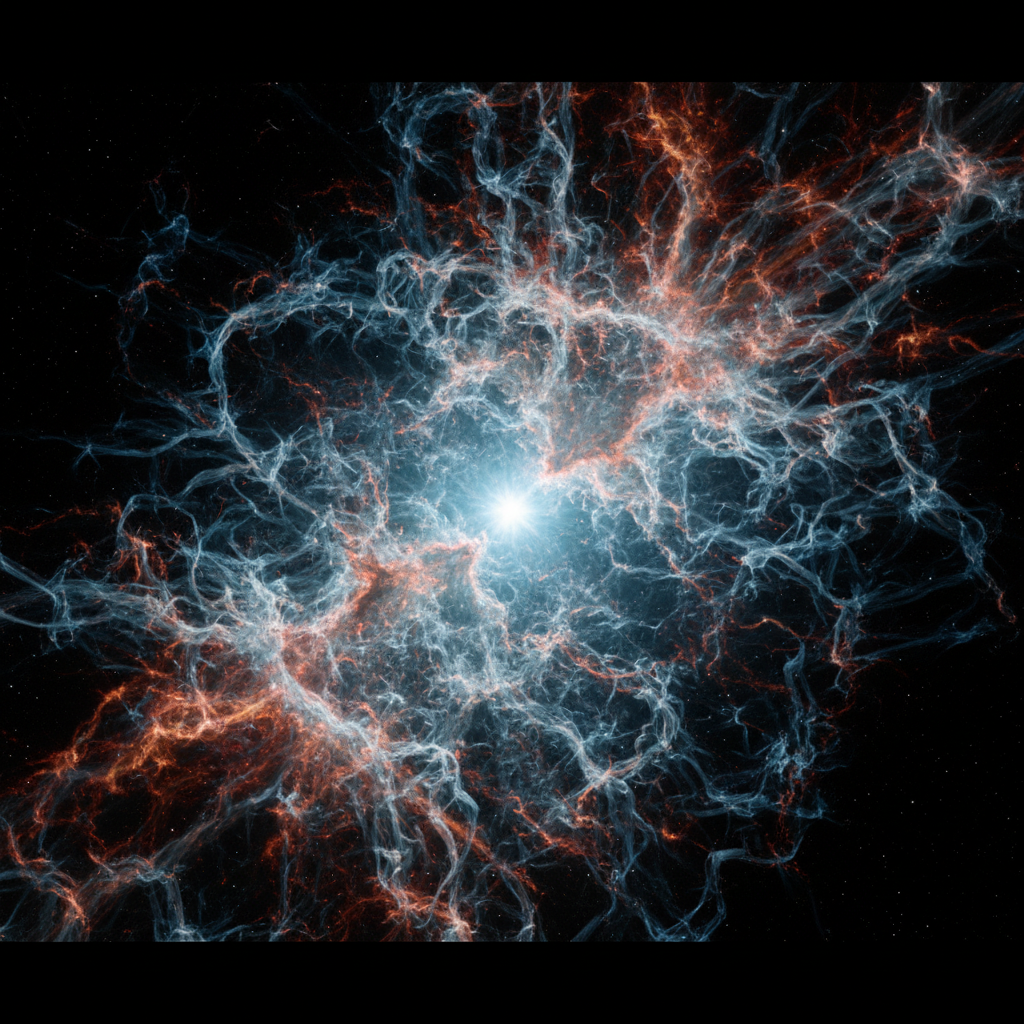
Introduction to Supernova Remnants
When a massive star — one with more than about eight times the mass of the Sun — reaches the end of its life, it does not go quietly. Its iron core collapses in under a second, releasing more energy than the Sun will radiate over its entire 10-billion-year lifetime. The rebounding shock wave blasts the star's outer layers into space, creating a supernova explosion bright enough to briefly outshine an entire galaxy of hundreds of billions of stars.
What remains after the explosion is a supernova remnant — the expanding shell of stellar material and swept-up interstellar gas that continues to evolve and glow for tens of thousands of years. These remnants are among the most energetic and physically complex objects in the galaxy, glowing across the entire electromagnetic spectrum: from radio waves to X-rays to gamma rays. They heat and stir the interstellar medium, distribute heavy elements synthesized inside the progenitor star, and accelerate particles to near the speed of light.
Supernova remnants are the factories of the heavy elements that make up our world. Every iron atom in your blood, every calcium atom in your bones, was forged in the core of a massive star and dispersed into the interstellar medium by the shock wave of a supernova remnant. We are, in the most literal sense, made of supernova remnants.
Physical Characteristics
Supernova Remnant Quick Facts
- Origin: Core collapse supernova (Type II/Ib/Ic) or thermonuclear supernova (Type Ia)
- Initial Expansion Speed: 10,000–30,000 km/s (up to 10% of the speed of light)
- Shock Temperature: 10 million – 100 million Kelvin
- Energy Released: ~10^44 joules (1% of total supernova energy)
- Lifespan: 10,000–100,000 years before merging with interstellar medium
- Emission: Radio, optical, X-ray, gamma-ray (synchrotron + thermal)
The physics of supernova remnants involves extreme conditions far beyond anything achievable in terrestrial laboratories. The initial shock front moves at thousands of km/s, compressing and heating the surrounding interstellar gas to temperatures of millions to tens of millions of Kelvin — hot enough to emit X-rays. The shocked gas glows across the electromagnetic spectrum, with different emission processes dominating at different wavelengths: thermal bremsstrahlung in X-rays, synchrotron radiation in radio and sometimes optical, and line emission in the optical.
Evolutionary Phases
Supernova remnants evolve through distinct phases over their lifetimes, driven by the interplay between the kinetic energy of the expanding ejecta and the resistance of the surrounding interstellar medium.
Free Expansion Phase (0–300 years)
In the earliest phase, the ejected material expands freely at near-constant velocity, as the swept-up interstellar mass is still much less than the ejected mass. The forward shock races outward while a reverse shock moves inward through the ejecta, heating the stellar debris. This phase lasts until the swept-up mass equals the ejected mass — typically a few hundred years after the explosion.
Sedov-Taylor Phase (300–30,000 years)
Once the swept-up mass exceeds the ejected mass, the remnant enters the adiabatic Sedov-Taylor phase. The expansion decelerates in a self-similar manner described by the Sedov-Taylor solution, where the remnant radius grows as the 2/5 power of time. Most well-studied supernova remnants, including the Crab Nebula and Cassiopeia A, are in this phase.
Radiative Phase (30,000+ years)
As the shock slows and the gas cools, radiative losses become significant. The shock becomes radiative — the gas behind it cools and compresses into a thin dense shell. The remnant transitions from a hot, diffuse X-ray emitter to a cool, dense optical shell. Eventually the shell velocity drops to the ambient sound speed and the remnant dissolves into the interstellar medium, depositing its energy and enriched material.
Types of Supernova Remnants
Shell-Type Remnants
The most common type, characterized by a bright ring or shell of emission produced by the forward shock interacting with the interstellar medium. The interior may appear relatively faint. The Veil Nebula (Cygnus Loop) and Tycho's Supernova Remnant are classic examples.
Pulsar Wind Nebulae (Plerions)
Remnants powered from within by a rapidly rotating neutron star (pulsar) at the center. The pulsar drives a wind of relativistic particles and magnetic fields that fill the interior with synchrotron-emitting plasma. The Crab Nebula is the canonical example, with its central pulsar spinning 30 times per second and powering the entire visible nebula.
Mixed-Morphology (Composite) Remnants
A significant fraction of supernova remnants show both a shell-like outer boundary and a center-filled X-ray morphology. These composite remnants may result from the remnant expanding into a non-uniform medium, or from the presence of a central neutron star that has slowed too much to power a bright pulsar wind nebula but still heats the interior.
Supernova Remnants and Cosmic Rays
One of the most profound roles of supernova remnants is as the probable primary accelerator of galactic cosmic rays — the high-energy charged particles that continuously bombard Earth from all directions. The energy density of cosmic rays in the Milky Way requires an enormous power source, and supernova remnants are the only known candidates with sufficient energy output.
Diffusive Shock Acceleration
The mechanism, called diffusive shock acceleration or first-order Fermi acceleration, works as follows: a charged particle near the shock front is scattered by magnetic field irregularities. If the particle crosses the shock, it gains energy from the converging flows on either side. It may cross the shock many times, gaining energy with each crossing. This produces a power-law energy spectrum — exactly the spectrum observed for cosmic rays up to approximately 10^15 electron volts, known as the "knee" of the cosmic ray spectrum.
Notable Supernova Remnants
- Crab Nebula (M1) — 6,500 light-years: The remnant of a supernova observed in 1054 AD by Chinese and Arab astronomers. Contains a central pulsar spinning 30 times per second that powers the entire visible nebula through synchrotron radiation. Expanding at 1,500 km/s, the Crab is the most intensively studied object beyond the solar system.
- Cassiopeia A — 11,000 light-years: The youngest known supernova remnant in the Milky Way, produced by an explosion approximately 340 years ago (though no one observed the supernova at the time). X-ray observations reveal the expanding ejecta in unprecedented detail, showing layers of silicon, sulfur, argon, calcium, and iron corresponding to different nuclear burning shells of the progenitor star.
- Veil Nebula (Cygnus Loop) — 2,400 light-years: The remains of a supernova that exploded 10,000–20,000 years ago, now spanning about 120 light-years. The filamentary optical emission traces the boundary where the shock front encounters denser interstellar clouds. The Eastern and Western Veils are popular astrophotography targets.
- SN 1987A — 168,000 light-years: The closest supernova observed since 1604 (in the Large Magellanic Cloud), providing an unprecedented opportunity to study a supernova in real time. The developing remnant — now showing a bright equatorial ring lit up by the advancing shock — is monitored continuously with space and ground-based telescopes.
Observing Supernova Remnants
Supernova remnants vary enormously in observability. The youngest are brightest in radio and X-ray wavelengths but may be faint optically. The most accessible optical targets are older, larger remnants where the shock has cooled enough to produce optical emission lines.
Best Optical Targets
- Veil Nebula (Cygnus Loop): Best visual SNR for northern observers. Requires an [OIII] filter and dark skies. The Eastern Veil (NGC 6992) and Pickering's Triangle are the brightest sections. A nebula filter is essential.
- Crab Nebula (M1): Visible in 6-inch telescope as an oval glow in Taurus. No special filter needed. One of the few SNRs showing structure in small telescopes.
- Simeis 147 (Spaghetti Nebula): Extremely faint but spectacular in H-alpha photography — a tangled web of filaments spanning 3 degrees of sky.
Interesting Facts About Supernova Remnants
- We Are Made of SNRs: Every heavy element in your body — carbon, oxygen, iron, calcium — was synthesized inside a massive star and dispersed by a supernova. The shock wave from that ancient explosion is what formed the supernova remnant that seeded the cloud that eventually formed our solar system.
- Speed of Destruction: The initial ejecta from a Type II supernova moves at up to 30,000 km/s — 10% of the speed of light, more than 100 times faster than Earth orbits the Sun.
- The Crab Pulsar: The neutron star at the center of the Crab Nebula spins 30.2 times per second and loses energy equivalent to 100,000 Suns. This energy powers the entire glowing nebula — the Crab is one of the few nebulae that would be significantly dimmer if the central engine were switched off.
- Cas A Reveals Stellar Layers: X-ray spectroscopy of Cassiopeia A maps the onion-skin layers of the progenitor star — silicon, sulfur, argon, and iron shells from different nuclear burning zones, now expanding outward in the remnant at different velocities.
- Galaxy Stirrers: Supernova remnants are the primary drivers of turbulence in the interstellar medium. They inject enough energy to stir gas on galactic scales, preventing molecular clouds from collapsing into stars too rapidly and regulating the overall star formation rate of the Milky Way.
- 1054 AD Observation: The Crab Nebula supernova was observed and recorded by Chinese astronomers in 1054 AD. It was bright enough to be visible in daylight for 23 days and remained visible to the naked eye at night for nearly two years.
- Tycho's Star: Tycho Brahe observed the supernova of 1572 — now known as SN 1572 — and used its lack of parallax to prove it was a celestial, not atmospheric, phenomenon. This challenged the Aristotelian doctrine of an unchanging stellar sphere and contributed to the scientific revolution.
- Missing Supernovae: Based on the rate of massive star deaths, the Milky Way should produce a visible supernova every 30–50 years. The last naked-eye supernova in our galaxy was Kepler's Star in 1604. Astronomers believe numerous recent supernovae have been hidden behind dust clouds in the galactic plane.
External Resources
- Chandra X-ray Observatory — SNRs - X-ray images and science from Chandra
- NASA — Crab Nebula - Multiwavelength Crab Nebula imagery
- Supernova Remnant — Wikipedia - Detailed scientific overview
- ESO Nebula Images - ESO deep imaging of supernova remnants
Frequently Asked Questions
What is a supernova remnant?
A supernova remnant (SNR) is the expanding shell of gas and ejected stellar material produced when a massive star explodes as a supernova. The explosion blasts the outer layers of the star into the surrounding interstellar medium at speeds of 10,000–30,000 km/s, creating powerful shock waves that heat and compress the surrounding gas to millions of degrees. SNRs can expand for tens of thousands of years before their energy dissipates into the general interstellar medium.
What is the difference between a supernova remnant and a planetary nebula?
Despite both being expanding gas shells, supernova remnants and planetary nebulae are completely unrelated phenomena. Planetary nebulae are produced by Sun-like stars (0.8–8 solar masses) that gently shed their outer layers — the expansion velocities are 10–30 km/s and the central star becomes a white dwarf. Supernova remnants are produced by massive stars (above 8 solar masses) that explode violently — expansion velocities are 10,000–30,000 km/s, millions of times more energetic, and the core collapses to a neutron star or black hole.
How are cosmic rays related to supernova remnants?
Supernova remnants are widely believed to be the primary source of cosmic rays in the Milky Way — high-energy charged particles (mostly protons) that bombard Earth from all directions. The shock fronts in expanding SNRs accelerate particles to enormous energies through a process called diffusive shock acceleration (Fermi acceleration): particles repeatedly cross the shock boundary, gaining energy each time. The Milky Way requires SNRs to produce cosmic rays to explain the observed cosmic ray flux and energy spectrum up to about 10^15 electron volts.
Do all supernovae leave behind visible remnants?
All supernovae eject material, but not all remnants remain visible indefinitely. Young remnants (under a few thousand years old) glow brightly across the electromagnetic spectrum. As they age, they expand and cool — the surface brightness drops and they eventually blend into the general interstellar medium after about 100,000 years. Of the roughly 300 supernovae that should have occurred in the Milky Way in the past 2,000 years, only about 300 remnants are identified, with the total expected to exceed 1,000 if older, fainter remnants could be detected.
What is a pulsar wind nebula?
A pulsar wind nebula (PWN) — also called a plerion — is a type of supernova remnant powered by an energetic pulsar at its center. The rapidly rotating neutron star drives a wind of relativistic particles and magnetic fields that inflate a bubble of synchrotron-emitting plasma. The Crab Nebula is the canonical example: a young, rapidly spinning pulsar (30 rotations per second) powers the entire nebula, producing the characteristic blue-white synchrotron glow. The Crab pulsar loses energy at a rate 100,000 times the total luminosity of the Sun.
Can supernova remnants trigger new star formation?
Yes — supernova remnant shock waves can compress nearby molecular clouds above their Jeans instability threshold, triggering a new generation of stars. This process, called triggered star formation, may explain the sequential star formation observed in OB associations where waves of stellar birth propagate across giant molecular clouds. There is evidence that the Sun itself may have been triggered by a nearby supernova approximately 4.6 billion years ago — the short-lived radioactive isotopes like aluminum-26 found in meteorites suggest a supernova contaminated the nascent solar system.