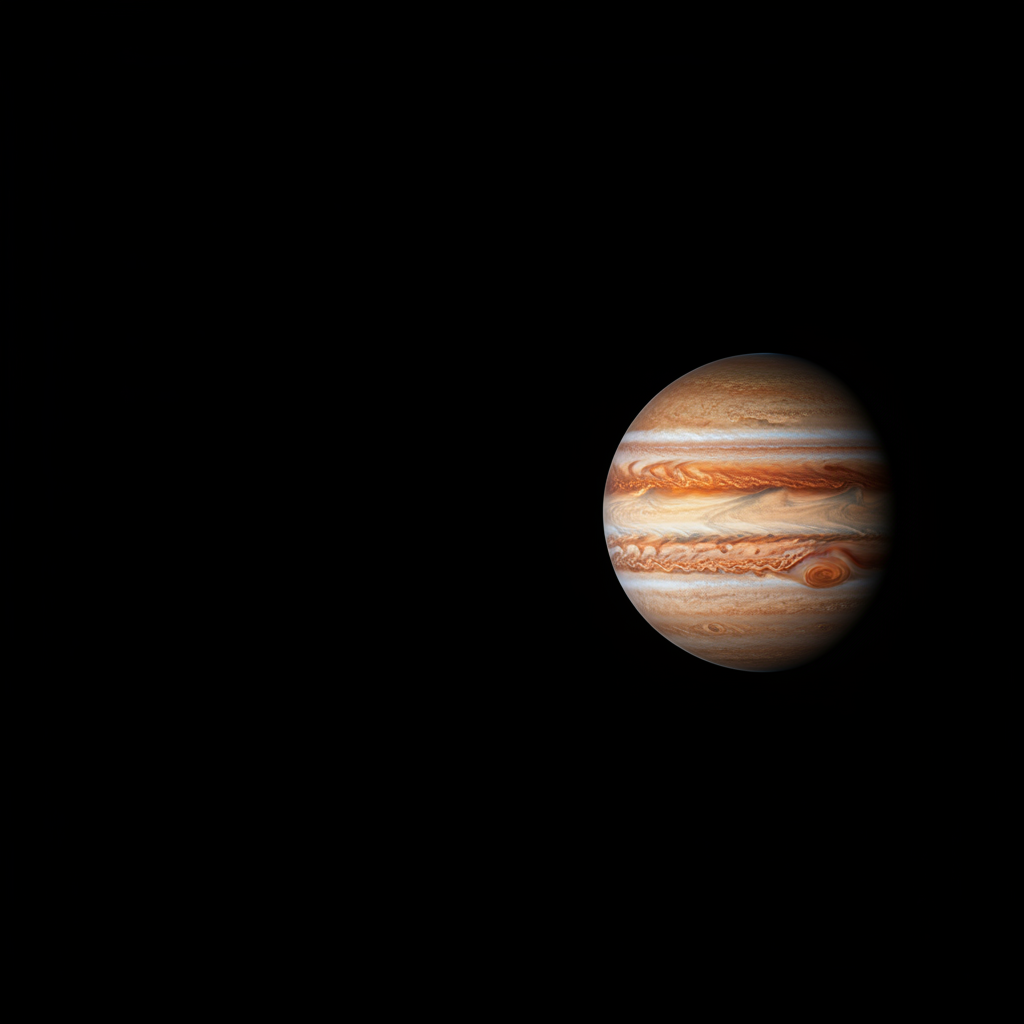
Introduction to Gas Giants
Gas giants are the largest planets in our solar system — and among the most influential. Jupiter, with a mass 318 times that of Earth, and Saturn, at 95 Earth masses, together account for more than 90% of all planetary mass in the solar system. Their gravitational dominance has sculpted the architecture of every other world, from the asteroid belt to the Kuiper Belt.
Unlike the rocky terrestrial planets, gas giants formed beyond the frost line — the distance from the young Sun where water, ammonia, and methane could freeze into solid ice. This extra reservoir of icy material allowed planetary cores to grow large enough to gravitationally capture hydrogen and helium gas from the solar nebula in vast quantities, rapidly building into giants.
Despite their name, gas giants are not simply balls of gas. Under immense pressure, hydrogen transitions through exotic states — from gas to liquid, and finally to metallic liquid hydrogen that conducts electricity and generates powerful magnetic fields. Jupiter's magnetic field is the strongest of any planet, 20,000 times more powerful than Earth's.
The moons of gas giants are worlds in their own right. Jupiter's Galilean moons include Ganymede (larger than Mercury), icy Europa (harboring a subsurface ocean), volcanic Io (the most volcanically active body in the solar system), and ancient Callisto. Saturn's Titan has a thick nitrogen atmosphere with methane lakes, while Enceladus vents water from an active subsurface ocean.
Physical Characteristics
Gas giants share several defining traits that distinguish them from smaller planets, though Jupiter and Saturn each have unique properties.
Gas Giant Quick Facts
- Composition: ~75% hydrogen, ~24% helium, traces of methane/ammonia
- Jupiter Diameter: 142,984 km (11.2× Earth)
- Saturn Diameter: 116,460 km (9.1× Earth)
- Jupiter Mass: 318 Earth masses
- Saturn Mass: 95 Earth masses
- Jupiter Moons: 95 confirmed; Saturn: 146 confirmed
Data: NASA Jupiter Overview
Both planets rotate very rapidly — Jupiter completes one rotation in just under 10 hours (the fastest of any planet), while Saturn rotates in about 10.5 hours. This rapid rotation causes significant equatorial bulging: Jupiter's equatorial diameter is 9,275 km larger than its polar diameter, giving it a noticeably flattened appearance. Saturn is even more oblate.
Saturn is notably the least dense planet in the solar system, with an average density of only 0.69 g/cm³ — less than water. If you could find a bathtub large enough, Saturn would float. This low density reflects the high proportion of hydrogen and helium in its composition, with relatively little rock or metal.
Jupiter — King of the Planets
Jupiter is the largest planet in the solar system, so massive that it barely qualifies as a planet rather than a failed star — if it were about 80 times more massive, it would have initiated hydrogen fusion and become a red dwarf. Its gravitational influence is felt throughout the solar system, and it may have played a crucial role in making Earth habitable by deflecting or capturing many large asteroid and comet impactors.
Atmosphere and Bands
Jupiter's visible atmosphere is organized into alternating light zones and dark belts running parallel to the equator. These bands are driven by powerful east-west jet streams. The lighter zones are regions of rising gas, while the darker belts are areas of sinking gas. Wind speeds between adjacent bands can differ by up to 150 m/s (540 km/h), creating powerful shear zones where storms develop.
Magnetosphere
Jupiter generates the largest magnetic field of any planet — extending outward to cover a region larger than the Sun. This magnetosphere is generated by convection of metallic liquid hydrogen in Jupiter's deep interior. It traps charged particles from the solar wind in intense radiation belts that would be lethal to unprotected spacecraft. Jupiter's aurora at its poles are hundreds of times more energetic than Earth's northern lights.
Juno Mission
NASA's Juno spacecraft, which has been orbiting Jupiter since 2016, has revealed that Jupiter's cloud bands extend deep into the atmosphere — about 3,000 km down — and that the planet's interior structure is more complex than expected, with a fuzzy, diffuse core rather than a distinct rocky center.
The Great Red Spot
The Great Red Spot (GRS) is the most iconic feature of Jupiter — a colossal anticyclonic storm in the planet's southern hemisphere that has raged for at least 350 years. Wind speeds within the storm reach 640 km/h at its outer edge, and the entire storm rotates counterclockwise with a period of about 6 days.
Size and Changes
In the 19th century, the GRS was large enough to contain three Earths. Today it has shrunk considerably — currently about 1.3 times Earth's diameter — and changed shape from oval to more circular. The cause of its reddish color is not fully understood, but may involve complex organic chemistry or sulfur compounds at high altitudes being exposed to UV radiation.
Smaller Storms
Jupiter also hosts many smaller storms, including Oval BA (nicknamed "Red Spot Jr."), which formed in 2000 when three white oval storms merged and later turned red. These storms can last decades and serve as natural laboratories for studying atmospheric dynamics on giant planets.
Saturn — The Ringed Wonder
Saturn is the second-largest planet and one of the most visually stunning objects in the solar system. Its rings, visible even in small telescopes, have captivated observers since Galileo first noticed Saturn's unusual shape in 1610 (though he could not resolve the rings). Saturn orbits the Sun at 9.58 AU with a year lasting 29.5 Earth years.
Atmosphere and Hexagonal Storm
Saturn's atmosphere shows similar banding to Jupiter but is less vivid due to a thicker haze layer. Saturn's most distinctive atmospheric feature is its polar hexagon — a persistent six-sided jet stream pattern at the north pole approximately 25,000 km across. First discovered by Voyager and confirmed by Cassini, this remarkable geometric pattern has been stable for decades.
Cassini Mission
NASA's Cassini spacecraft orbited Saturn from 2004 to 2017, returning revolutionary discoveries about the planet, its rings, and its moons. Cassini found that Saturn's rings are surprisingly young (perhaps 100 million years old), discovered active water vapor geysers on Enceladus, and characterized Titan's complex methane cycle. Cassini ended its mission by diving into Saturn's atmosphere in September 2017.
Saturn's Ring System
Saturn's rings are among the solar system's most spectacular features — a vast, thin disk of ice and debris spanning roughly 280,000 km from the planet's center but only 10–100 meters thick. The rings are divided into named sections based on composition and density.
Main Ring Divisions
Moving outward from Saturn: the D ring (faint, innermost), C ring (moderately bright), B ring (the brightest and most massive, containing most of the ring material), the Cassini Division (a 4,800 km gap kept clear by orbital resonance with the moon Mimas), and the A ring. Beyond the main rings lie the F, G, and E rings, each with distinct properties. The E ring is fed by material from Enceladus's geysers.
Ring Composition and Origin
Ring particles range from microscopic ice grains to boulders several meters wide, composed primarily of water ice. The rings are surprisingly young — Cassini data suggests they formed within the last 100 million years, long after the dinosaurs roamed Earth. They may have formed when a moon the size of Mimas was torn apart by Saturn's gravity (Roche limit disruption) or from a comet or asteroid capture event.
Notable Moons
The gas giants host the largest and most diverse collection of moons in the solar system, several of which are prime targets in the search for extraterrestrial life.
Jupiter's Galilean Moons
Io is the most volcanically active world in the solar system, with over 400 active volcanoes driven by tidal heating from Jupiter's gravity. Plumes reach 500 km high. Europa has a smooth icy surface hiding a global liquid water ocean 100 km deep, heated by tidal friction — considered one of the best candidates for extraterrestrial life. NASA's Europa Clipper mission launched in 2024. Ganymede is the largest moon in the solar system (5,268 km diameter), larger than Mercury, with its own magnetic field. Callisto is the most cratered object in the solar system, preserving a record of heavy bombardment 4 billion years ago.
Saturn's Major Moons
Titan is the second-largest moon in the solar system, with a nitrogen atmosphere 1.5 times denser than Earth's and lakes of liquid methane and ethane near its poles. The Dragonfly mission (launching 2028) will send a rotorcraft to Titan's surface. Enceladus is a small icy moon with active geysers venting water vapor, ice particles, and organic molecules from a subsurface ocean — discovered by Cassini. Mimas, with its giant Herschel crater, resembles the Death Star from Star Wars.
How Gas Giants Formed
Gas giants formed beyond the frost line through a process fundamentally different from terrestrial planet formation, taking place within the first few million years of the solar system before the solar nebula dissipated.
Core Accretion Model
The leading theory, core accretion, proposes that gas giants began as rocky and icy planetary cores — similar to terrestrial planets but larger (10–15 Earth masses). Beyond the frost line, solid material was far more abundant because ices could condense alongside rock, providing more building material. Once the core reached a critical mass, its gravity rapidly captured enormous amounts of hydrogen and helium gas from the surrounding solar nebula within just 1–3 million years.
Grand Tack Hypothesis
Jupiter may have migrated inward toward the Sun in its early history — almost reaching where the asteroid belt is today — before Saturn's gravity pulled it back outward. This "Grand Tack" scenario explains several features of the solar system, including the relatively small mass of Mars and the composition of the asteroid belt.
Interesting Facts About Gas Giants
- Jupiter as Solar System Protector: Jupiter's powerful gravity has diverted thousands of comets and asteroids away from the inner solar system over billions of years, reducing the impact rate on Earth and potentially making complex life possible.
- Saturn Would Float on Water: Saturn's average density (0.69 g/cm³) is lower than that of water (1.0 g/cm³). If you could place Saturn in a large enough ocean, it would float — it is the least dense planet in the solar system.
- Jupiter Radiates More Heat Than It Receives: Jupiter emits about 1.7 times more energy than it receives from the Sun. This excess heat comes from slow gravitational contraction — Jupiter is still very slowly shrinking, converting gravitational potential energy to heat.
- Diamond Rain on Saturn: Scientists believe that lightning storms in Saturn's upper atmosphere convert methane into carbon soot, which solidifies into graphite and then diamond as it sinks through increasing pressure. Diamonds may "rain" toward Saturn's core and eventually dissolve in the hot interior.
- Saturn's Rings Are Vanishing: Saturn's rings are slowly being lost. Ring material is being drawn into Saturn's atmosphere at a rate of up to 10,000 kg per second. At this rate, the rings will be entirely gone within 300 million years — meaning humans are lucky to live when they exist.
- Io Has No Impact Craters: Despite being in a region bombarded by meteoroids, Io has essentially no impact craters — its entire surface is continuously resurfaced by volcanic lava flows, burying any craters almost as fast as they form.
- Jupiter's Day Is Short: Despite being 11 times Earth's diameter, Jupiter completes one rotation in just 9 hours 55 minutes — the shortest day of any planet. This rapid spin creates powerful Coriolis forces that stretch storms into horizontal bands.
- Europa's Ocean Is Larger Than Earth's: Europa's subsurface ocean is estimated to contain twice as much liquid water as all of Earth's oceans combined, despite Europa being smaller than Earth's Moon. This vast ocean, kept liquid by tidal heating, is one of the most exciting targets in astrobiology.
External Resources
- NASA Jupiter Overview - Juno mission results and Jupiter science
- NASA Saturn Overview - Cassini mission findings and Saturn science
- NASA Europa Clipper Mission - Upcoming mission to Jupiter's icy moon Europa
- NASA Titan Overview - Saturn's moon with thick atmosphere and methane lakes
Frequently Asked Questions
What makes a planet a gas giant?
A gas giant is a large planet composed primarily of hydrogen and helium, with no solid surface to stand on. Jupiter and Saturn are the two gas giants in our solar system. Their massive size and composition set them apart from the rocky terrestrial planets and the methane-rich ice giants. Gas giants likely have dense rocky or metallic cores surrounded by layers of metallic hydrogen, liquid hydrogen, and finally a thick gaseous atmosphere.
Does Jupiter have a solid surface?
Jupiter has no solid surface. As you descend through its atmosphere, the gas gradually transitions into liquid under immense pressure, but there is no sharp boundary like a ground. Deep in Jupiter's interior, hydrogen is compressed into a metallic liquid state that conducts electricity. There may be a dense rocky or metallic core at the very center, but it would be surrounded by thousands of kilometers of crushing fluid.
How long has the Great Red Spot existed?
The Great Red Spot is an anticyclonic storm in Jupiter's atmosphere that has been observed continuously since at least 1831, and possibly since Giovanni Cassini first documented a similar feature in 1665 — meaning it may have persisted for over 350 years. It is currently about 1.3 times the width of Earth, though it has been shrinking and changing shape over recent decades. Scientists study it to understand the dynamics of long-lived atmospheric vortices.
What are Saturn's rings made of?
Saturn's rings are composed primarily of water ice particles ranging in size from tiny grains to chunks several meters across, with a small amount of rocky debris. The rings span about 280,000 km in diameter but are remarkably thin — typically only 10 to 100 meters thick. The rings are thought to be relatively young in astronomical terms, perhaps only 100 million years old, possibly formed from the break-up of a former moon or comet.
How many moons does Jupiter have?
As of 2024, Jupiter has 95 confirmed moons — more than any other planet. The four largest, known as the Galilean moons (Io, Europa, Ganymede, and Callisto), were discovered by Galileo Galilei in 1610. Ganymede is the largest moon in the solar system, bigger than the planet Mercury. Europa is one of the most promising places to search for extraterrestrial life due to its subsurface liquid water ocean beneath an icy crust.
Could gas giants have moons with life?
Several moons of gas giants are considered promising candidates for extraterrestrial life. Jupiter's Europa almost certainly harbors a liquid water ocean beneath its icy surface, heated by tidal friction from Jupiter's gravity. Saturn's Enceladus actively vents water vapor and organic molecules from subsurface oceans, and its plumes have already been sampled by the Cassini spacecraft. Saturn's Titan has a thick nitrogen atmosphere and liquid methane lakes, potentially supporting exotic chemistry.