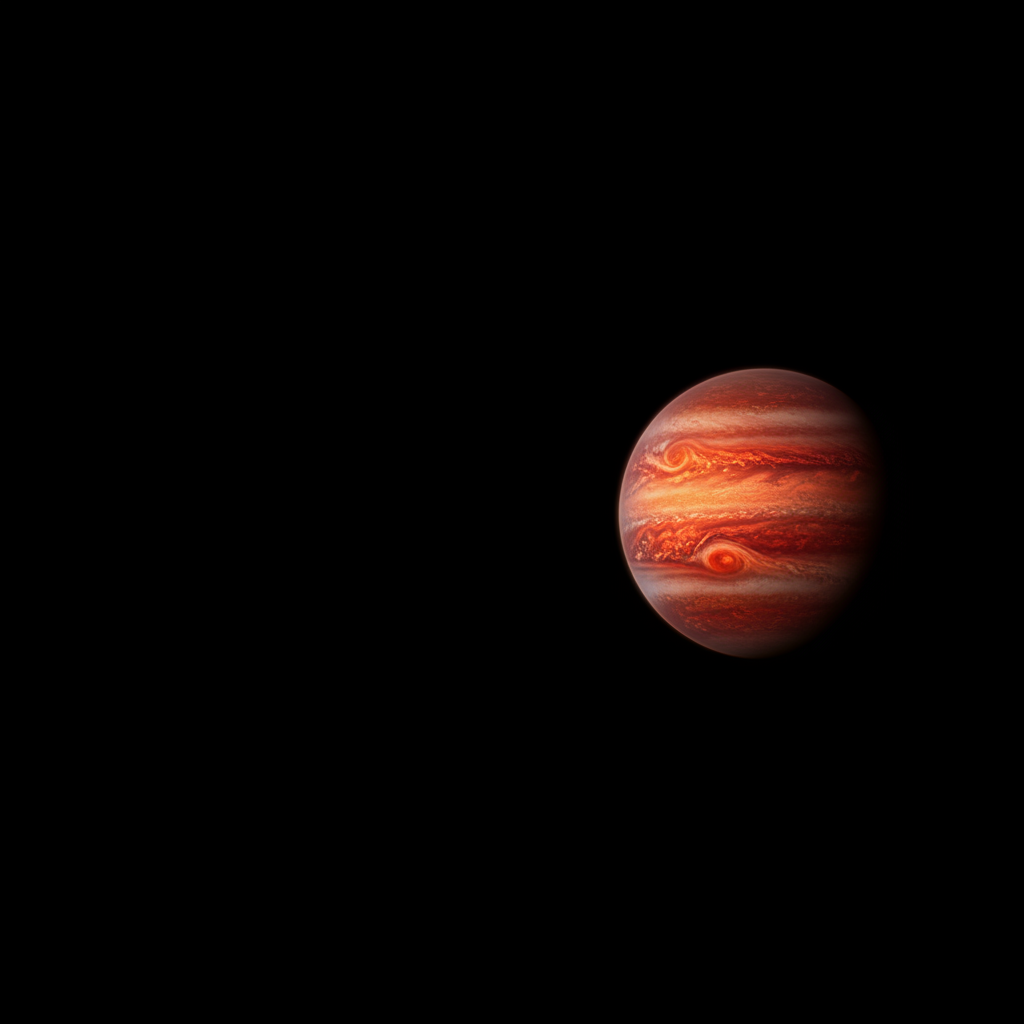
Introduction to Hot Jupiters
Hot Jupiters are among the most dramatic planets ever discovered — gas giants the size of Jupiter or larger, yet orbiting their host stars at a tiny fraction of Mercury's distance from the Sun. Their discovery in 1995 sent shockwaves through planetary science, overturning decades of theory about where and how giant planets form. They remain among the most intensively studied exoplanets today because their extreme properties make them ideal laboratories for atmospheric physics.
A hot Jupiter orbits its star in less than 10 days, compared to Jupiter's 12-year orbit. At these distances, the planet receives thousands of times more stellar radiation than Earth does from the Sun. Day-side temperatures exceed 1,000°C on typical hot Jupiters and can reach 3,000°C on the hottest examples — hotter than the surfaces of some stars. The night side, permanently shadowed, may be hundreds or thousands of degrees cooler.
Hot Jupiters are comparatively rare — surveys suggest they occur around only about 0.5–1% of Sun-like stars. Yet they have played an outsized role in exoplanet science because their large size, close orbits, and high temperatures make them far easier to detect and characterize than other exoplanet types. Almost everything we know about exoplanet atmospheres — composition, wind patterns, temperature maps — was first learned from hot Jupiters.
The very existence of hot Jupiters challenged the "minimum mass solar nebula" models of planet formation that predicted giant planets could only form beyond the frost line. Their discovery triggered the development of planetary migration theory — the idea that giant planets form far from their stars and then move inward through interactions with the protoplanetary disk. This theoretical revolution had profound implications for understanding the architecture of all planetary systems, including our own.
Physical Properties
Hot Jupiters share several defining characteristics that distinguish them from both gas giants at normal distances and from smaller close-in planets.
Hot Jupiter Quick Facts
- Orbital Period: Less than 10 days (typically 1–5 days)
- Orbital Distance: 0.015–0.05 AU from host star
- Typical Temperature: 1,000–3,000 K (day side)
- Mass Range: 0.3–13 Jupiter masses
- Radius: Often inflated beyond Jupiter (1.0–2.0 R♃)
- Frequency: ~0.5–1% of Sun-like stars
Data: NASA Exoplanet Exploration — Hot Jupiters
The defining feature of many hot Jupiters is "radius inflation" — their observed radii are significantly larger than models of isolated gas giants predict for their mass. Jupiter-like objects should have radii close to Jupiter's (~71,492 km), yet many hot Jupiters have radii 1.5 to 2 times larger. The cause is the intense stellar irradiation heating their atmospheres and slowing atmospheric cooling, keeping the planet bloated. The more extreme the irradiation, the more inflated the planet tends to be.
Despite their extreme temperatures, hot Jupiters are in many ways similar to our Jupiter in bulk composition — mostly hydrogen and helium. However, the irradiation drives exotic atmospheric chemistry. Molecules like water, methane, sodium, and potassium behave very differently at 1,500 K than at Jupiter's 165 K cloud tops. At very high temperatures, molecules dissociate into atoms, and on the hottest hot Jupiters, hydrogen molecules are dissociated on the day side and reform on the night side — releasing or absorbing substantial energy that helps drive atmospheric circulation.
51 Pegasi b — The First of Its Kind
The discovery of 51 Pegasi b on October 6, 1995 by Michel Mayor and Didier Queloz at the Haute-Provence Observatory is one of the most consequential moments in the history of astronomy. Using the radial velocity method, they detected a planet with approximately half Jupiter's mass orbiting the Sun-like star 51 Pegasi (51 light-years from Earth) every 4.23 days — placing it just 0.052 AU from its star.
Initial Skepticism
The result was initially met with skepticism. Planet formation theory at the time held that gas giants could only form beyond the frost line (~4 AU), where there was enough solid material (including ices) to build a rocky core massive enough to capture gas. Finding a Jupiter-mass object in a 4-day orbit seemed impossible — planet formation models could not explain it. Some astronomers speculated the signal came from stellar pulsations rather than a planet.
Confirmation and Nobel Prize
The discovery was confirmed within weeks by Geoffrey Marcy and Paul Butler, who used their own radial velocity program to verify the signal. 51 Pegasi b (now informally nicknamed Dimidium) became the template for the entire hot Jupiter class. Mayor and Queloz were awarded the Nobel Prize in Physics in 2019 for this discovery, which "transformed our conception of the cosmos."
Tidal Locking
Hot Jupiters are almost certainly tidally locked — rotating synchronously with their orbital motion so that the same hemisphere always faces the star. This is the same phenomenon that keeps the Moon always showing the same face to Earth, but extreme: while it took the Moon billions of years to synchronize, a hot Jupiter tidally locks within millions of years due to the far stronger tidal forces at such close orbital distances.
Day-Night Temperature Contrast
Tidal locking creates a permanent dayside receiving constant intense stellar radiation and a permanent nightside in perpetual darkness. The temperature difference between the two hemispheres can be dramatic — on some hot Jupiters, the dayside reaches 3,000 K while the nightside is 1,000 K cooler. This temperature gradient drives powerful atmospheric winds that attempt to redistribute heat from day to night side.
Mapping Atmospheres
By measuring how a hot Jupiter's total infrared brightness changes as it orbits — sometimes showing its hot dayside, sometimes its cooler nightside — astronomers can create "thermal maps" of the atmosphere. The Spitzer Space Telescope pioneered this technique, revealing that many hot Jupiters have hot spots slightly offset from the substellar point by their wind patterns. JWST has extended this mapping to spectacular precision, directly observing temperature variations and wind speeds.
Inflated and Exotic Atmospheres
Hot Jupiter atmospheres are among the most extensively studied of any exoplanet type, and they reveal exotic phenomena impossible to observe anywhere in our solar system.
Atmospheric Escape
The intense stellar irradiation heats hot Jupiter upper atmospheres to temperatures where hydrogen atoms travel fast enough to escape the planet's gravity — a process called photoevaporation or Jeans escape. Several hot Jupiters have been observed to have extended hydrogen "comet tails" trailing behind them as their atmospheres stream away into space. This atmospheric loss may slowly erode hot Jupiters over billions of years, potentially transforming them into smaller, denser remnants.
Molecular Detections
JWST and the Hubble Space Telescope have detected an extraordinary variety of molecules in hot Jupiter atmospheres: water vapor, carbon dioxide, carbon monoxide, methane, sodium, potassium, titanium oxide, and even heavy metals like iron and vanadium in the most extreme cases. In 2022, JWST's first exoplanet spectrum — of WASP-39b — detected SO₂ (sulfur dioxide) produced by photochemistry, demonstrating the telescope's unmatched sensitivity for atmospheric characterization.
WASP-12b — Being Consumed
WASP-12b is the most extreme hot Jupiter known in terms of stellar proximity. Discovered in 2008, it orbits its F-type star in just 1.09 days at a distance of only 3.4 million km — about 40 times closer than Mercury's distance from the Sun. Its day-side temperature reaches approximately 2,900 K (2,600°C), hot enough to destroy most molecules.
Tidal Disruption in Progress
WASP-12b orbits so close that its host star's tidal forces are actively distorting the planet's shape into an ellipsoid and pulling material off its atmosphere. The planet is losing mass at roughly 6 × 10⁸ kg per second — the equivalent of Earth's mass every few tens of millions of years. At current rates, WASP-12b will be completely disrupted within approximately 3 million years, a cosmically short timescale. Observations have directly confirmed the orbital period is slowly decreasing as the planet spirals inward.
Ultra-Black Surface
Surprisingly, WASP-12b reflects almost no starlight — it absorbs more than 94% of incident radiation, making it one of the darkest known exoplanets. Its Bond albedo of ~0.064 is darker than coal. The extreme temperature has destroyed the reflective clouds and aerosols that would normally scatter starlight, leaving only light-absorbing atomic sodium and potassium in the upper atmosphere.
Planetary Migration
The existence of hot Jupiters requires that gas giant planets can migrate vast distances through a planetary system — from their formation sites beyond 4 AU to final positions within 0.05 AU. This migration must happen before the protoplanetary disk dissipates (within ~5 million years), and it must stop before the planet falls into the star.
Disk Migration
The leading mechanism is Type II migration: as a gas giant forms, it gravitationally clears a gap in the protoplanetary disk. The planet then spirals inward along with the disk material drifting toward the star through viscous dissipation. The planet migrates until either the disk dissipates, stopping the migration, or tidal interactions with the star begin pushing the planet outward — creating a "parking orbit."
High-Eccentricity Migration
An alternative pathway involves gravitational scattering: a gas giant is kicked into a highly elliptical orbit by another planet or stellar companion, and then tidal interactions with the star gradually circularize the orbit at a small semi-major axis over billions of years. This "high-e migration" could explain hot Jupiters with unusual orbital orientations (misaligned with the star's equator), which disk migration alone would not produce.
Detection and Study
Hot Jupiters are the easiest exoplanets to detect because of their large size, close orbits, and strong gravitational effect on their stars. The transit signal of a hot Jupiter can dim its star by 1–2% — easily measurable from the ground. The radial velocity signal can be up to 100 times larger than that of an Earth-mass planet.
Ground-based surveys like SuperWASP (Wide Angle Search for Planets), HATNet, and KELT have found hundreds of hot Jupiters by monitoring thousands of stars for transit signals. Space missions like Kepler, TESS, and CHEOPS have found hundreds more with even higher precision. For atmospheric characterization, the most powerful tools are transmission spectroscopy (analyzing starlight filtered through the atmosphere during transit) and emission spectroscopy (measuring the planet's own thermal emission during secondary eclipse), both done at infrared wavelengths.
Interesting Facts About Hot Jupiters
- Hotter Than Some Stars: The most extreme hot Jupiters — "ultra-hot Jupiters" — have day-side temperatures exceeding 3,000 K. This is hotter than red dwarf stars like Proxima Centauri (3,000 K surface temperature). At these temperatures, molecular hydrogen (H₂) dissociates into individual hydrogen atoms on the day side and recombines on the night side.
- 51 Peg b Triggered a Nobel Prize: The discovery of 51 Pegasi b in 1995 was so significant that it was specifically cited in the 2019 Nobel Prize in Physics citation awarded to Michel Mayor and Didier Queloz. The Nobel committee called it a discovery that "transformed our conception of the cosmos."
- WASP-12b Has 3 Million Years Left: WASP-12b is being tidally disrupted by its star and losing mass at a rate that will see it completely consumed within approximately 3 million years — a blink of an eye astronomically. Humans are lucky to exist during the brief window when this dramatic destruction can be observed.
- Some Have Wind Speeds of 10,000+ km/h: The temperature difference between day and night hemispheres drives powerful equatorial jets on hot Jupiters. Wind speeds of several kilometers per second — 10,000 to 20,000 km/h — have been inferred from Doppler-shifted molecular absorption lines, many times the fastest winds on any solar system planet.
- Iron Can Rain on Hot Jupiters: On the most extreme ultra-hot Jupiters, iron vaporizes on the day side, rises to high altitudes, flows to the night side in the upper atmosphere, and condenses — raining liquid iron droplets down through the cooler night-side atmosphere. Titanium behaves similarly. These metal "weather systems" are completely alien to any solar system planet.
- They Prevented Super-Earths in Early Searches: Because hot Jupiters were the easiest exoplanets to find, they dominated early exoplanet statistics, creating a misleading picture where Jupiter-sized planets at Earth-like distances seemed common. Kepler corrected this: hot Jupiters are actually rare compared to sub-Neptunes and super-Earths, which are far more common but harder to detect.
- Aligned vs. Misaligned Orbits: Some hot Jupiters have orbits tilted at large angles to their star's equatorial plane — even retrograde (orbiting in the opposite direction to the star's spin). Disk migration should produce aligned orbits; misaligned hot Jupiters may have arrived via the high-eccentricity scattering mechanism, recording the chaotic gravitational history of their early planetary systems.
- No Known Hot Jupiter in Our Solar System: Jupiter is at 5.2 AU from the Sun — 100 times farther than a typical hot Jupiter. If Jupiter had migrated inward in our solar system's early history, it would likely have destroyed or ejected the terrestrial planets, and Earth would not exist. We owe our existence partly to Jupiter remaining in the outer solar system.
External Resources
- NASA — Hot Jupiter Planet Type - Overview and examples of hot Jupiters
- NASA Exoplanet Archive - Search the full database of confirmed hot Jupiters
- JWST Exoplanet Atmospheres - WASP-39b and other hot Jupiter atmosphere results
- Hot Jupiter on Wikipedia - Comprehensive overview of formation, properties, and examples
Frequently Asked Questions
What is a hot Jupiter?
A hot Jupiter is a class of gas giant exoplanet with an orbital period shorter than about 10 days, placing it extremely close to its host star — typically 0.015–0.05 AU, compared to Jupiter's 5.2 AU. At these distances, the planet is intensely irradiated and heated to temperatures of 1,000–3,000 K. Hot Jupiters have masses and radii comparable to Jupiter but are "puffed up" — their atmospheres are expanded by stellar heating, making them less dense than their cooler counterparts.
How did 51 Pegasi b change our understanding of planets?
51 Pegasi b, discovered in 1995 by Michel Mayor and Didier Queloz using the radial velocity method, was the first exoplanet confirmed around a Sun-like star. Its properties — a Jupiter-mass planet in a 4.2-day orbit — were completely unexpected by the planet formation models of the time, which held that gas giants could only form far from their stars beyond the frost line. The discovery forced a fundamental revision: gas giants must migrate inward from their formation sites, and our solar system may be unusual rather than typical.
What is tidal locking in hot Jupiters?
A tidally locked planet always shows the same face to its star, just as our Moon always shows the same face to Earth. Hot Jupiters orbit so close that tidal forces synchronize their rotation with their orbital period within millions of years. The result is a permanent dayside (facing the star, extremely hot) and a permanent nightside (facing away, much cooler). The temperature difference between day and night sides — thousands of degrees on the most extreme hot Jupiters — drives powerful atmospheric circulation that astronomers can map by measuring changes in the planet's infrared brightness.
Why do hot Jupiters have inflated atmospheres?
Many hot Jupiters have radii significantly larger than expected for their mass — some are two to three times the radius of Jupiter despite having similar mass. This 'radius inflation' is caused by the intense stellar irradiation depositing energy into the planet's upper atmosphere, puffing it outward. The specific mechanism remains debated: possibilities include Ohmic dissipation (magnetic induction heating), atmospheric circulation depositing energy at depth, or simply reduced cooling from the heated day side. Jupiter-sized planets at Earth's distance from the Sun would not be inflated in this way.
Can hot Jupiters be destroyed by their stars?
Yes — hot Jupiters can be destroyed in several ways. WASP-12b is the most famous example: it orbits so close to its star (1.9-day period) that stellar tidal forces are actively pulling mass off the planet's upper atmosphere, and the planet will be completely consumed within about 3 million years. Hot Jupiters also lose atmosphere through photoevaporation — intense UV radiation from the star heats the outer atmosphere to escape velocity. Over billions of years, some hot Jupiters may be stripped down to their rocky or metallic cores, potentially explaining the population of 'hot Neptunes' and rocky close-in planets.
How do hot Jupiters form so close to their stars?
Hot Jupiters cannot form where they are currently found — the intense stellar irradiation and lack of material in the inner protoplanetary disk preclude giant planet formation there. Instead, they form beyond the frost line (as normal gas giants do) and then migrate inward through interactions with the protoplanetary disk (disk migration), or through gravitational scattering off other planets followed by tidal circularization. Disk migration is thought to be the dominant channel, occurring within the first few million years while the disk still exists, before the disk dissipates.