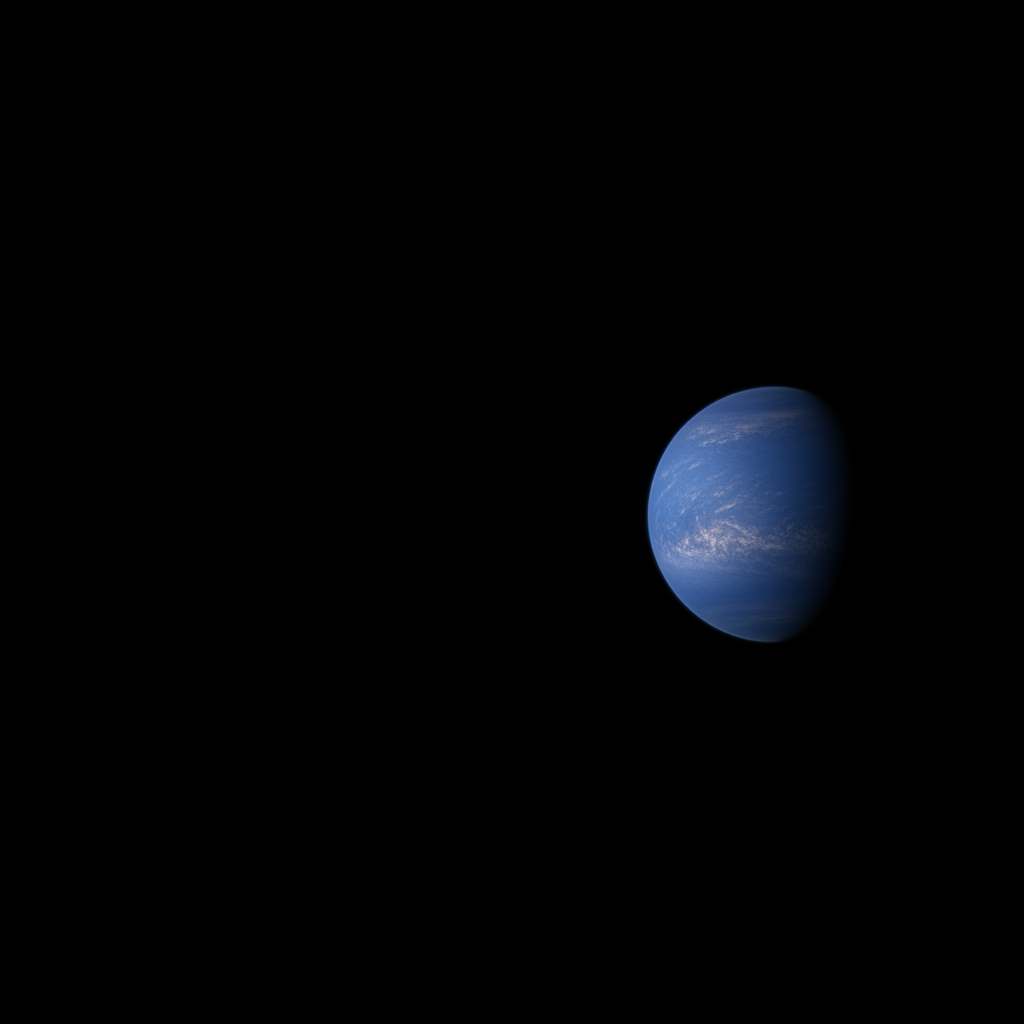
Introduction to Ice Giants
Ice giants represent a distinct and poorly understood class of planet. Superficially similar to the gas giants Jupiter and Saturn, Uranus and Neptune are actually fundamentally different in composition and internal structure. While gas giants are predominantly hydrogen and helium, ice giants are rich in "ices" — water, methane, and ammonia — in hot, dense fluid states that bear little resemblance to the everyday materials those words suggest.
Uranus and Neptune orbit in the cold outer solar system, at 19.2 and 30.1 AU from the Sun respectively. At those distances, sunlight is extremely faint — Neptune receives about 900 times less sunlight than Earth. Both planets are perpetually cold at their visible cloud tops, with temperatures around -200°C, yet both have complex, dynamic atmospheres with powerful storm systems.
Despite being neighbors in the outer solar system and sharing similar sizes and bulk compositions, Uranus and Neptune are strikingly different in several ways. Uranus is tilted almost entirely on its side (97.77° axial tilt) and emits almost no detectable internal heat. Neptune, meanwhile, has a modest axial tilt similar to Earth's (28.3°) and radiates 2.6 times more energy than it receives from the Sun, suggesting a hot interior. The origin of these differences remains an active area of research.
Both worlds remain among the least explored in the solar system — only one spacecraft, Voyager 2, has ever visited them, flying past Uranus in 1986 and Neptune in 1989. The ice giants are the highest-priority target for the next flagship planetary mission, and a dedicated Uranus orbiter has been recommended as the top large-mission priority by NASA's planetary science community.
Physical Characteristics
Uranus and Neptune are broadly similar in size and bulk composition, yet differ significantly in their behavior and internal heat output.
Ice Giant Quick Facts
- Uranus Diameter: 51,118 km (4× Earth)
- Neptune Diameter: 49,528 km (3.9× Earth)
- Uranus Mass: 14.5 Earth masses
- Neptune Mass: 17.1 Earth masses
- Uranus Axial Tilt: 97.77° (rotates on its side)
- Neptune Wind Speeds: Up to 2,100 km/h
Data: NASA Uranus Overview
Both planets have similar internal structures: a small rocky core, surrounded by a mantle of hot, dense water-ammonia-methane fluid, topped by a thick hydrogen-helium atmosphere with methane clouds. The "ice" in ice giant refers to these high-pressure fluid compounds, not frozen solids. Temperatures and pressures in the interior are enormous — pressures reach millions of bar and temperatures thousands of degrees Celsius.
Unlike gas giants, neither Uranus nor Neptune is thought to have a distinct layer of metallic hydrogen. Instead, their mantles of hot ionic fluid conduct electricity and generate magnetic fields, though both planets have strange, highly tilted magnetic fields offset from their rotation axes — suggesting complex internal dynamics unlike any other planets.
Uranus — The Sideways Planet
Uranus is the third-largest planet by diameter and fourth by mass. It orbits at 19.2 AU with a year of 84 Earth years. Its most extraordinary feature is its 97.77° axial tilt — Uranus essentially rolls around the Sun on its side, with its rings and moons orbiting around its equator like a bulls-eye when seen from Earth.
Extreme Seasons
This extreme tilt creates the most unusual seasons of any planet. Each pole experiences 42 years of continuous sunlight followed by 42 years of darkness. During solstice, one pole points almost directly at the Sun while the other sits in perpetual night. Surprisingly, despite the dramatic difference in insolation, Uranus's poles are not significantly warmer than its equator — another mystery for planetary scientists.
The Thermal Mystery
Most planets radiate more heat than they receive from the Sun, indicating hot interiors from their formation and radioactive decay. Uranus is the exception — it emits almost no internal heat. The leading hypothesis involves a density discontinuity deep in Uranus's interior that acts as a barrier, preventing internal heat from convecting to the surface and escaping. The nature of this barrier is unknown.
Atmosphere and Clouds
Uranus appears as a featureless pale blue-green disc to most Earth-based telescopes, largely because its cloud deck is suppressed below a thick hydrocarbon haze. Hubble Space Telescope and Keck Observatory observations have revealed bright cloud bands and storms during Uranus's equinox periods, when solar heating becomes more symmetrical. Uranus's cloud top temperature is -224°C — the coldest planetary atmosphere in the solar system.
Neptune — The Windy World
Neptune is the outermost planet in the solar system, orbiting at 30.1 AU, so far that sunlight takes over 4 hours to reach it. One Neptunian year lasts 165 Earth years — Neptune completed its first full orbit since its discovery in 1846 only in 2011. Despite receiving so little solar energy, Neptune is an extraordinarily dynamic world, hosting the fastest sustained winds of any planet.
Supersonic Winds and the Great Dark Spot
Neptune's winds reach 2,100 km/h — faster than the speed of sound on Earth — and blow westward, opposite to the planet's eastward rotation. When Voyager 2 flew past in 1989, it observed a Great Dark Spot — an anticyclonic storm the size of Earth in Neptune's southern hemisphere, similar to Jupiter's Great Red Spot. By 1994, Hubble Space Telescope found the original spot had vanished and a new one had formed in the northern hemisphere, demonstrating that Neptune's atmosphere changes dramatically over years.
Internal Heat
Neptune radiates 2.61 times more energy than it receives from the Sun. This substantial internal heat source drives Neptune's vigorous atmospheric dynamics despite the extreme cold. The heat comes from the slow gravitational contraction and differentiation of its interior — processes that began 4.5 billion years ago and continue today. Neptune's internal heat likely explains its far more active weather compared to the relatively calm Uranus.
Why Ice Giants Are Blue
Both Uranus and Neptune display blue-green to azure coloration from Earth. The fundamental cause is methane (CH₄) in their upper atmospheres. Methane is an efficient absorber of red and infrared wavelengths of light. When sunlight enters the atmosphere, red wavelengths are absorbed by methane while blue and green wavelengths scatter back toward space, producing the characteristic color.
However, Uranus appears pale blue-green while Neptune is a much deeper azure blue — despite both having similar methane concentrations. The difference likely involves other chemical species in Neptune's atmosphere that enhance the blue color, possibly as-yet unidentified chromophores (color-producing compounds). The specific atmospheric chemistry responsible for Neptune's deeper blue color remains under investigation.
Notable Moons
Triton — Neptune's Captured Moon
Triton is Neptune's largest moon and one of the most fascinating objects in the solar system. It orbits in a retrograde direction (opposite to Neptune's spin), at a 157° inclination — strong evidence that it was captured from the Kuiper Belt rather than forming alongside Neptune. Triton is the only large moon in the solar system with a retrograde orbit.
Despite surface temperatures of -235°C (the coldest measured surface in the solar system), Triton is geologically active. Voyager 2 observed nitrogen geysers erupting 8 km high, powered by sublimation of nitrogen ice heated by the faint sunlight. Triton's orbit is slowly decaying due to tidal interaction with Neptune; in approximately 3.6 billion years it will cross the Roche limit and be torn apart into a ring system.
Uranus's Moons
Uranus has 28 confirmed moons, all named after characters from Shakespeare plays and Alexander Pope's poem The Rape of the Lock. The five major moons — Miranda, Ariel, Umbriel, Titania, and Oberon — are intriguing worlds. Miranda in particular has one of the most unusual landscapes in the solar system, with enormous canyons (Verona Rupes is up to 20 km deep) and chaotic terrain that may result from a catastrophic impact or geological upheaval.
Ring Systems
Both ice giants have ring systems, though far less spectacular than Saturn's. Uranus's rings were discovered in 1977 when Uranus passed in front of a background star and astronomers noticed dips in the star's brightness on both sides — caused by rings blocking starlight before and after occultation. Uranus has 13 known rings, the brightest being the epsilon ring. Unlike Saturn's bright icy rings, Uranus's rings are composed of very dark material (likely organic compounds or carbon) and are difficult to observe.
Neptune's rings were partially detected from Earth before Voyager 2 confirmed their full extent. Neptune has 5 main rings, the outermost of which — the Adams ring — has distinct clumping of material into arc-like structures (Liberté, Egalité, Fraternité, Courage) that persist due to orbital resonances with the moon Galatea. These arcs are unique in the solar system and represent an unusual dynamical state.
Exploration of the Ice Giants
Uranus and Neptune are among the least explored planets, visited only by Voyager 2's brief flybys in 1986 and 1989 respectively. These encounters, while groundbreaking, provided only snapshots of each world. Given the 84-year orbital period of Uranus, seasonal changes observed since Voyager require dedicated follow-up missions.
NASA's Planetary Science Decadal Survey 2023–2032 ranked an Uranus orbiter and atmospheric probe as the highest-priority large flagship mission. Such a mission would study Uranus's internal structure, magnetic field, atmosphere, rings, and moons in detail comparable to what Cassini did for Saturn. Travel time to Uranus is roughly 13 years, so launch windows in the late 2020s to early 2030s are critical to intercept beneficial gravity assists from Jupiter.
Interesting Facts About Ice Giants
- Uranus Rolls Around the Sun: With a 97.77° tilt, Uranus essentially rotates on its side. Its north pole points almost at the Sun during northern solstice. This means Uranus's poles receive more total sunlight than its equator over its 84-year orbit.
- Neptune Discovered by Math: Neptune was the first planet found through mathematical prediction rather than direct observation. Astronomers Urbain Le Verrier and John Adams independently predicted its position based on gravitational perturbations of Uranus's orbit. Neptune was observed in 1846 within 1° of Le Verrier's prediction.
- Diamond Rain: Scientists have experimentally confirmed that under the extreme pressures inside Uranus and Neptune, carbon can crystallize into diamond and "rain" toward the interior. Laser experiments replicating ice giant interior conditions produced tiny diamonds within nanoseconds.
- Uranus is the Coldest Planet: Despite not being the outermost planet, Uranus holds the record for the coldest measured atmospheric temperature: -224°C (-371°F). This results from its lack of internal heat emission rather than just distance from the Sun.
- Triton Will Become a Ring: Triton is the only large retrograde moon in the solar system and is slowly spiraling inward toward Neptune. In about 3.6 billion years, it will cross Neptune's Roche limit and be shredded into a spectacular ring system that could rival Saturn's.
- Neptune's Year Just Completed: Neptune was discovered in 1846. It completed its first full orbit since discovery in July 2011 — 165 years later. A baby born on the day of Neptune's discovery would need to live to 165 to witness a complete Neptunian year.
- Magnetic Fields Are Weirdly Tilted: Both Uranus and Neptune have highly unusual magnetic fields offset significantly from their rotation axes and from each other. Uranus's magnetic field is tilted 59° from its rotation axis; Neptune's is tilted 47°. The origin of these anomalous fields may involve fluid dynamics in their mantles unlike anything in other planets.
- Neptune and Pluto Cross Orbits: For about 20 years out of every 248-year Pluto orbit, Pluto is actually closer to the Sun than Neptune. However, an orbital resonance (3:2) ensures they never come close to each other — Neptune completes exactly 3 orbits for every 2 Pluto orbits, keeping them perpetually separated.
External Resources
- NASA Uranus Overview - Facts, missions, and Uranus science
- NASA Neptune Overview - Neptune facts, Voyager 2 findings, Triton
- NASA Triton Overview - Neptune's extraordinary captured moon
- Planetary Society — Uranus Orbiter - Next flagship ice giant mission details
Frequently Asked Questions
What is an ice giant and how is it different from a gas giant?
Ice giants are a distinct class of planet from gas giants. While gas giants like Jupiter and Saturn are composed mainly of hydrogen and helium gas, ice giants like Uranus and Neptune contain a much higher proportion of "ices" — compounds like water, methane, and ammonia in hot, dense fluid states (not literally frozen). Ice giants are also significantly smaller and denser than gas giants. Their blue-green color comes from methane in the atmosphere absorbing red light.
Why is Uranus tilted on its side?
Uranus has an axial tilt of 97.77°, meaning it essentially rotates on its side with its poles pointing roughly toward the Sun. The leading explanation is a massive collision with an Earth-sized protoplanet early in solar system history that knocked Uranus onto its side. This extreme tilt creates the most extreme seasons of any planet — each pole spends 42 years in continuous sunlight followed by 42 years in darkness.
Why does Uranus emit almost no internal heat?
This is one of the great mysteries of planetary science. Neptune, which is similar in size and composition, radiates 2.6 times more energy than it receives from the Sun, suggesting a hot interior. Uranus, however, emits almost no detectable internal heat — its internal temperature appears to match what solar heating alone would produce. One hypothesis is that a layer of high-density material deep in Uranus's interior acts as a thermal blanket, trapping internal heat and preventing it from escaping to the surface.
What are the winds like on Neptune?
Neptune has the fastest planetary winds in the solar system, reaching speeds of up to 2,100 km/h (1,300 mph) — faster than the speed of sound on Earth. These winds blow in the opposite direction of the planet's rotation (retrograde winds), which is unusual. Neptune also had a Great Dark Spot — a storm the size of Earth observed by Voyager 2 in 1989 — that had disappeared by 1994, showing Neptune's atmosphere is more dynamic than initially thought.
What is special about Neptune's moon Triton?
Triton is extraordinary for several reasons. It orbits Neptune in a retrograde direction (opposite to Neptune's rotation), strongly suggesting it is a captured Kuiper Belt Object — not a moon that formed alongside Neptune. Triton is also geologically active, with nitrogen geysers erupting from its surface despite its extremely cold surface temperature of -235°C. Triton is slowly spiraling inward toward Neptune and will either be torn apart into a ring system or crash into Neptune in about 3.6 billion years.
Have any spacecraft visited Uranus or Neptune?
Only one spacecraft has visited each of them: NASA's Voyager 2, which flew past Uranus in January 1986 and Neptune in August 1989. These remain the only close encounters with either planet. Voyager 2 discovered Uranus's 10 new moons, confirmed Neptune's Great Dark Spot, and found Triton's active geysers. As of 2026, no new missions have reached the ice giants, though NASA's Planetary Science Decadal Survey (2023–2032) ranked an Uranus orbiter and probe as the highest-priority large mission.