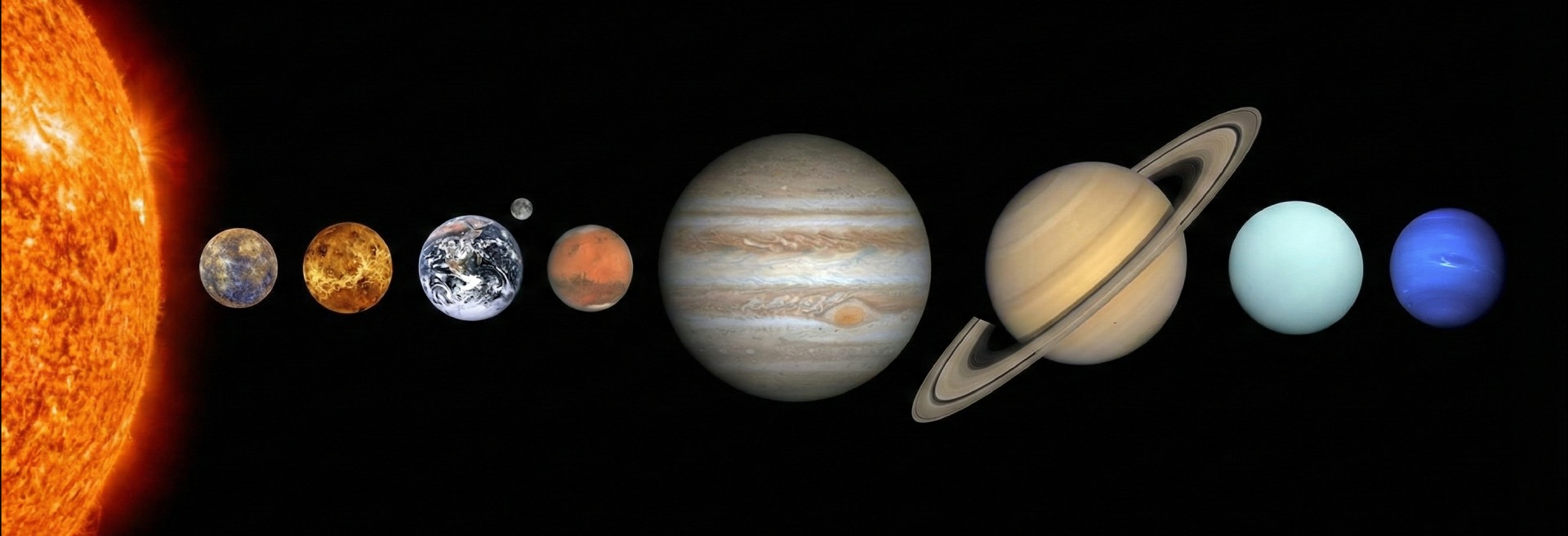
Explore the Planets
Click any planet to discover its unique features, mysteries, and exploration history

What is the Solar System?
The Solar System is the gravitationally bound system of the Sun and the objects that orbit it. Located in the Orion Arm of the Milky Way galaxy, approximately 26,000 light-years from the galactic center, our Solar System is one of countless planetary systems scattered throughout the universe.
Our cosmic neighborhood extends far beyond the familiar planets. The Solar System encompasses everything from the scorching surface of Mercury, just 58 million kilometers from the Sun, to the frigid depths of the Oort Cloud, a spherical shell of icy objects that may extend up to 100,000 astronomical units (AU) from the Sun—nearly two light-years into interstellar space.
The Solar System contains an extraordinary diversity of worlds: rocky terrestrial planets with solid surfaces, gas giants with swirling atmospheres thousands of kilometers deep, ice giants with exotic interior compositions, icy dwarf planets at the solar system's edge, and countless smaller bodies including asteroids, comets, and meteoroids. Each object tells a unique story about the conditions and processes that shaped our cosmic neighborhood over 4.6 billion years of history.
The Sun: Our Star
At the heart of the Solar System lies the Sun, a G-type main-sequence star (G2V) that contains 99.86% of the total mass of the entire Solar System. This yellow dwarf star has been burning hydrogen in its core for approximately 4.6 billion years and will continue to do so for another 5 billion years before evolving into a red giant.
Sun Facts
- Diameter: 1.4 million km (109 Earths wide)
- Mass: 1.989 × 10³⁰ kg (333,000 Earths)
- Surface Temperature: 5,500°C (9,932°F)
- Core Temperature: 15 million°C (27 million°F)
- Age: 4.6 billion years
- Composition: 73% hydrogen, 25% helium
The Sun generates energy through nuclear fusion, converting approximately 620 million metric tons of hydrogen into helium every second. This process releases energy equivalent to exploding 100 billion nuclear bombs per second. The energy produced in the core takes about 170,000 years to reach the surface, where it radiates into space as light and heat, making life on Earth possible.
The Sun's influence extends throughout the Solar System via the solar wind—a continuous stream of charged particles (plasma) that flows outward at speeds of 400-800 kilometers per second. This solar wind creates the heliosphere, a vast bubble that shields the Solar System from interstellar radiation and defines the boundary of our Sun's domain.
The Inner Planets (Terrestrial Planets)
The four inner planets—Mercury, Venus, Earth, and Mars—are collectively known as the terrestrial or rocky planets. These worlds share several characteristics: solid rocky surfaces, relatively small sizes, few or no moons, and no ring systems. They formed in the warmer inner region of the protoplanetary disk where only metals and silicates could condense.
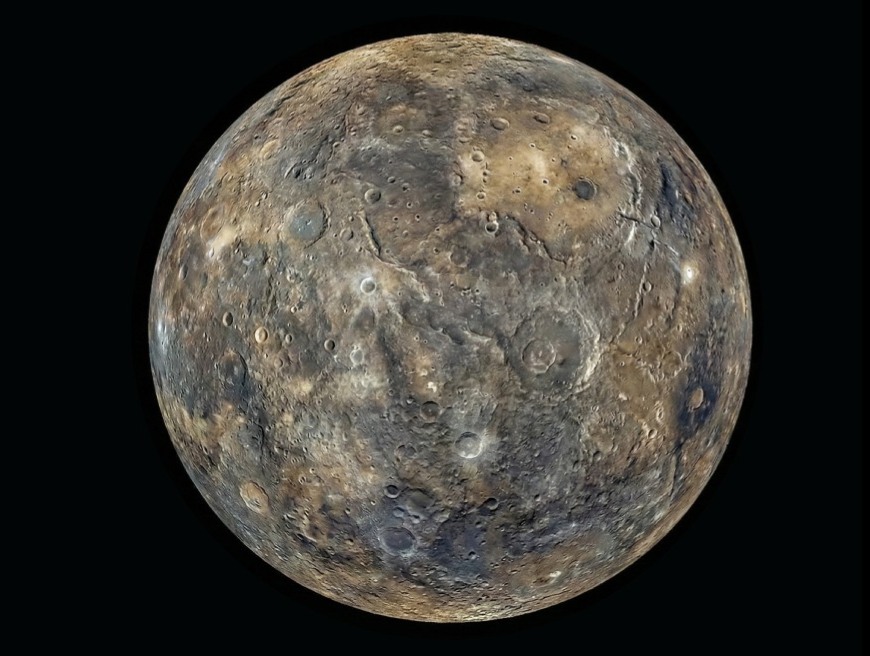
Mercury
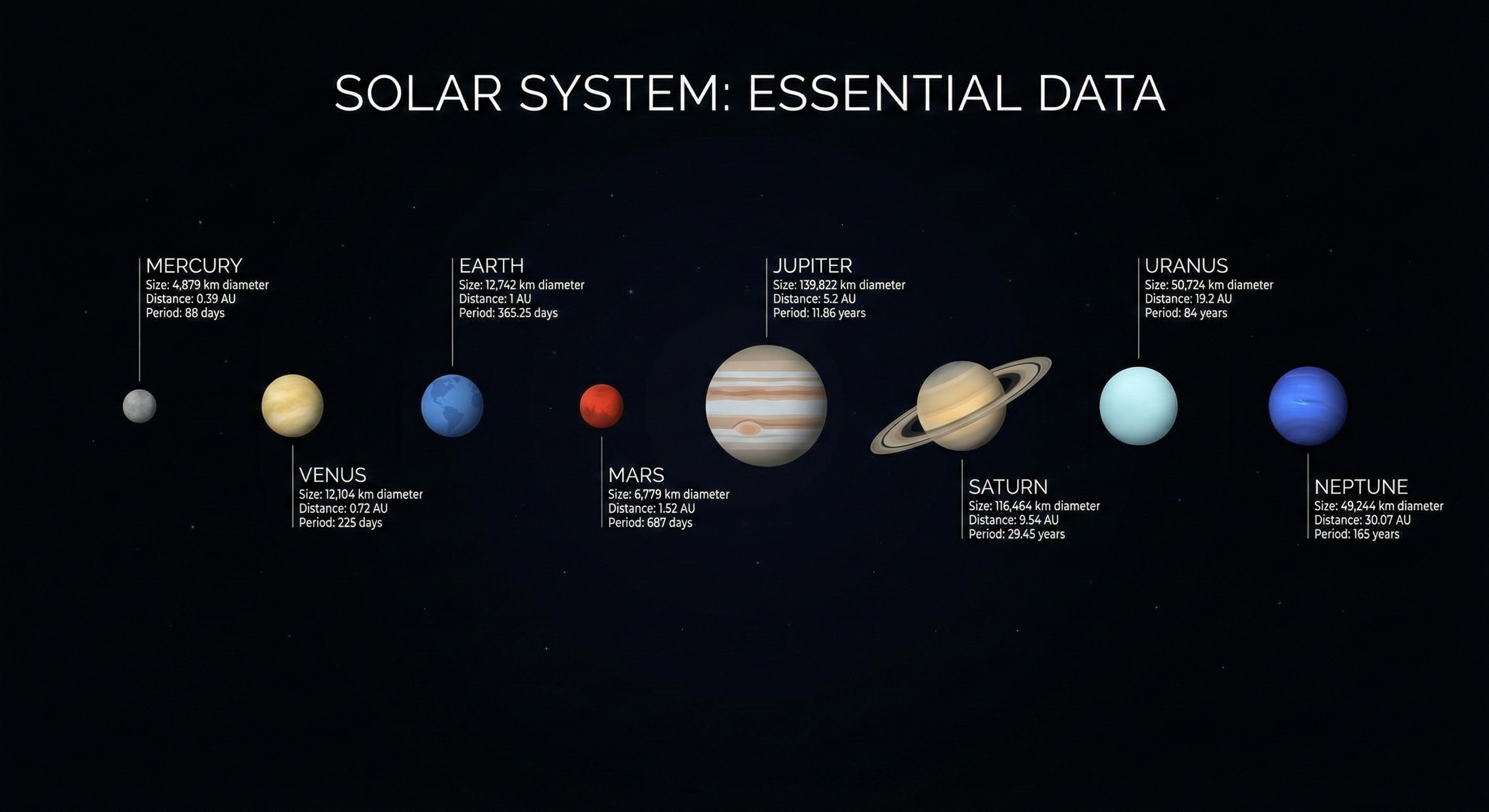
Mercury is the smallest planet in the Solar System and the closest to the Sun, orbiting at an average distance of just 58 million kilometers. Despite its proximity to the Sun, Mercury is not the hottest planet—that distinction belongs to Venus. However, Mercury experiences the most extreme temperature variations of any planet, ranging from -180°C at night to 430°C during the day.
Mercury's surface is heavily cratered, resembling Earth's Moon. The Caloris Basin, one of the largest impact craters in the Solar System at 1,550 kilometers in diameter, dominates one hemisphere. The planet has virtually no atmosphere, just a thin exosphere of atoms blasted off its surface by the solar wind. Mercury completes an orbit around the Sun every 88 Earth days but rotates very slowly, taking 59 Earth days to complete one rotation.
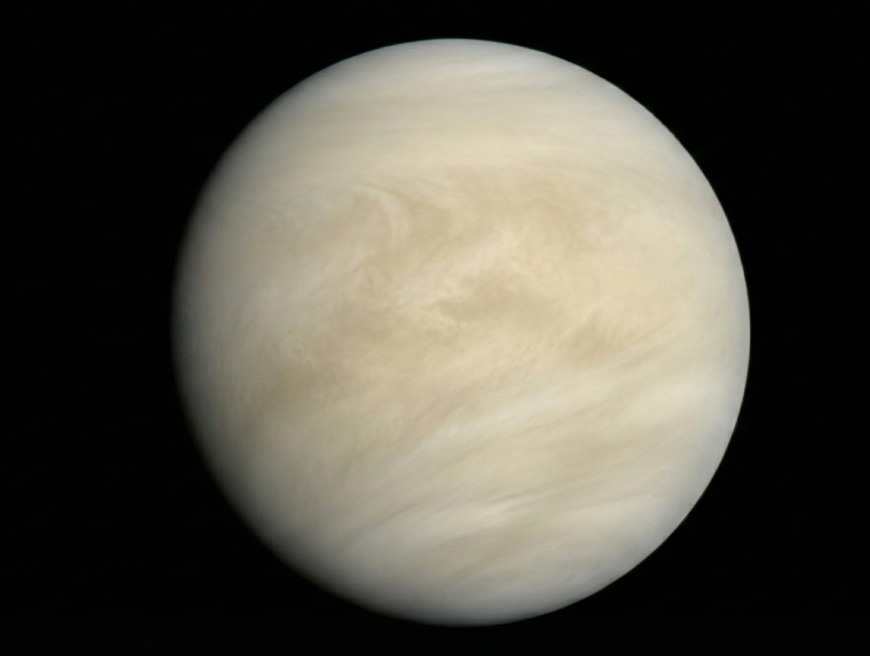
Venus
Venus, often called Earth's "sister planet" due to its similar size and mass, is actually a world of extremes that couldn't be more different from our home. The planet is shrouded in thick clouds of sulfuric acid that completely obscure its surface and create a runaway greenhouse effect, making Venus the hottest planet in the Solar System with surface temperatures averaging 465°C—hot enough to melt lead.
The atmospheric pressure on Venus's surface is 92 times that of Earth, equivalent to the pressure found 900 meters underwater on Earth. Venus rotates backward (retrograde rotation) compared to most other planets, and extremely slowly—a single Venusian day lasts 243 Earth days, longer than its year of 225 Earth days. Beneath the clouds, radar mapping has revealed a surface dominated by vast volcanic plains, thousands of volcanoes, and highland regions comparable in size to Earth's continents.
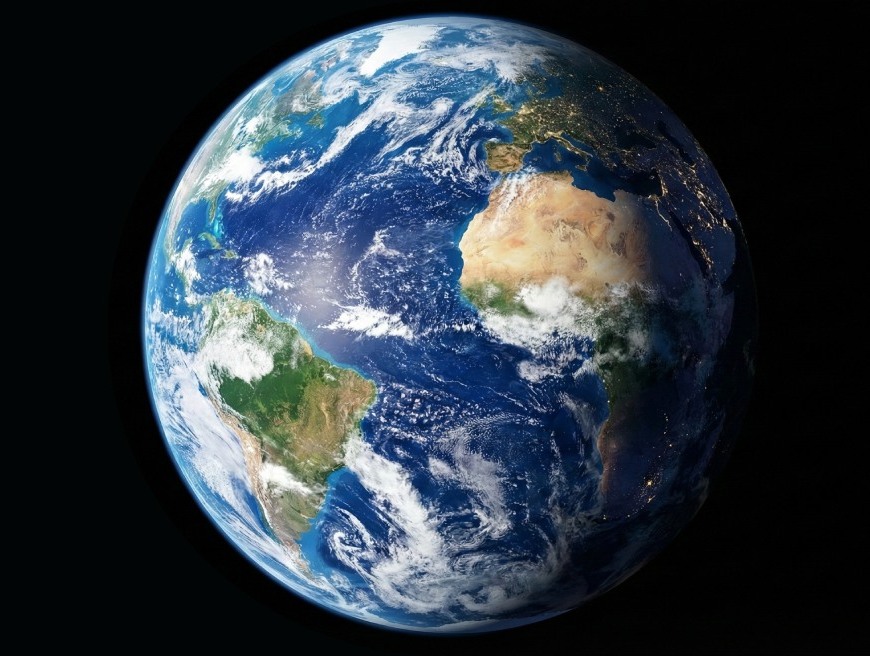
Earth
Earth is the third planet from the Sun and the only known world to harbor life. Our planet's unique combination of factors—liquid water on the surface, a protective magnetic field, a nitrogen-oxygen atmosphere, and a stable orbit in the habitable zone—creates conditions that support an astonishing diversity of life forms.
Earth's surface is 71% covered by water, a feature unique among the rocky planets. The planet's interior is differentiated into layers: a solid iron inner core, a liquid iron outer core (which generates Earth's magnetic field), a silicate mantle, and a thin crust. Plate tectonics continuously reshapes Earth's surface, creating mountains, ocean basins, and driving the carbon cycle that helps regulate our climate. Earth has one natural satellite, the Moon, which is unusually large relative to its parent planet and plays a crucial role in stabilizing Earth's axial tilt.
Mars
Mars, the Red Planet, has captivated human imagination for centuries and remains the primary target for future human exploration. The planet's distinctive red color comes from iron oxide (rust) in its soil. Though only about half Earth's diameter, Mars hosts some of the Solar System's most impressive geological features.
Olympus Mons, a shield volcano on Mars, is the largest known volcano in the Solar System, rising 22 kilometers above the surrounding terrain—nearly three times the height of Mount Everest. Valles Marineris, a vast canyon system, stretches over 4,000 kilometers long and up to 7 kilometers deep. Evidence of ancient river valleys, lake beds, and minerals that form in the presence of water suggests that Mars once had a thicker atmosphere and liquid water on its surface. Today, water exists primarily as ice at the polar caps and possibly as subsurface deposits. Mars has two small, irregularly shaped moons: Phobos and Deimos.
The Outer Planets (Gas and Ice Giants)
Beyond the asteroid belt lie the four giant planets: Jupiter, Saturn, Uranus, and Neptune. These massive worlds are fundamentally different from the terrestrial planets, composed primarily of gases and ices rather than rock and metal. They all possess ring systems (though Saturn's is by far the most spectacular) and numerous moons.
Jupiter
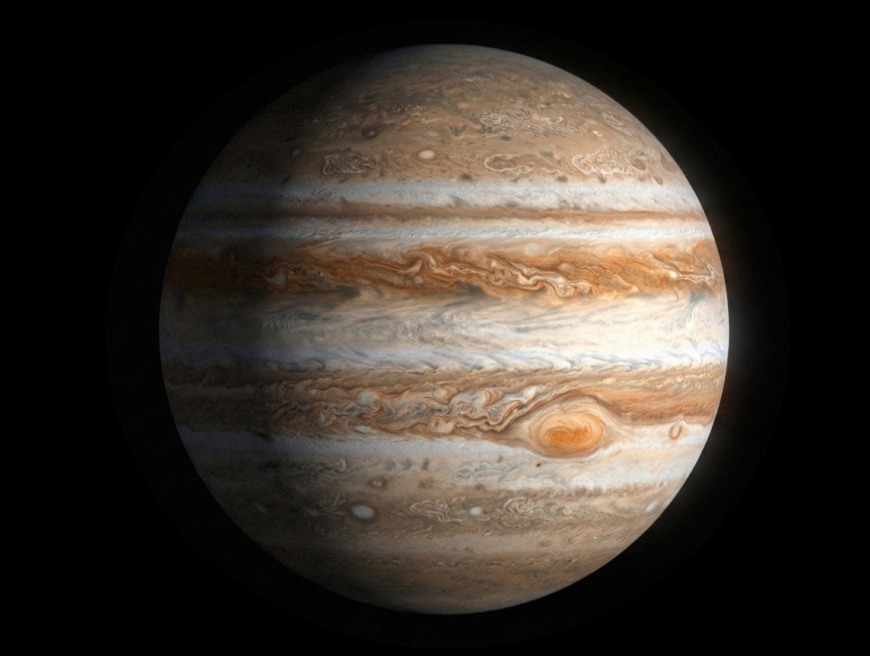
Jupiter is the largest planet in the Solar System, so massive that it contains more than twice the mass of all other planets combined. This gas giant could fit over 1,300 Earths inside its volume. Jupiter's atmosphere displays distinctive bands of clouds and the famous Great Red Spot—a storm larger than Earth that has been raging for at least 400 years.
Jupiter has no solid surface; its atmosphere gradually transitions into a liquid hydrogen ocean, then into metallic hydrogen at extreme pressures deep in the interior. The planet's rapid rotation (a day on Jupiter lasts just under 10 hours) creates powerful jet streams and a strong magnetic field—20,000 times more powerful than Earth's. Jupiter has at least 95 known moons, including the four large Galilean moons: Io (the most volcanically active body in the Solar System), Europa (which likely has a subsurface ocean of liquid water), Ganymede (the largest moon in the Solar System), and Callisto (a heavily cratered ice world).
Saturn
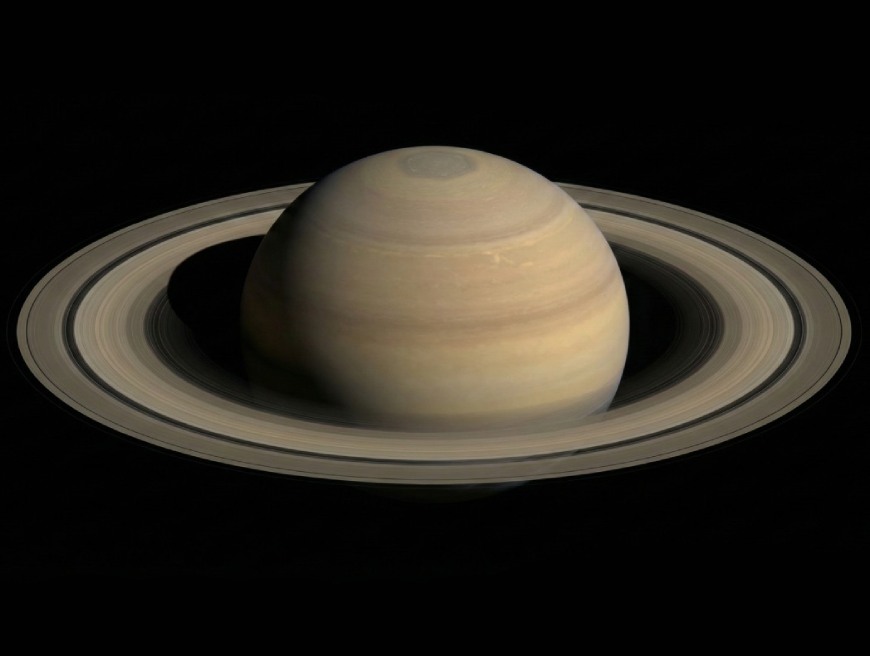
Saturn is the second-largest planet and perhaps the most visually stunning, famous for its magnificent ring system. These rings, composed primarily of ice particles ranging from tiny grains to house-sized chunks, extend up to 282,000 kilometers from the planet's center but are remarkably thin—typically less than 100 meters thick.
Like Jupiter, Saturn is a gas giant with no solid surface. It is the least dense planet in the Solar System—so light that it would float if placed in a giant bathtub of water. Saturn rotates rapidly, completing a day in just 10.7 hours, which causes the planet to bulge noticeably at its equator. Saturn has at least 146 confirmed moons, more than any other planet. Titan, its largest moon, is the only moon in the Solar System with a substantial atmosphere and has lakes and seas of liquid methane and ethane on its surface. Enceladus, another fascinating moon, has geysers that spray water ice from a subsurface ocean, making it another candidate for extraterrestrial life.
Uranus
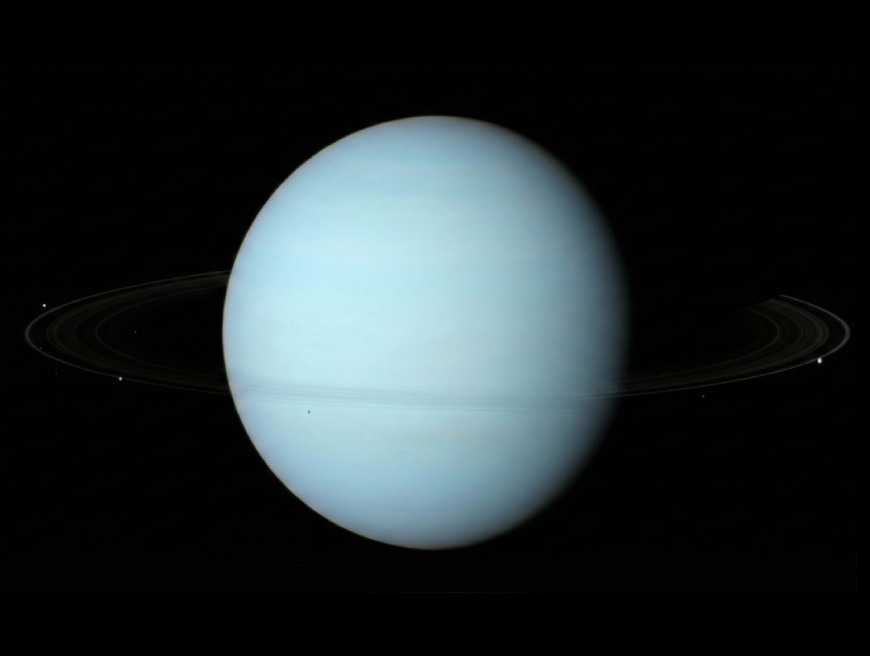
Uranus is the third-largest planet and the first to be discovered with a telescope (by William Herschel in 1781). This ice giant has a blue-green color due to methane in its atmosphere, which absorbs red light. Uranus's most distinctive feature is its extreme axial tilt of 98 degrees—the planet essentially rolls around the Sun on its side, possibly due to a massive collision early in its history.
Uranus's interior is thought to contain water, methane, and ammonia ices surrounding a small rocky core, earning it the classification of "ice giant" rather than "gas giant." The planet has a faint ring system discovered in 1977 and 27 known moons, all named after characters from the works of William Shakespeare and Alexander Pope. The five largest—Miranda, Ariel, Umbriel, Titania, and Oberon—are icy worlds with varied and intriguing surfaces.
Neptune
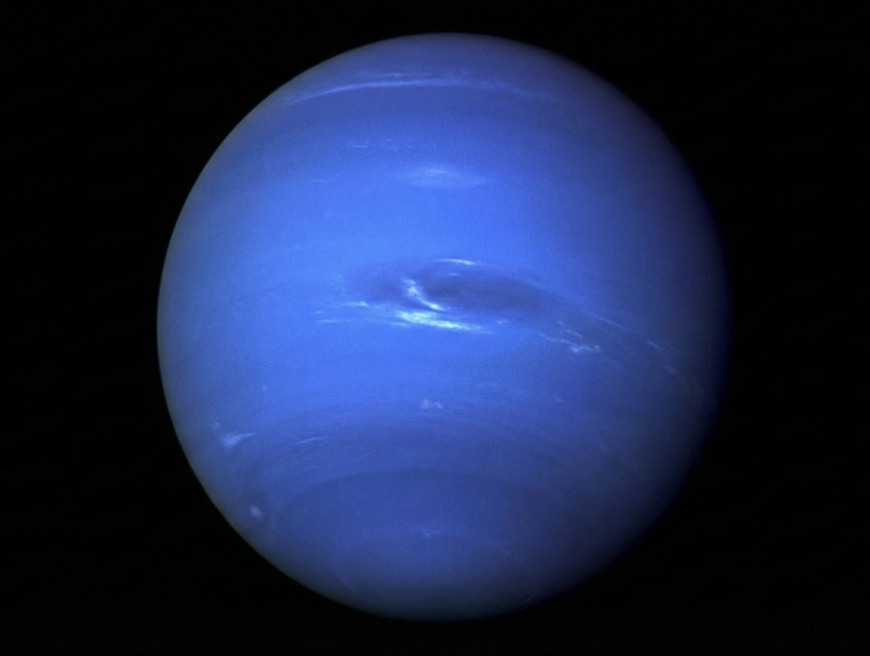
Neptune, the eighth and most distant planet, was the first planet discovered through mathematical prediction rather than direct observation. Astronomers noticed that Uranus's orbit was being perturbed by the gravity of an unseen object, leading to Neptune's discovery in 1846. This ice giant displays the most vivid blue color of any planet, again due to atmospheric methane.
Despite receiving little solar energy due to its distance from the Sun, Neptune has the strongest sustained winds in the Solar System, reaching speeds of 2,100 kilometers per hour. The Great Dark Spot, observed by Voyager 2 in 1989, was a storm system similar to Jupiter's Great Red Spot, though subsequent observations showed it had dissipated. Neptune has 16 known moons, dominated by Triton—a captured Kuiper Belt object that orbits Neptune in the opposite direction (retrograde) to the planet's rotation. Triton has active geysers that eject nitrogen gas and is one of the coldest objects in the Solar System.
See the Planets in Motion
Watch the relative orbital speeds of all eight planets. Mercury orbits fastest at 88 Earth days, while Neptune takes 165 years to complete one orbit.
The Vast Scale of the Solar System
If the Sun were the size of a basketball (25 cm), Earth would be a 2 mm pebble 27 metres away. Scroll the track below to travel outward through the solar system — and feel the staggering emptiness between worlds.
You are at the Sun. Light begins its 299,792 km/s journey outward from here.
Dwarf Planets
In 2006, the International Astronomical Union established the category of "dwarf planet" for objects that orbit the Sun, have sufficient mass for gravity to make them roughly spherical, but have not "cleared the neighborhood" around their orbits. Currently, five objects are officially recognized as dwarf planets: Pluto, Eris, Haumea, Makemake, and Ceres.
Pluto
Once considered the ninth planet, Pluto was reclassified as a dwarf planet in 2006. Located in the Kuiper Belt, Pluto has a highly elliptical orbit that sometimes brings it closer to the Sun than Neptune. NASA's New Horizons spacecraft revealed Pluto to be a geologically complex world with mountains of water ice, nitrogen glaciers, and a thin atmosphere. The heart-shaped region known as Sputnik Planitia is a vast plain of nitrogen ice. Pluto has five known moons, with Charon being so large that the Pluto-Charon system is sometimes considered a binary dwarf planet system.
Eris
Eris, discovered in 2005, is the most massive known dwarf planet, slightly more massive than Pluto though slightly smaller in diameter. It orbits in the scattered disc, a region beyond the Kuiper Belt, at distances ranging from 38 to 98 AU from the Sun. Eris has one known moon, Dysnomia.
Ceres
Ceres is unique among the dwarf planets as the only one located in the inner Solar System, residing in the asteroid belt between Mars and Jupiter. It was the first asteroid discovered (in 1801) and contains about one-third of the total mass of the asteroid belt. NASA's Dawn spacecraft studied Ceres in detail, revealing bright spots that are deposits of sodium carbonate—evidence of past or present subsurface activity.
Haumea and Makemake
Haumea and Makemake are both located in the Kuiper Belt. Haumea is notable for its elongated, egg-like shape caused by its rapid rotation (completing a day in just 4 hours) and has two small moons. Makemake is one of the brightest objects in the Kuiper Belt and has one known moon.
Other Objects in the Solar System
The Asteroid Belt
Between Mars and Jupiter lies the asteroid belt, a region containing millions of rocky objects ranging from small boulders to the dwarf planet Ceres. Despite science fiction depictions, the asteroid belt is mostly empty space—spacecraft routinely pass through it without incident. The total mass of all asteroids combined is less than 4% of the Moon's mass. Notable asteroids include Vesta (the brightest asteroid visible from Earth) and Pallas.
Comets
Comets are icy bodies that develop spectacular tails when they approach the Sun. Short-period comets originate from the Kuiper Belt, while long-period comets come from the Oort Cloud. When heated by the Sun, comets release gas and dust that form the characteristic coma (atmosphere) and tails that can stretch millions of kilometers. Famous comets include Halley's Comet, which returns every 75-76 years, and Comet Hale-Bopp, one of the most widely observed comets of the 20th century.
The Kuiper Belt
The Kuiper Belt is a ring of icy bodies extending from Neptune's orbit (30 AU) to approximately 50 AU from the Sun. It contains at least three dwarf planets (Pluto, Makemake, and Haumea) and is believed to be the source of short-period comets. Thousands of Kuiper Belt Objects (KBOs) have been discovered, and many more likely remain undetected.
The Oort Cloud
The Oort Cloud is a theoretical spherical shell of icy objects that may extend from about 2,000 AU to as far as 100,000 AU from the Sun. While no objects have been directly observed in the Oort Cloud, long-period comets that visit the inner Solar System are believed to originate from this region. The Oort Cloud marks the gravitational boundary of the Solar System and the transition to interstellar space.
Formation and History
The Solar System formed approximately 4.6 billion years ago from a giant molecular cloud of gas and dust. A nearby supernova explosion may have triggered the collapse of part of this cloud, causing it to begin rotating and flattening into a disk—the solar nebula.
Most of the mass concentrated at the center, heating up through gravitational compression until hydrogen fusion ignited, giving birth to the Sun. In the surrounding disk, solid particles began clumping together through a process called accretion. In the warmer inner regions, only metals and silicates could condense, forming the rocky terrestrial planets. In the cooler outer regions, ices of water, ammonia, and methane also condensed, allowing the formation of larger planetary cores that captured massive gaseous envelopes—the giant planets.
The first few hundred million years, known as the Late Heavy Bombardment, saw intense asteroid and comet impacts throughout the Solar System. Evidence of this violent period can still be seen in the heavily cratered surfaces of Mercury, the Moon, and other ancient surfaces.
Over billions of years, the Solar System settled into its current configuration, though it continues to evolve. Planetary orbits slowly shift, moons get captured or lost, and the Sun gradually grows brighter. In about 5 billion years, the Sun will exhaust its hydrogen fuel and expand into a red giant, potentially engulfing Mercury, Venus, and possibly Earth, before shedding its outer layers and leaving behind a white dwarf.
Space Exploration
Humanity's exploration of the Solar System began with the Space Age in the late 1950s. Since then, spacecraft have visited every planet and many smaller bodies, transforming our understanding of our cosmic neighborhood.
Historic Missions
- Mariner Missions (1962-1973): First successful flybys of Venus and Mars; Mariner 10 was first to visit Mercury
- Apollo Program (1969-1972): Six crewed Moon landings, bringing back 382 kg of lunar samples
- Pioneer 10 & 11 (1972-1973): First spacecraft to traverse the asteroid belt and visit Jupiter and Saturn
- Voyager 1 & 2 (1977-present): Grand tour of the outer planets; Voyager 1 is now in interstellar space
- Cassini-Huygens (1997-2017): Orbited Saturn for 13 years; Huygens probe landed on Titan
- New Horizons (2006-present): First spacecraft to visit Pluto (2015) and Kuiper Belt object Arrokoth
Current and Future Exploration
Today, multiple spacecraft continue exploring the Solar System. Mars hosts several active rovers and orbiters. The Juno spacecraft orbits Jupiter, studying its atmosphere and interior. The Parker Solar Probe is making unprecedented close approaches to the Sun, while the James Webb Space Telescope observes Solar System objects with unprecedented detail.
Future missions include NASA's Europa Clipper (launching 2024) to study Jupiter's potentially habitable moon, and various planned missions to Venus, asteroids, and the outer Solar System. Human missions to Mars are being planned by multiple space agencies and private companies, potentially marking the next giant leap in human exploration.
External Resources
- NASA Solar System Exploration - Official NASA portal for Solar System science and missions
- Solar System on Wikipedia - Comprehensive encyclopedia article
- NASA Eyes on the Solar System - Interactive 3D visualization
Frequently Asked Questions
How many planets are in the Solar System?
There are eight planets in the Solar System: Mercury, Venus, Earth, Mars, Jupiter, Saturn, Uranus, and Neptune. Pluto was reclassified as a dwarf planet in 2006 by the International Astronomical Union.
How old is the Solar System?
The Solar System is approximately 4.6 billion years old. It formed from a giant molecular cloud of gas and dust that collapsed under its own gravity, eventually forming the Sun and the planets.
What is the largest planet in the Solar System?
Jupiter is the largest planet in the Solar System. It has a diameter of about 139,820 kilometers and is so massive that it contains more than twice the mass of all other planets combined.
How far is the edge of the Solar System?
The Solar System extends to the Oort Cloud, which may reach up to 100,000 astronomical units (AU) from the Sun—nearly 2 light-years. The heliosphere, the region of space dominated by the solar wind, extends to about 120 AU.
Which planet has the most moons?
Saturn has the most confirmed moons with at least 146 known natural satellites. Jupiter comes second with at least 95 confirmed moons. Both gas giants continue to have new moons discovered.
Is there life elsewhere in the Solar System?
No confirmed life has been found yet, but several locations are considered promising for potential microbial life: <a href="/atlas/solar-system/mars/">Mars</a> (past or present subsurface life), Europa (subsurface ocean), Enceladus (water geysers), and Titan (complex organic chemistry).