Introduction to the Moon
Look up on a clear night and there it is—the Moon, humanity's constant companion. For as long as humans have existed, the Moon has been a source of wonder, navigation, timekeeping, and myth. It's the first celestial object recognizable to children, and remains one of the few worlds where humans have actually walked.
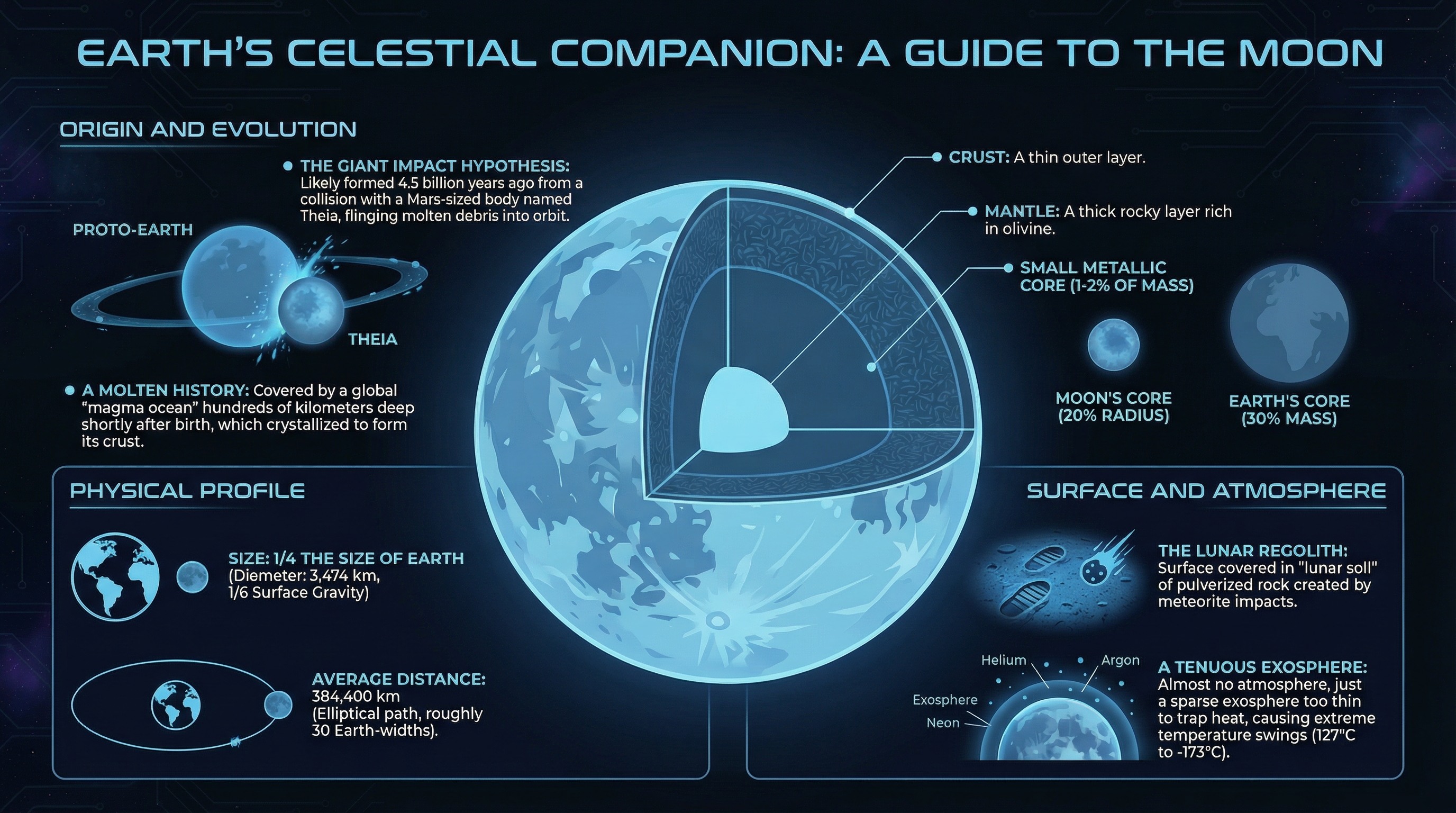
The Moon (also known as Luna, from Latin) is Earth's only natural satellite and, at 3,474 km in diameter, it's the fifth-largest moon in the Solar System. What makes it truly exceptional is its size relative to Earth—the Moon is about one-quarter Earth's diameter, making the Earth-Moon system almost a "double planet." No other planet has a moon so large in proportion to itself.
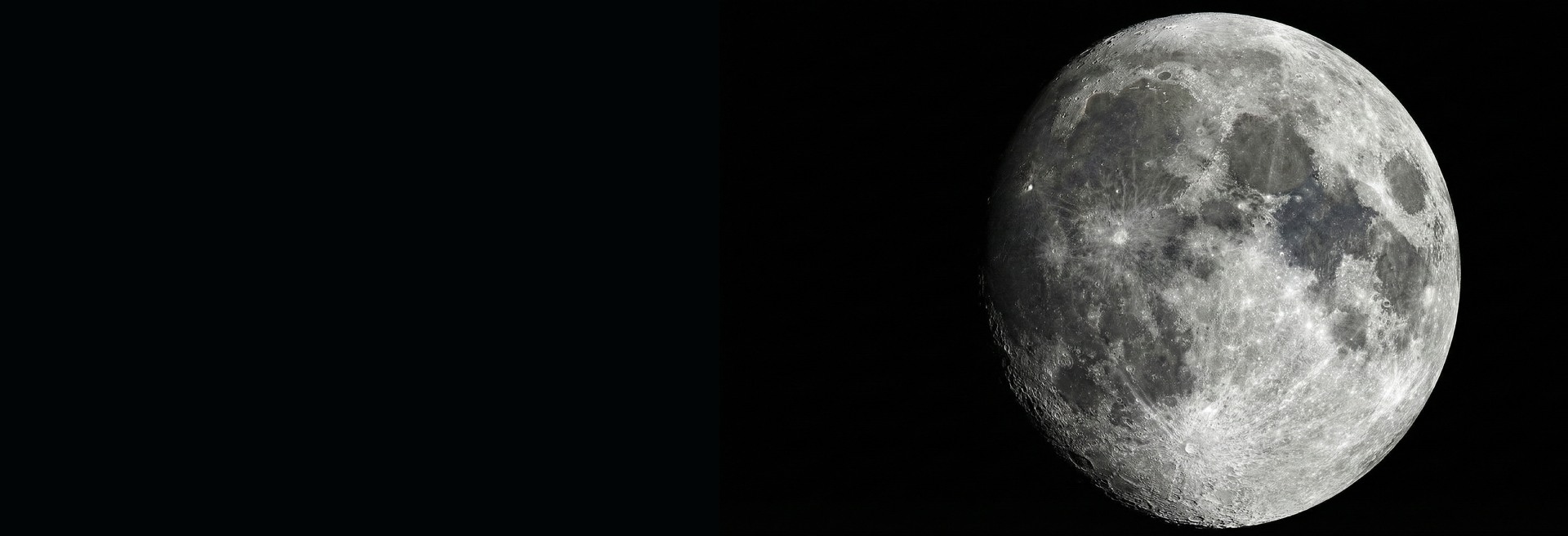
The Moon orbits Earth at an average distance of 384,400 km (about 30 Earth diameters), close enough that we can see surface features with the naked eye. Those dark and light patches that people throughout history have imagined as faces or figures are actually vast plains of ancient lava (the dark maria) and heavily cratered highlands (the bright regions).
Unlike Earth, the Moon is a quiet, airless world. It has no atmosphere to speak of, no weather, no liquid water on its surface, and no protection from the harsh environment of space. Temperatures swing from 127°C in direct sunlight to -173°C in shadow. Yet despite—or because of—this extreme environment, the Moon preserves a record of the Solar System's violent early history that has been erased on more geologically active worlds.
Physical Characteristics
The Moon is a rocky, airless world with a surface shaped by billions of years of asteroid and meteoroid impacts. Its relatively small size and lack of geological activity mean it has remained largely unchanged for eons.
Moon Quick Facts
- Diameter: 3,474 km (2,159 miles) - about 1/4 of Earth
- Mass: 7.35 × 10²² kg (1.2% of Earth's mass)
- Surface Gravity: 1.62 m/s² (16.6% of Earth's)
- Average Distance: 384,400 km (238,855 miles)
- Orbital Period: 27.3 days (sidereal)
- Synodic Period: 29.5 days (phase cycle)
- Surface Temperature: -173°C to 127°C
- Atmosphere: Essentially none (exosphere only)
Data: NASA Planetary Science
The Moon's gravity is only about 1/6th of Earth's. An astronaut who weighs 180 pounds on Earth weighs only 30 pounds on the Moon. This weak gravity means the Moon couldn't hold onto an atmosphere—any gases escape into space. It also means you could jump six times higher than on Earth, which is why Apollo astronauts adopted that distinctive bouncing gait.
The Moon is tidally locked to Earth, meaning the same side always faces us. It takes the Moon about 27.3 days to complete one orbit around Earth, and exactly the same amount of time to rotate once on its axis. This synchronization happened over hundreds of millions of years as Earth's gravity tugged on slight bulges in the Moon's shape, gradually slowing its rotation until one side permanently faces Earth.
Formation: The Giant Impact
The Moon's origin is one of the most dramatic events in Earth's history. The leading scientific theory—the Giant Impact Hypothesis—describes a collision of almost unimaginable violence that shaped both worlds we know today.
The Collision
About 4.5 billion years ago, when the Solar System was still young and chaotic, a Mars-sized protoplanet (sometimes called Theia) collided with the young Earth. The impact was oblique rather than head-on, and the energy released was staggering—enough to completely melt Earth's surface and vaporize much of both bodies.
The collision ejected a massive cloud of debris into orbit around Earth. Within just a few hundred years—a cosmic eyeblink—this debris coalesced into the Moon. The newly formed Moon was much closer to Earth than it is today, perhaps only 25,000 km away, and would have appeared enormous in the sky.
Evidence for the Impact
Several lines of evidence support this theory:
- Composition: The Moon's rocks are chemically similar to Earth's mantle, as would be expected if the Moon formed from ejected Earth material
- Angular momentum: The Earth-Moon system has the right amount of rotational energy for this scenario
- Small iron core: The Moon has a tiny iron core (about 20% of its diameter vs. Earth's 55%), consistent with forming from mostly mantle material
- Oxygen isotopes: Lunar rocks have the same oxygen isotope ratios as Earth rocks—a unique chemical fingerprint
A Magma Ocean
When the Moon first formed, it was so hot that its entire outer layer was molten—a global "magma ocean" hundreds of kilometers deep. As this ocean slowly cooled over millions of years, different minerals crystallized and either sank or floated, creating the Moon's internal structure and the compositional differences between the highlands and maria we see today.
Surface Features
The Moon's surface tells the story of 4.5 billion years of cosmic bombardment. With no atmosphere, weather, or plate tectonics to erase them, features on the Moon remain preserved for eons. Even the footprints left by Apollo astronauts will last millions of years.
Maria (The "Seas")
The dark patches visible to the naked eye are called maria (Latin for "seas")—a name given by early astronomers who thought they were water. They're actually vast plains of ancient basaltic lava that flooded enormous impact basins between 3 and 4 billion years ago. The maria cover about 16% of the lunar surface, mostly on the near side. Major maria include:
- Mare Tranquillitatis (Sea of Tranquility): Where Apollo 11 landed
- Mare Imbrium (Sea of Rains): The largest mare, over 1,100 km across
- Mare Serenitatis (Sea of Serenity): Where Apollo 17 landed nearby
- Oceanus Procellarum (Ocean of Storms): The largest dark region on the Moon
Highlands
The lighter regions are the lunar highlands—the original ancient crust that crystallized from the Moon's magma ocean. They're heavily cratered because they're older than the maria, having been exposed to impacts for the entire history of the Solar System. The highlands are composed primarily of a rock called anorthosite, rich in the mineral plagioclase feldspar.
Craters
The Moon's surface is pockmarked with craters ranging from microscopic to hundreds of kilometers across. Notable craters include:
- Tycho: A young, bright crater with spectacular ray systems extending across the visible disk
- Copernicus: A prominent 93-km crater visible to the naked eye
- South Pole-Aitken Basin: One of the largest known impact structures in the Solar System, 2,500 km across and 8 km deep
The Far Side
The far side of the Moon (sometimes incorrectly called the "dark side") was a complete mystery until the Soviet Luna 3 spacecraft photographed it in 1959. Surprisingly, it looks very different from the near side—it's almost entirely highlands with very few maria. The reason for this asymmetry is still debated, but may relate to differences in crustal thickness or internal heating between the two hemispheres.
Phases and Eclipses
The Moon's changing appearance throughout the month has been used for calendars and rituals since the beginning of human civilization. Understanding why these changes occur requires understanding the geometry of the Sun-Earth-Moon system.
Full Moon
100% illuminated • Day 15
The Moon's entire visible disk is illuminated by the Sun.
Lunar Phases
The Moon doesn't produce its own light—it shines by reflecting sunlight. As the Moon orbits Earth, we see different portions of its sunlit half, creating the phases:
- New Moon: The Moon is between Earth and Sun; we see only the dark side
- Waxing Crescent: A sliver of light appears on the right
- First Quarter: Half the Moon is illuminated (right half)
- Waxing Gibbous: More than half illuminated, growing
- Full Moon: Earth is between Moon and Sun; we see the entire sunlit face
- Waning Gibbous: More than half illuminated, shrinking
- Third Quarter: Half illuminated (left half)
- Waning Crescent: A sliver of light on the left, then back to new
This cycle takes about 29.5 days (the synodic month), which is longer than the Moon's orbital period (27.3 days) because Earth is also moving around the Sun.
Solar Eclipses
A solar eclipse occurs when the Moon passes directly between Earth and the Sun, casting a shadow on Earth. By an extraordinary cosmic coincidence, the Moon and Sun appear almost exactly the same size in our sky—the Moon is 400 times smaller than the Sun, but also 400 times closer. This allows for total solar eclipses, where the Moon perfectly covers the Sun's disk, revealing the ghostly corona. Total solar eclipses are among the most awe-inspiring natural phenomena.
Lunar Eclipses
A lunar eclipse occurs when Earth passes between the Sun and Moon, casting Earth's shadow on the Moon. During a total lunar eclipse, the Moon turns a deep red color—sometimes called a "blood moon"—because Earth's atmosphere bends red sunlight into the shadow. Unlike solar eclipses, lunar eclipses can be seen from anywhere on Earth's night side and are completely safe to observe.
No Eclipse
The Moon is outside Earth's shadow — a normal full moon night.
Why Not Every Month?
The Moon's orbit is tilted about 5 degrees relative to Earth's orbit around the Sun. This means most months, the Moon passes slightly above or below the Sun (no solar eclipse) and slightly above or below Earth's shadow (no lunar eclipse). Eclipses only occur when the Moon crosses Earth's orbital plane near new or full moon.
Tides and the Moon's Influence on Earth
The Moon doesn't just hang in the sky looking pretty—it profoundly affects Earth in ways that have shaped the evolution of our planet and life itself.
Ocean Tides
The Moon's gravity pulls on Earth, but it pulls more strongly on the side facing the Moon than on Earth's center, and more on the center than the far side. This difference in gravitational pull—called the tidal force—stretches Earth slightly along the Earth-Moon axis, creating two bulges of water: one facing the Moon, one facing away. As Earth rotates beneath these bulges, we experience two high tides and two low tides daily.
The Sun also creates tides, about half as strong as the Moon's. When Sun and Moon align (new and full moons), their tidal effects add together, creating extra-high "spring tides." When they're at right angles (quarter moons), they partially cancel, creating weaker "neap tides."
Tidal Locking
The same tidal forces that create ocean tides also create slight bulges in Earth's solid rock. These bulges act as a brake on Earth's rotation, gradually slowing it down. Earth's day is getting longer by about 1.4 milliseconds per century. In exchange for this lost rotational energy, the Moon is spiraling slowly outward at about 3.8 cm per year.
Stabilizing Earth's Tilt
Perhaps the Moon's most important influence is stabilizing Earth's axial tilt. Earth's axis is tilted 23.5 degrees, giving us seasons. Without the Moon's gravitational influence, this tilt would vary chaotically from nearly 0 to over 85 degrees over millions of years, causing wild climate swings. The Moon's gravity keeps Earth's tilt relatively stable, providing the consistent seasons that life has adapted to.
Early Earth-Moon System
Immediately after its formation, the Moon was perhaps only 25,000 km from Earth (compared to 384,000 km today). Earth rotated in just 5-6 hours, and the Moon would have appeared enormous in the sky. Tides were hundreds of meters high, crashing on shores that may not even have existed yet. Over billions of years, tidal friction slowed Earth's rotation and pushed the Moon outward to its current distance.
Exploration History
The Moon has been the target of more than 100 missions, making it by far the most explored destination in space beyond Earth. The Space Race between the United States and Soviet Union drove a frenzy of lunar missions in the 1960s and 70s.
Early Missions
- Luna 1 (1959): First spacecraft to escape Earth's gravity; missed the Moon but discovered the solar wind
- Luna 2 (1959): First spacecraft to reach another celestial body (impacted the Moon)
- Luna 3 (1959): First images of the Moon's far side
- Ranger 7-9 (1964-65): First U.S. close-up photographs of the lunar surface
- Luna 9 (1966): First soft landing on the Moon; first photos from the surface
- Surveyor 1 (1966): First U.S. soft landing; demonstrated the surface could support a spacecraft
- Lunar Orbiter 1-5 (1966-67): Mapped 99% of the Moon for Apollo landing site selection
The Apollo Missions
The Apollo program represents humanity's greatest exploration achievement. Between 1969 and 1972, NASA landed twelve astronauts on the Moon—still the only humans to have walked on another world.
Apollo Milestones
- Apollo 8 (December 1968): First humans to orbit the Moon; iconic "Earthrise" photograph
- Apollo 10 (May 1969): Full dress rehearsal, descending to within 15 km of the surface
- Apollo 11 (July 1969): First Moon landing. Neil Armstrong and Buzz Aldrin walked on the Moon while Michael Collins orbited above
- Apollo 12 (November 1969): Precision landing near Surveyor 3 spacecraft; retrieved parts for analysis
- Apollo 13 (April 1970): Oxygen tank explosion; crew survived through ingenuity and teamwork
- Apollo 14 (February 1971): Alan Shepard hit golf balls on the Moon
- Apollo 15 (July 1971): First use of the Lunar Roving Vehicle; longest EVAs to date
- Apollo 16 (April 1972): First landing in lunar highlands; studied ancient highland crust
- Apollo 17 (December 1972): Final Apollo mission; only mission with a scientist (geologist Harrison Schmitt)
"One Small Step"
On July 20, 1969, at 20:17 UTC, the Lunar Module "Eagle" touched down in the Sea of Tranquility. Six and a half hours later, Neil Armstrong descended the ladder and became the first human to set foot on another world, speaking the famous words: "That's one small step for [a] man, one giant leap for mankind." Buzz Aldrin joined him minutes later, describing the scene as "magnificent desolation."
Scientific Legacy
The Apollo missions brought back 382 kg of lunar samples—rocks, soil, and core samples that scientists continue to study today. These samples revealed the Moon's formation history, age, and composition. The astronauts also deployed experiments that still operate, including retroreflectors that allow precise laser ranging of the Moon's distance.
Future Exploration
After decades of focusing on low Earth orbit and robotic missions, humanity is preparing to return to the Moon—this time to stay.
Artemis Program
NASA's Artemis program aims to return humans to the Moon, landing the first woman and first person of color on the lunar surface. The program will establish sustainable lunar exploration with regular crewed missions. Artemis uses the Space Launch System (SLS) rocket and Orion spacecraft, with a Human Landing System provided by commercial partners including SpaceX.
Gateway
The Lunar Gateway is a planned small space station in lunar orbit that will serve as a staging point for surface missions and deep space exploration. International partners including ESA, JAXA, and CSA are contributing to Gateway, making it a truly global endeavor.
International Activity
The Moon is seeing renewed international interest:
- China: Chang'e program has landed rovers and returned samples; planning crewed missions
- India: Chandrayaan program exploring the Moon; planning more ambitious missions
- Japan: SLIM mission achieved first Japanese lunar landing; JAXA participating in Artemis
- Russia: Luna-25 and follow-on missions planned
- Private Companies: SpaceX, Blue Origin, Intuitive Machines, and others developing lunar capabilities
Lunar Resources
Future missions will focus on utilizing lunar resources—especially water ice at the poles. This water could provide drinking water, oxygen for breathing, and hydrogen and oxygen for rocket fuel. The Moon could become a gateway to deeper space exploration, with locally-produced propellant enabling missions to Mars and beyond.
Interesting Facts About the Moon
The Moon is full of surprises and fascinating details that make it endlessly captivating.
- Moonquakes Happen: The Moon has "moonquakes" caused by tidal stresses from Earth and thermal expansion and contraction. Apollo seismometers detected thousands of moonquakes, some lasting over an hour because the dry, rigid lunar crust doesn't dampen vibrations like Earth's does.
- It's Slowly Escaping: The Moon is moving away from Earth at about 3.8 cm per year. In the distant future, it will appear smaller and total solar eclipses will no longer be possible. Eventually, the Earth-Moon system will become fully tidally locked, with Earth showing only one face to the Moon.
- Extreme Temperature Swings: With no atmosphere to moderate temperatures, the Moon experiences swings from 127°C (260°F) in sunlight to -173°C (-280°F) in shadow—a range of 300°C (540°F).
- Dusty and Dangerous: Lunar dust is incredibly fine, sharp (never weathered by wind or water), and slightly electrostatically charged. Apollo astronauts found it got into everything, scratched visors, and irritated lungs. Managing lunar dust is one of the biggest challenges for future missions.
- Time Capsule: With no atmosphere or geological activity, the Moon preserves history. Apollo footprints will last millions of years. Ancient impact craters record the bombardment history of the inner Solar System.
- The Moon Smells: Apollo astronauts reported that moon dust smells like spent gunpowder. Scientists think this is caused by dangling molecular bonds in the dust reacting with oxygen and water in the spacecraft after EVAs.
- A Familiar Face: The same side of the Moon always faces Earth, but we actually see about 59% of the Moon's surface over time due to libration—slight wobbles in the Moon's rotation.
- Astronaut Families: Three astronauts from Apollo 15 brought personal items to the Moon's surface. They also secretly left a small memorial to astronauts and cosmonauts who died in the space program, including a small figurine called "Fallen Astronaut."
External Resources
- NASA Moon Exploration - Official NASA page for lunar science and Artemis program
- Moon on Wikipedia - Comprehensive encyclopedia article
- Apollo 50th Anniversary - NASA's celebration of the Moon landings
- LROC QuickMap - Interactive map of the Moon from Lunar Reconnaissance Orbiter
Frequently Asked Questions
Why does the Moon have phases?
The Moon's phases occur because we see different portions of its sunlit side as it orbits Earth. When the Moon is between Earth and the Sun (new moon), we see only the dark side. When Earth is between the Moon and Sun (full moon), we see the entire sunlit face. The phases cycle through new, waxing crescent, first quarter, waxing gibbous, full, waning gibbous, third quarter, and waning crescent over about 29.5 days.
Why do we always see the same side of the Moon?
The Moon is "tidally locked" to Earth, meaning it rotates on its axis in exactly the same time it takes to orbit Earth (about 27.3 days). This synchronization happened over millions of years as Earth's gravity created tidal bulges on the Moon, gradually slowing its rotation until one side always faces us. This is called synchronous rotation and is common among moons in the Solar System.
How far away is the Moon?
The Moon orbits at an average distance of about 384,400 km (238,855 miles) from Earth—roughly 30 Earth diameters away. This distance varies between about 356,500 km at closest approach (perigee) and 406,700 km at farthest (apogee). Light takes about 1.3 seconds to travel from the Moon to Earth, and the Apollo astronauts took about 3 days to reach it.
Is there water on the Moon?
Yes! Water ice has been confirmed in permanently shadowed craters near the Moon's poles, where temperatures never rise above -250°C. The LCROSS mission in 2009 found water ice in a south polar crater, and subsequent observations have detected water molecules across the lunar surface. This water will be crucial for future lunar bases, potentially providing drinking water, oxygen, and rocket fuel.
Why does the Moon cause tides on Earth?
The Moon's gravity pulls on Earth, but it pulls more strongly on the side facing the Moon than on Earth's center, and more on the center than the far side. This differential gravitational pull stretches Earth slightly, creating bulges of water on both the near and far sides. As Earth rotates beneath these bulges, we experience two high tides and two low tides each day.
Can you see the American flags on the Moon?
Not from Earth—even our most powerful telescopes can't resolve objects that small from 384,000 km away. The smallest features visible from Earth are about 1 km across. However, NASA's Lunar Reconnaissance Orbiter has photographed the Apollo landing sites from lunar orbit, clearly showing the descent stages, equipment, and even astronaut footpaths in the dust.