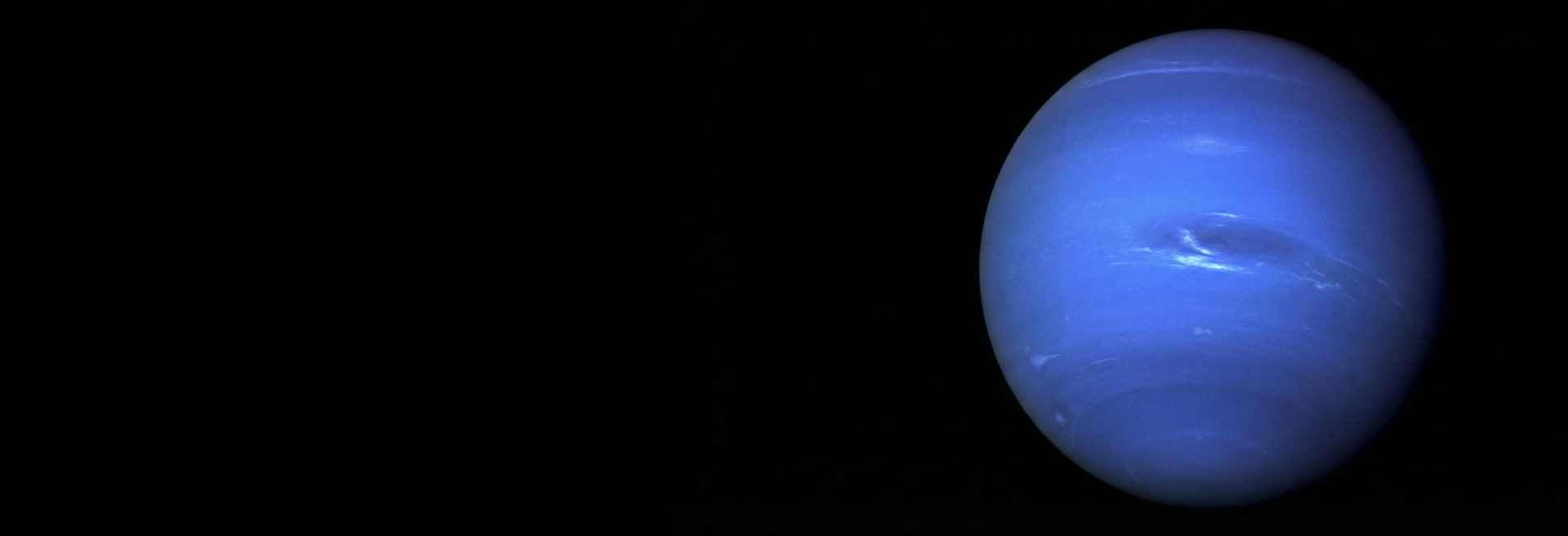
Introduction to Neptune
Neptune, named after the Roman god of the sea, is the eighth and outermost planet in our solar system. This distant ice giant represents the frontier of the planetary realm—beyond Neptune lies only the Kuiper Belt, scattered disc, and eventually the Oort Cloud marking the solar system's edge. Despite its remote location 4.5 billion kilometers from the Sun, Neptune is a dynamic, active world with violent weather, the fastest winds in the solar system, and a fascinating family of moons.
Neptune holds a unique place in astronomical history as the only planet discovered through mathematical prediction rather than direct observation. Its existence was deduced from gravitational perturbations in Uranus's orbit, and when astronomers looked at the predicted location in 1846, there Neptune was—a triumph that validated celestial mechanics and inspired confidence in mathematical astronomy.
As an ice giant (along with Uranus), Neptune differs fundamentally from the gas giants Jupiter and Saturn. Rather than being composed primarily of hydrogen and helium, Neptune's interior consists mainly of water, methane, and ammonia ices in fluid states under extreme pressure. This composition, combined with Neptune's distance from the Sun and powerful internal heat source, creates a world of extremes that continues to puzzle and fascinate planetary scientists.
The Mathematical Discovery of Neptune
Neptune's discovery stands as one of the greatest achievements in the history of astronomy—a planet found not by chance observation, but through mathematical prediction based on Newton's laws of motion and gravitation.
The Problem of Uranus
By the early 1840s, astronomers had tracked Uranus for over 60 years since its discovery in 1781. They noticed something puzzling: Uranus wasn't following its predicted orbit. Sometimes it moved faster than expected, sometimes slower. The deviations were small but unmistakable—something was pulling on Uranus gravitationally.
Some astronomers suggested Newton's laws of gravitation might not apply at such great distances from the Sun. Others proposed the intriguing possibility that an unknown planet beyond Uranus was causing these perturbations. If the latter were true, could mathematics reveal where to find this unseen world?
Two Mathematicians, One Solution
Two mathematicians independently tackled this problem. In England, John Couch Adams began calculations in 1843 and presented his predicted position to the Royal Observatory in 1845. In France, Urbain Le Verrier performed similar calculations and published his prediction in 1846. Both arrived at remarkably similar positions for the unknown planet.
Adams's work was initially overlooked by British astronomers. Le Verrier, facing similar skepticism in France, sent his predictions to Johann Galle at the Berlin Observatory in Germany. On the night of September 23, 1846—the very first night Galle searched—he found Neptune within one degree of Le Verrier's predicted position. The discovery caused an international sensation and sparked a priority dispute between England and France that lasted for decades.
A Triumph of Mathematics
Neptune's discovery validated the universal application of Newton's laws and demonstrated that celestial mechanics could predict the existence of unknown worlds. It showed that mathematical theory could guide observation, not merely explain it after the fact. This success emboldened astronomers to search for additional planets, eventually leading to Pluto's discovery in 1930 (though Pluto was later reclassified as a dwarf planet).
Physical Characteristics
Neptune is the fourth-largest planet by diameter and third-largest by mass. Though similar to Uranus in many ways, Neptune exhibits notable differences in appearance, activity, and energy output.
Neptune Quick Facts
- Diameter: 49,528 km (3.9 Earths wide)
- Mass: 1.02 × 10²⁶ kg (17 Earth masses)
- Density: 1.64 g/cm³
- Surface Gravity: 11.15 m/s² (1.14× Earth's)
- Day Length: 16 hours, 6 minutes
- Year Length: 165 Earth years
- Moons: 16 known
- Distance from Sun: 4.5 billion km (30 AU)
Data: NASA Planetary Science
The Most Vivid Blue
Neptune displays the most striking blue color of any planet in the solar system—a deep, rich azure that appears almost artificial in photographs. This vivid color comes from methane in the atmosphere, which absorbs red wavelengths while reflecting blue light. However, Neptune appears much bluer than Uranus despite having similar amounts of methane, suggesting additional factors contribute to its color.
Recent research indicates Neptune may have less atmospheric haze than Uranus, allowing deeper, more intensely colored layers to show through. There may also be an unknown chromophore—a light-absorbing molecule—that enhances Neptune's blue color. Whatever the exact mechanism, the result is unmistakable: Neptune is the bluest world in our solar system.
Size and Mass
Neptune is slightly smaller than Uranus in diameter (49,528 km vs 51,118 km) but more massive (17 Earth masses vs 14.5 Earth masses), making Neptune denser than Uranus. About 57 Earths could fit inside Neptune's volume. Despite being massive by terrestrial standards, Neptune is dwarfed by Jupiter (318 Earth masses) and Saturn (95 Earth masses).
Atmosphere and Extreme Weather
Neptune's atmosphere is one of the most dynamic and violent in the solar system, with wind speeds exceeding 2,000 km/h and storm systems that appear, evolve, and disappear over years.
Atmospheric Composition
Neptune's atmosphere consists of approximately 80% hydrogen, 19% helium, and 1.5% methane, with trace amounts of hydrogen deuteride, ethane, and other hydrocarbons. The methane concentration, while similar to Uranus, produces a much more intense blue color. At depth, water, ammonia, and methane ices condense into clouds, though these are hidden beneath the visible upper atmosphere.
The Fastest Winds in the Solar System
Neptune holds the record for the strongest sustained winds in the solar system. Wind speeds in the upper atmosphere reach 2,100 kilometers per hour (1,300 mph)—nearly supersonic and five times faster than the strongest hurricane winds on Earth. These extreme winds are particularly puzzling because Neptune receives only about 1/900th of the sunlight that Earth does.
The winds on Neptune blow in the opposite direction to the planet's rotation—they're retrograde. At the equator, winds blow westward at speeds up to 400 m/s, while at mid-latitudes, they can reach 300 m/s. These powerful jet streams are thought to be driven by Neptune's internal heat rather than solar heating, though the exact mechanism remains debated.
The Great Dark Spot
When Voyager 2 flew past Neptune in 1989, it discovered a massive storm system dubbed the Great Dark Spot (GDS)—similar in relative size to Jupiter's Great Red Spot. The GDS was an anticyclonic storm (rotating counterclockwise) about the size of Earth, located at 22°S latitude. Bright, high-altitude clouds accompanied the dark spot, and it moved westward at 325 meters per second.
However, when the Hubble Space Telescope observed Neptune in 1994, the Great Dark Spot had disappeared. In its place, a new dark spot had formed in the northern hemisphere. Since then, multiple dark spots have been observed appearing and disappearing, suggesting these storms are temporary features unlike Jupiter's centuries-old Great Red Spot. In 2018, Hubble observed a dark vortex being disrupted and changing direction before dissipating, providing rare insight into the life cycle of Neptune's storms.
Bright Cloud Features
Neptune displays bright, white methane clouds that form at high altitudes where temperatures are cold enough for methane to condense. These clouds cast shadows on the cloud deck below, a phenomenon Voyager 2 captured in remarkable detail. Some clouds move around the planet at different speeds, creating a dynamic, ever-changing appearance. Ground-based observations with adaptive optics have revealed that Neptune's cloud activity varies seasonally, despite the planet's 165-year orbit.
The most violent weather layer in the solar system, with sustained winds reaching 2,100 km/h — nearly supersonic. White methane clouds cast shadows on the cloud deck below, first captured by Voyager 2 in 1989. The Great Dark Spot storms appear and disappear over years, unlike Jupiter's centuries-old Great Red Spot.
Click any layer to explore it
Interior Structure and Heat
Neptune's interior, like Uranus, differs fundamentally from the gas giants. As an ice giant, Neptune's bulk consists of dense fluids under extreme pressure rather than metallic hydrogen.
Layers of Neptune
Neptune's interior is thought to consist of three main regions:
- Core: A rocky/icy core containing silicates and metals, possibly with a mass around 1.2 Earth masses
- Icy Mantle: A thick layer of hot, dense fluid consisting of water, methane, and ammonia "ices" at temperatures of thousands of degrees. Despite high temperatures, extreme pressure keeps these materials in exotic fluid or superionic states
- Atmosphere: A hydrogen-helium envelope extending about 10-20% of the radius, gradually transitioning into the mantle below
Internal Heat Source
One of Neptune's most intriguing characteristics is its powerful internal heat source. The planet radiates about 2.6 times more energy into space than it receives from the Sun—among the highest ratios of any planet. This internal heat drives Neptune's violent weather and strong winds despite the planet's great distance from the Sun.
The source of this heat likely includes gravitational contraction—Neptune is slowly shrinking under its own gravity, converting gravitational potential energy into heat. Additional heat may come from differentiation, where heavier materials sink toward the core while lighter materials rise, releasing gravitational energy. Some scientists also propose that "diamond rain" occurs in Neptune's interior—methane decomposing under extreme pressure to form carbon, which crystallizes into diamond and sinks toward the core, releasing heat in the process.
Why Neptune Has Heat While Uranus Doesn't
Neptune's substantial internal heat contrasts sharply with Uranus, which radiates almost no excess heat. Scientists don't fully understand this difference. One hypothesis suggests the massive impact that tilted Uranus on its side may have released most of its internal heat. Alternatively, Uranus and Neptune may have different internal structures or convection patterns that affect heat transport. Resolving this mystery is one of the key motivations for future ice giant missions.
Neptune's Ring System
Neptune has a faint ring system discovered in 1984 (with hints dating back to 1968) and fully revealed by Voyager 2 in 1989. The rings are extremely dark—even darker than Uranus's rings—and contain a unique feature not found around any other planet.
The Five Main Rings
Neptune has five principal rings named after astronomers who made significant contributions to Neptune research:
- Galle Ring: The innermost ring, faint and diffuse
- Le Verrier Ring: Named after Neptune's co-discoverer, this narrow ring is relatively well-defined
- Lassell Ring: A broad, faint sheet of material
- Arago Ring: Another faint ring
- Adams Ring: The outermost and most interesting ring, containing unique arc segments
The Mysterious Ring Arcs
The Adams Ring displays a unique feature: five bright arcs named Courage, Liberté, Egalité 1, Egalité 2, and Fraternité (French revolutionary ideals). These arcs are brighter, denser concentrations of material within the ring, confined to specific locations rather than spreading evenly around the planet. This is puzzling because orbital dynamics predict that material in rings should spread uniformly within a few years.
The arcs are shepherded by Neptune's moon Galatea, whose gravitational resonances confine the material to specific locations. However, the exact mechanism remains debated. Observations show the arcs are dynamic—they change brightness, merge, and possibly form and dissipate over years to decades. Understanding how these arcs remain stable is an ongoing area of research in planetary ring dynamics.
Ring Composition
Neptune's rings are composed of very dark material, possibly organic compounds processed by radiation, making them difficult to observe from Earth. The rings may originate from small moons that were shattered by impacts or disrupted by tidal forces when they wandered too close to Neptune.
The Moons of Neptune
Neptune has 16 known moons, dominated by Triton—one of the most fascinating objects in the solar system. The other moons are either small inner satellites or distant irregular moons captured from the Kuiper Belt.
Triton: The Retrograde Giant
Triton, discovered just 17 days after Neptune itself in 1846, is Neptune's only large moon and the seventh-largest moon in the solar system. With a diameter of 2,706 kilometers, Triton is larger than Pluto and is one of only a few moons massive enough to have achieved hydrostatic equilibrium (a nearly spherical shape).
Triton's most remarkable feature is its retrograde orbit—it orbits Neptune in the opposite direction to the planet's rotation. This retrograde motion proves conclusively that Triton didn't form alongside Neptune but was captured from the Kuiper Belt. Triton is likely a Kuiper Belt Object (similar to Pluto) that wandered too close to Neptune and was gravitationally captured, probably during the solar system's early, chaotic period.
Active Cryovolcanism
Voyager 2's 1989 flyby revealed that Triton is geologically active despite its frigid surface temperature of -235°C (-391°F)—one of the coldest measured temperatures in the solar system. The spacecraft discovered active nitrogen geysers erupting through Triton's icy surface, shooting plumes up to 8 kilometers high. These geysers erupt through weak points in the crust when seasonal sunlight warms subsurface nitrogen ice, causing it to sublimate explosively.
Triton's surface displays a variety of terrain types, including:
- The "cantaloupe terrain"—a unique landscape of dimpled, pitted surfaces unlike anything else in the solar system
- Smooth plains of frozen nitrogen
- Long fractures and ridges created by tidal stresses
- A pinkish polar cap of frozen nitrogen and methane
- Dark streaks from geyser deposits blown downwind
Triton's Doomed Future
Triton's retrograde orbit is gradually decaying due to tidal interactions with Neptune. The moon is slowly spiraling inward and will eventually cross the Roche limit—the distance at which Neptune's tidal forces will tear Triton apart. This catastrophic disruption will occur in approximately 3.6 billion years, creating a spectacular ring system around Neptune that could rival or surpass Saturn's rings in grandeur.
Other Moons
Neptune's other 15 moons fall into two categories:
Regular Inner Moons: Seven small moons orbit close to Neptune within or near the ring system. These include Naiad, Thalassa, Despina, Galatea (which shepherds the Adams ring arcs), Larissa, and Proteus. Proteus is the second-largest Neptunian moon but is irregularly shaped because it's just barely not massive enough for gravity to pull it into a sphere.
Irregular Outer Moons: Eight small moons orbit far from Neptune in eccentric, inclined, or retrograde orbits. These are likely captured Kuiper Belt objects. Nereid, the third-largest moon, has the most eccentric orbit of any moon in the solar system, suggesting a violent capture history possibly related to Triton's capture.
Magnetosphere
Neptune possesses a magnetic field similar in strength to Earth's but with an unusual configuration like Uranus's. The magnetic field is tilted 47 degrees from Neptune's rotation axis and offset from the planet's center by about 0.55 Neptune radii (about 13,500 km).
A Tilted, Offset Field
The extreme tilt and offset create a highly asymmetric magnetosphere that wobbles dramatically as Neptune rotates every 16 hours. This configuration, similar to Uranus, suggests the magnetic field is generated not in a central metallic core but in a conducting fluid layer in the outer parts of the planet's interior—possibly in the water-ammonia "ocean" mantle where ionized molecules can carry electric currents.
Magnetospheric Dynamics
Neptune's magnetosphere extends about 20-25 Neptune radii on the sunward side but is compressed by the solar wind. On the opposite side, it stretches into a long magnetotail. The wobbling magnetic field creates complex interactions with the solar wind and may contribute to the acceleration of particles that create auroras. Triton contributes to the magnetosphere by releasing neutral particles that become ionized and trapped in Neptune's magnetic field.
Voyager 2: Humanity's Only Visit
All our close-up knowledge of Neptune comes from a single spacecraft encounter: Voyager 2's historic flyby on August 25, 1989. This encounter represented the final planetary target of the Voyagers' Grand Tour of the outer solar system.
The Grand Finale
Voyager 2, launched in 1977, used a rare planetary alignment to visit Jupiter (1979), Saturn (1981), Uranus (1986), and finally Neptune (1989). By the time it reached Neptune, Voyager had been traveling for nearly 12 years and had covered 4.4 billion kilometers from Earth.
The Neptune encounter was Voyager 2's most challenging. The spacecraft was three times farther from the Sun than during its Jupiter encounter, receiving 900 times less sunlight. Ground controllers were 4 light-hours away, meaning commands took 4 hours to reach the spacecraft and another 4 hours for confirmation to return to Earth. Despite these challenges, Voyager 2 returned stunning images and revolutionary data about Neptune and its system.
Major Discoveries
Voyager 2's Neptune encounter revolutionized our understanding of ice giants:
- Great Dark Spot: Discovered a massive storm system comparable to Jupiter's Great Red Spot
- Extreme Winds: Measured wind speeds exceeding 2,000 km/h—the fastest in the solar system
- Complete Ring System: Revealed Neptune's rings and discovered the unique ring arcs in the Adams ring
- Six New Moons: Discovered six previously unknown moons
- Triton's Geysers: Revealed active nitrogen geysers on Triton—only the fourth volcanically active body known at the time
- Triton's Surface: Mapped Triton's bizarre cantaloupe terrain and smooth plains
- Magnetic Field: Measured Neptune's tilted, offset magnetic field
- Atmospheric Composition: Determined atmospheric composition and structure
- Internal Heat: Confirmed Neptune radiates 2.6 times more energy than it receives
Triton Flyby
Voyager 2 passed within 40,000 kilometers of Triton, returning the only close-up images we have of this fascinating moon. The Triton encounter required Voyager to make its closest approach to any object during the entire mission, and the trajectory was calculated to maximize scientific return. The stunning images of Triton's surface, combined with the discovery of active geysers, made the Triton encounter one of the highlights of the entire Voyager program.
After Neptune
After passing Neptune, Voyager 2 continued on an interstellar trajectory. In November 2018, it crossed the heliopause—the boundary where the solar wind meets interstellar space—becoming the second human-made object (after Voyager 1) to enter interstellar space. As of 2025, Voyager 2 continues to send back data about the interstellar environment, though communication is increasingly difficult as the spacecraft moves farther from Earth.
No Return Missions... Yet
No spacecraft has returned to Neptune since Voyager 2, making it one of the least-explored planets in the solar system. However, several missions have been proposed, including orbiters and Triton landers. The scientific community has identified Neptune and Uranus as high-priority targets for future exploration, recognizing that ice giants represent a major class of planets in the universe that we've barely begun to understand.
Interesting Facts About Neptune
Neptune's extreme distance, dynamic atmosphere, and fascinating moons make it one of the solar system's most intriguing worlds.
- Mathematical Discovery: Neptune is the only planet discovered through mathematical prediction. Astronomers calculated where it should be based on perturbations in Uranus's orbit, looked at that spot in the sky, and found Neptune within one degree of the predicted position—one of mathematics' greatest triumphs.
- One Orbit Since Discovery: Neptune was discovered in 1846 and didn't complete its first observed orbit until 2011—164.8 Earth years later. Neptune has therefore completed just over one Neptunian year since its discovery. The planet won't return to its discovery position until 2030.
- Supersonic Winds: Neptune's winds exceed 2,100 km/h (1,300 mph), approaching supersonic speeds. These are the fastest sustained winds in the solar system, yet Neptune receives only 1/900th of Earth's sunlight—showing that internal heat, not solar heating, powers Neptune's atmosphere.
- Bluest Planet: While both Neptune and Uranus contain methane that creates blue coloration, Neptune appears much bluer. Scientists believe Neptune has less atmospheric haze than Uranus, allowing deeper, more intensely blue layers to show through.
- Diamond Rain: Scientists theorize that deep in Neptune's interior, methane is compressed into carbon, which crystallizes into diamond. These diamonds then "rain" slowly downward through the mantle toward the core. Laboratory experiments have successfully recreated the conditions for diamond formation at Neptune-like pressures.
- Captured Moon: Triton orbits Neptune backward (retrograde), proving it was captured from the Kuiper Belt. The capture event was likely violent, disrupting any moons that previously orbited Neptune and possibly explaining the unusual orbits of Neptune's remaining small moons.
- Doomed Moon: Triton is slowly spiraling toward Neptune and will be torn apart by tidal forces in about 3.6 billion years, creating a ring system that could be even more spectacular than Saturn's current rings.
- Voyager 2's Finale: Neptune was Voyager 2's final planetary encounter, concluding the Grand Tour of the outer planets. The spacecraft's trajectory past Neptune was designed to provide a close encounter with Triton, even though this meant Voyager 2 would be ejected from the solar system's plane and couldn't visit Pluto.
- Disappearing Storms: Unlike Jupiter's Great Red Spot, which has lasted centuries, Neptune's dark spots appear and disappear over years. The Great Dark Spot observed by Voyager 2 in 1989 had vanished by 1994, replaced by a new dark spot in a different hemisphere.
- Coldest Volcanic Activity: Triton's nitrogen geysers erupt at surface temperatures around -235°C (-391°F), making it the coldest known volcanically active body in the solar system. The geysers are powered by seasonal sunlight warming subsurface nitrogen ice until it explosively sublimates.
External Resources
- NASA Neptune Overview - Official NASA page with latest Neptune discoveries
- Neptune on Wikipedia - Comprehensive encyclopedia article
- Voyager 2 Neptune Encounter - Details of the historic 1989 flyby
- The Planetary Society: Neptune - Educational resources and mission updates
Frequently Asked Questions
How was Neptune discovered?
Neptune is the only planet discovered through mathematical prediction rather than direct observation. In the 1840s, astronomers noticed that Uranus wasn't following its predicted orbit—something was pulling on it gravitationally. French mathematician Urbain Le Verrier and English mathematician John Couch Adams independently calculated where an unknown planet must be located to cause these perturbations. On September 23, 1846, German astronomer Johann Galle found Neptune within one degree of Le Verrier's predicted position, confirming the power of mathematical astronomy. This discovery stands as one of the greatest triumphs of mathematical physics.
Why is Neptune so blue?
Neptune displays the most vivid blue color of any planet due to methane in its atmosphere. Methane molecules absorb red wavelengths of sunlight while reflecting blue wavelengths back to space. However, Neptune appears much bluer than Uranus despite having similar methane concentrations. Recent research suggests Neptune may have less haze in its atmosphere than Uranus, allowing its deeper, more intensely blue layers to show through. There may also be an additional unknown component that contributes to Neptune's striking azure appearance.
Does Neptune have the fastest winds in the solar system?
Yes, Neptune has the strongest sustained winds in the solar system, with speeds reaching 2,100 kilometers per hour (1,300 mph)—nearly supersonic. These winds are particularly remarkable because Neptune receives only 1/900th of the sunlight that Earth does, yet somehow generates more atmospheric energy than closer planets. Scientists believe Neptune's powerful winds may be driven by internal heat—the planet radiates about 2.6 times more energy than it receives from the Sun. The exact mechanism that creates such extreme winds on this distant, cold world remains a subject of ongoing research.
What makes Triton unique?
Triton is Neptune's largest moon and one of the most fascinating objects in the solar system. It's unique for several reasons: First, Triton orbits Neptune in retrograde (backward) direction, opposite to the planet's rotation—the only large moon in the solar system to do this. This retrograde orbit proves Triton was captured from the Kuiper Belt rather than forming alongside Neptune. Second, Triton has active nitrogen geysers that erupt through its icy surface, making it one of only four volcanically active bodies in the solar system. Third, Triton is slowly spiraling toward Neptune and will be torn apart by tidal forces in 3.6 billion years, creating a spectacular ring system.
How long would it take to travel to Neptune?
Travel time to Neptune depends on the mission trajectory. Voyager 2, which flew past Neptune in 1989, took 12 years to reach it after launching in 1977, using gravity assists from Jupiter, Saturn, and Uranus. A direct trajectory without gravity assists would take much longer—potentially 30 years or more. Neptune orbits at an average distance of 4.5 billion kilometers (30 AU) from the Sun, making it the most distant planet. Even light takes over 4 hours to travel from Neptune to Earth.
Why is Neptune warmer than Uranus despite being farther from the Sun?
Paradoxically, Neptune's atmosphere is warmer than Uranus's despite being 1.5 billion kilometers farther from the Sun. The reason is internal heat: Neptune radiates about 2.6 times more energy than it receives from the Sun, while Uranus radiates almost no excess heat. This internal heat source, likely from gravitational contraction and possibly helium differentiation in the interior, warms Neptune's atmosphere and drives its vigorous weather systems. Scientists still don't understand why Uranus lacks this internal heat while Neptune possesses it in abundance.