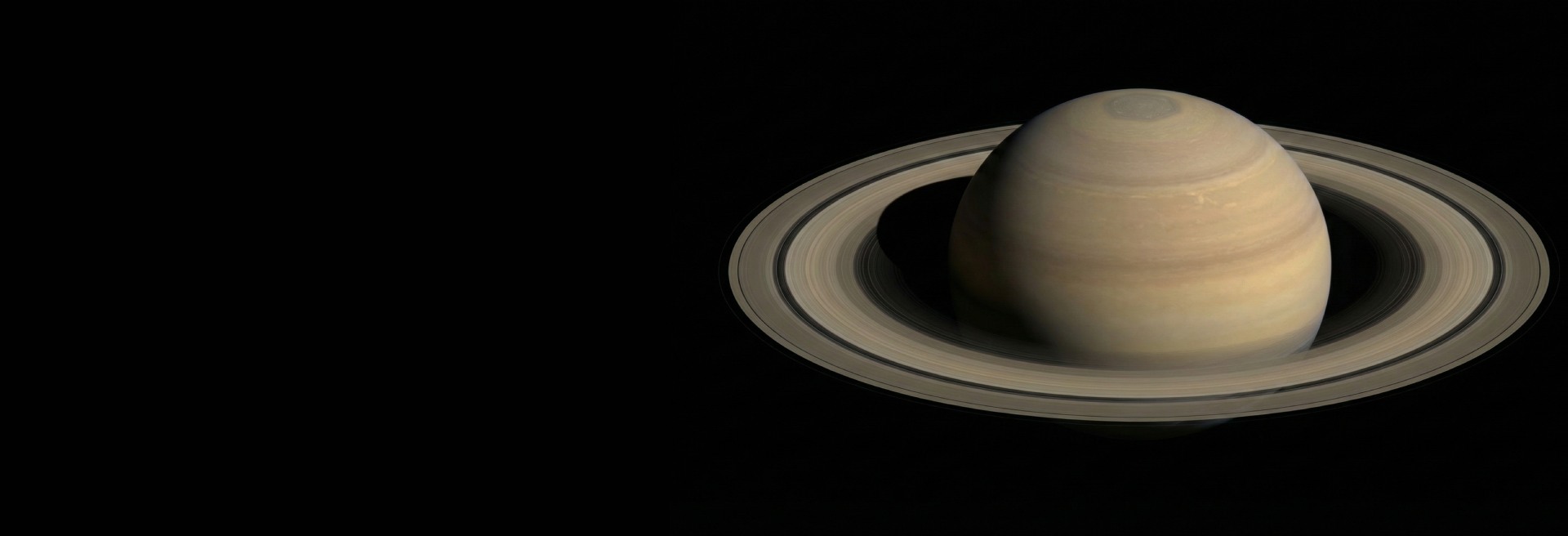
Introduction to Saturn
Saturn, named after the Roman god of agriculture and time, is perhaps the most visually stunning planet in our solar system. Its magnificent ring system, visible through even modest amateur telescopes, has captivated humanity since Galileo first observed the planet in 1610, though he couldn't resolve the rings clearly and described Saturn as having "ears." Today, we know these "ears" form the most spectacular planetary ring system known to science.
As a gas giant, Saturn shares many characteristics with its larger sibling Jupiter—both are composed primarily of hydrogen and helium, have no solid surface, possess numerous moons, and rotate rapidly. However, Saturn's lower mass and density, combined with its iconic rings and diverse family of moons, give it a distinct character that has made it a primary target for planetary exploration.
Saturn orbits the Sun at an average distance of 1.4 billion kilometers (9.5 AU), taking 29.5 Earth years to complete one orbit. Despite this great distance, Saturn is easily visible to the naked eye, appearing as a yellowish "star" in the night sky. Through a telescope, Saturn transforms into one of the most rewarding sights in amateur astronomy—a golden world encircled by brilliant rings, often accompanied by several of its brighter moons.
Physical Characteristics
Saturn is the second-largest planet in the solar system, yet it has the lowest density of all planets. This combination of large size and low density creates a world with unique physical properties and appearance.
Saturn Quick Facts
- Diameter: 120,536 km (9.4 Earths wide)
- Mass: 5.68 × 10²⁶ kg (95 Earth masses)
- Density: 0.687 g/cm³ (less than water!)
- Surface Gravity: 10.44 m/s² (1.07× Earth's)
- Day Length: 10 hours, 33 minutes
- Year Length: 29.5 Earth years
- Moons: 146+ confirmed
- Distance from Sun: 1.4 billion km (9.5 AU)
Data: NASA Planetary Science
A Light Planet
Saturn's most remarkable physical characteristic is its extremely low density—only 0.687 grams per cubic centimeter, less dense than water (1.0 g/cm³). This has led to the often-repeated factoid that Saturn would float if you could find an ocean large enough. This low density results from Saturn's composition: the planet is made almost entirely of the lightest elements—hydrogen (96%) and helium (3%)—with only trace amounts of heavier elements.
Saturn's rapid rotation causes significant equatorial bulging. The planet spins once every 10 hours and 33 minutes, making it one of the fastest-rotating planets despite its immense size. This rapid rotation creates centrifugal force that flattens Saturn at the poles and bulges it at the equator—Saturn's equatorial diameter is about 10% larger than its polar diameter, giving it a noticeably oblate (squashed) appearance.
Atmospheric Appearance
Saturn appears as a serene golden-yellow world, much more subdued than the colorful, turbulent Jupiter. This calmer appearance results from a layer of ammonia haze that covers the planet, muting the colors of the clouds beneath. Despite this tranquil appearance, Saturn's atmosphere is far from peaceful—wind speeds can exceed 1,800 kilometers per hour (1,100 mph) at the equator, among the fastest winds measured on any planet.
Saturn's Magnificent Ring System
Saturn's rings are the planet's most iconic feature and the most extensive ring system in the solar system. While Jupiter, Uranus, and Neptune also have rings, none approach the brilliance and complexity of Saturn's.
Composition and Structure
The rings are composed of countless particles ranging from tiny grains the size of sand to massive chunks as large as mountains. Most ring particles are 99.9% pure water ice, which makes them highly reflective and gives the rings their brilliant appearance. The remaining material consists of rocky debris and dust, possibly from shattered moons or comets.
Despite spanning up to 282,000 kilometers from Saturn's center, the rings are remarkably thin—typically only 10 to 30 meters thick in most places. To put this in perspective, if the rings were scaled down to the thickness of a piece of paper, they would be over a kilometer in diameter. This extreme thinness means the rings essentially disappear when viewed edge-on from Earth, an event that occurs approximately every 15 years as Saturn orbits the Sun.
The Main Ring Divisions
Saturn's rings are divided into several main sections, designated by letters in order of discovery:
- D Ring: The innermost ring, faint and difficult to observe
- C Ring: Also called the "Crepe Ring" due to its dusky appearance
- B Ring: The brightest and most massive ring, containing most of the ring system's mass
- Cassini Division: A 4,800-km-wide gap between the B and A rings, visible through small telescopes
- A Ring: The outermost major ring, separated from the B ring by the Cassini Division
- F Ring: A narrow, complex ring just outside the A ring, shepherded by small moons
- G Ring: A very faint, diffuse ring
- E Ring: An extremely wide but diffuse ring extending beyond the main rings, fed by geysers on Enceladus
Ring Dynamics and Shepherd Moons
The rings are not static—they're constantly evolving through complex gravitational interactions. Small moons called "shepherd moons" orbit near the rings and use their gravity to confine ring particles, maintaining sharp edges and gaps. The F ring, for example, is shepherded by the moons Prometheus and Pandora, which create intricate patterns in the ring material through their gravitational influence.
Gaps in the rings are created by orbital resonances with Saturn's moons. The prominent Cassini Division, for instance, results from a 2:1 orbital resonance with the moon Mimas—particles in the gap orbit Saturn twice for every orbit of Mimas, and this resonance clears the region of material over time.
The Origin and Age of the Rings
The origin of Saturn's rings remains debated. They could have formed from the destruction of a moon that wandered too close to Saturn and was torn apart by tidal forces, from debris left over from Saturn's formation, or from a shattered comet. Recent analysis from the Cassini mission suggests the rings are surprisingly young—perhaps only 100-400 million years old, forming long after the dinosaurs roamed Earth. This is much younger than Saturn itself and suggests the rings we see today are a temporary feature in the planet's history.
Ring Material Zoom
To the naked eye the rings look like solid discs. Zoom in and discover what they're really made of.
Wide view — Saturn's rings appear as smooth, glowing discs of light.
Ring Tilt Time-Slider
Saturn takes 29.5 years to orbit the Sun. As it does, our view of the rings changes — they open, close, and every ~15 years appear perfectly edge-on and nearly vanish. Drag the slider to travel through Saturn's orbit.
Rings are maximally open — easily visible even through small telescopes.
Atmosphere and Weather
Saturn's atmosphere, like Jupiter's, is primarily composed of hydrogen and helium with trace amounts of methane, ammonia, and other compounds. However, Saturn's atmosphere appears much calmer and more uniform, with subtler banding and fewer prominent storm features.
Atmospheric Composition
Saturn's atmosphere consists of approximately 96% hydrogen, 3% helium, and trace amounts of methane, ammonia, ethane, and other hydrocarbons. The ammonia ice crystals in the upper atmosphere give Saturn its characteristic pale yellow color. Deeper in the atmosphere, water ice clouds form, and still deeper, water droplets may exist in warmer layers.
Cloud Bands and Jet Streams
Saturn displays cloud bands similar to Jupiter, but they're more muted and difficult to observe due to overlying ammonia haze. These bands represent different atmospheric layers moving at different speeds—some of the fastest winds in the solar system occur in Saturn's equatorial region, where jet streams reach speeds of 1,800 km/h (1,100 mph), significantly faster than Jupiter's strongest winds.
The Hexagon
One of Saturn's most bizarre and fascinating features is a persistent hexagonal cloud pattern at the north pole, discovered by Voyager in the 1980s and studied extensively by Cassini. Each side of this hexagon is approximately 13,800 kilometers long—wider than Earth's diameter. The hexagon is a massive jet stream with winds reaching 320 km/h (200 mph). The hexagon has persisted for at least several decades and possibly much longer, making it one of the most stable weather features observed on any planet.
Scientists believe the hexagon forms due to interactions between different wind speeds and the planet's rotation, similar to how eddies form in rivers but on a planetary scale. No other planet displays such a geometric weather pattern, making Saturn's hexagon a unique phenomenon in atmospheric science.
Storms and the Great White Spot
Approximately once per Saturnian year (roughly every 30 Earth years), Saturn develops a massive storm system called the Great White Spot. These storms are bright, vast convective events that can encircle the entire planet and last for months. The most recent occurred in 2010-2011 and was visible through amateur telescopes. These periodic storms may be triggered by seasonal changes as Saturn's axial tilt (27 degrees) causes significant seasonal variation in solar heating.
The visible weather layer where ammonia ice crystals form Saturn's pale yellow cloud bands. Jet streams reach 1,800 km/h — the fastest sustained winds of any planet. The iconic north-polar hexagonal vortex sits at this level, wider than Earth's diameter.
Click any layer to explore it
Interior Structure
Saturn, like Jupiter, has no solid surface. Instead, the gaseous atmosphere gradually transitions into liquid and then into exotic forms of matter under extreme pressure deep in the planet's interior.
Layers of Saturn
Saturn's interior is thought to consist of several distinct layers:
- Outer Atmosphere: Primarily gaseous hydrogen and helium with ammonia clouds
- Liquid Hydrogen Layer: Below about 1,000 km depth, increasing pressure causes hydrogen to liquefy
- Metallic Hydrogen Layer: At depths around 30,000 km, pressure exceeds 3 million bars, transforming hydrogen into a metallic form that conducts electricity
- Core: A rocky core composed of metals and rock, perhaps 10-20 times Earth's mass, though its exact nature remains uncertain
Internal Heat
Saturn radiates about 2.5 times more energy into space than it receives from the Sun. This internal heat source results from gravitational compression—Saturn is slowly contracting under its own gravity, converting gravitational potential energy into heat. Additionally, helium droplets may be separating from hydrogen and sinking toward the core in a process called "helium rain," which releases gravitational energy as heat. This internal heat drives Saturn's powerful winds and weather systems.
Magnetosphere and Auroras
Saturn possesses a strong magnetic field generated by electric currents in its metallic hydrogen layer. This field creates a vast magnetosphere—a bubble of magnetic influence extending millions of kilometers into space.
The Magnetic Field
Saturn's magnetic field is about 578 times stronger than Earth's, though weaker than Jupiter's. Interestingly, Saturn's magnetic field is almost perfectly aligned with its rotation axis—within one degree—unlike most other planets. This unusual alignment puzzled scientists until Cassini data suggested Saturn's magnetic field may be influenced by its moons and ring system.
Auroras
Like Earth, Saturn experiences auroras at its poles when charged particles from the solar wind interact with the planet's magnetic field. Saturn's auroras can cover regions larger than Earth and emit ultraviolet light detected by spacecraft. The moon Enceladus contributes to Saturn's auroras by ejecting water vapor that becomes ionized and follows magnetic field lines toward the poles.
The Moons of Saturn
Saturn hosts at least 146 confirmed moons, the most of any planet in our solar system. These range from Titan, larger than Mercury, to tiny moonlets just a few meters across embedded in the rings. Seven moons are large enough to be rounded by gravity: Titan, Rhea, Iapetus, Dione, Tethys, Enceladus, and Mimas.
Titan: A World of Its Own
Titan is Saturn's largest moon and the second-largest moon in the solar system. With a diameter of 5,150 kilometers, it's larger than Mercury and is the only moon with a substantial atmosphere. Titan's atmosphere is 1.5 times thicker than Earth's and consists primarily of nitrogen (95%) with methane (5%) and trace organic compounds.
Surface temperatures on Titan average -179°C (-290°F), cold enough that water ice is as hard as rock. At these temperatures, methane exists as a liquid and undergoes a hydrological cycle similar to water on Earth—methane evaporates into clouds, forms rain, carves river channels, and collects in lakes and seas. Titan's largest lake, Kraken Mare, is larger than the Caspian Sea and contains more liquid hydrocarbons than all of Earth's oil reserves.
The Cassini-Huygens mission revealed Titan as a complex world with mountains, dunes, canyons, and a possible subsurface ocean of liquid water beneath the icy crust. The combination of organic chemistry, liquid methane, and potentially liquid water makes Titan a prime target in the search for exotic forms of life. NASA's Dragonfly mission, launching in 2027, will send a nuclear-powered rotorcraft to explore Titan's surface and search for signs of prebiotic chemistry or even life.
Enceladus: Ocean World
Enceladus, just 504 kilometers in diameter, is one of the most scientifically exciting worlds in the solar system. In 2005, Cassini discovered enormous geysers erupting from cracks near Enceladus's south pole, shooting water vapor, ice particles, and organic molecules hundreds of kilometers into space. This material forms Saturn's faint E ring.
The geysers provided direct evidence that Enceladus harbors a global subsurface ocean of liquid water beneath its icy crust, kept liquid by tidal heating from Saturn's gravity. Cassini flew through the geyser plumes and detected not only water but also organic compounds, salts, and molecular hydrogen—ingredients that could potentially support microbial life. The discovery of phosphates in Enceladus's plume in 2023 added another crucial ingredient for life, making Enceladus one of the most promising places to search for extraterrestrial life in our solar system.
Other Notable Moons
Saturn's other major moons each have distinctive characteristics:
- Mimas: Features the massive Herschel Crater, giving it an appearance similar to the Death Star from Star Wars
- Tethys: Has a huge canyon system called Ithaca Chasma that extends for 2,000 kilometers
- Dione: Shows evidence of past geological activity with bright ice cliffs and wispy features
- Rhea: Saturn's second-largest moon, possibly with its own thin ring system
- Iapetus: Has a distinctive two-tone coloration—one hemisphere is extremely dark while the other is bright white
- Hyperion: An irregularly shaped moon with a sponge-like appearance and chaotic rotation
Exploration History
Saturn has been visited by four spacecraft: Pioneer 11, Voyager 1, Voyager 2, and Cassini. These missions transformed our understanding of the Saturn system from telescopic observations to detailed knowledge of a complex planetary environment.
Pioneer 11 (1979)
Pioneer 11 became the first spacecraft to visit Saturn in September 1979, flying within 20,900 kilometers of the planet's cloud tops. The spacecraft discovered two previously unknown rings (the F and G rings) and a new small moon. Pioneer 11's measurements of Saturn's magnetic field and radiation environment provided crucial data for planning future missions.
Voyager 1 and 2 (1980-1981)
The Voyager missions revolutionized our understanding of Saturn. Voyager 1 flew past Saturn in November 1980, followed by Voyager 2 in August 1981. Together, they returned stunning close-up images of Saturn, its rings, and moons. Key discoveries included:
- Complex structure within the rings, revealing hundreds of ringlets
- The first detection of the hexagonal storm at Saturn's north pole
- Detailed images of Titan's thick atmosphere (though unable to see the surface)
- Discovery of active weather patterns in Saturn's atmosphere
- Detection of "shepherd moons" that maintain ring structure
- Multiple new moons, bringing the known total to 18
Cassini-Huygens Mission (2004-2017)
The Cassini-Huygens mission stands as one of the most successful planetary missions in history. This joint NASA-ESA-ASI project arrived at Saturn in July 2004 and studied the system for 13 years, revolutionizing our understanding of Saturn, its rings, and moons.
The mission consisted of two parts: NASA's Cassini orbiter and ESA's Huygens probe. In January 2005, Huygens detached from Cassini and descended through Titan's atmosphere, becoming the first spacecraft to land in the outer solar system. During its 2.5-hour descent and brief surface operations, Huygens returned images of river-like channels, lakes, and a landscape shaped by liquid methane.
Major Cassini discoveries include:
- The geysers of Enceladus and evidence of a subsurface ocean
- Liquid methane and ethane lakes on Titan
- Rain on Titan and complete mapping of its surface
- Detailed study of Saturn's rings, including the discovery of "propeller" moonlets
- Evidence that the rings are much younger than Saturn itself
- Discovery of dozens of new moons
- Detailed observations of Saturn's hexagon and polar auroras
- Seasonal changes over nearly half a Saturnian year
Cassini's mission ended on September 15, 2017, when controllers deliberately plunged the spacecraft into Saturn's atmosphere. This "Grand Finale" ensured Cassini wouldn't contaminate potentially habitable moons like Enceladus or Titan with Earth microbes. During its final months, Cassini performed 22 daring dives between Saturn and its rings, sampling the planet's atmosphere and making unprecedented measurements of the ring system.
Future Missions
While no missions are currently en route to Saturn, several proposed and approved missions target the Saturn system, particularly its fascinating moons.
Dragonfly Mission to Titan
NASA's Dragonfly mission, selected in 2019 and scheduled for launch in 2028, will send a nuclear-powered rotorcraft to explore Titan. The drone will fly between different locations on Titan's surface, studying its organic chemistry and searching for biosignatures. Dragonfly will sample materials in diverse geological settings, including dunes, craters, and deposits possibly related to cryovolcanism. The mission will arrive at Titan in 2034 and operate for at least 2.7 years, flying a total of over 175 kilometers.
Proposed Enceladus Missions
Several missions to Enceladus have been proposed, including orbiters that would fly through the geyser plumes to sample material from the subsurface ocean and search for signs of life. The Enceladus Orbilander concept would orbit Enceladus, then land near the south polar geysers to directly sample fresh material. Such a mission could definitively determine whether Enceladus's ocean harbors life.
Saturn Atmospheric Probe
A dedicated Saturn atmospheric probe has been proposed to study the planet's composition, structure, and dynamics by descending deep into the atmosphere—something Cassini couldn't do. Such a mission could resolve questions about Saturn's interior, the abundance of heavy elements, and atmospheric processes.
Interesting Facts About Saturn
Saturn's unique characteristics and fascinating discoveries make it one of the most intriguing planets in our solar system.
- Floating Planet: Saturn is the only planet less dense than water (0.687 g/cm³). If you could find an ocean large enough, Saturn would float—though the planet's mass would likely create a substantial wake!
- A Planet of Moons: With at least 146 confirmed moons, Saturn has more known natural satellites than any other planet. New small moons are still being discovered, particularly among the ring-embedded moonlets.
- Ring Rain: Saturn's rings are slowly disappearing. Material from the rings rains down onto Saturn at a rate that could eliminate the rings in just 100 million years. We're fortunate to live when Saturn has such spectacular rings.
- Mysterious Hexagon: The hexagonal jet stream at Saturn's north pole is unique in the solar system. Each side of this geometric storm is wider than Earth's diameter, and it has persisted for decades, possibly centuries.
- Titan's Methane Cycle: Titan is the only world besides Earth with stable liquid on its surface, though it's methane and ethane instead of water. Like Earth's water cycle, Titan has methane clouds, rain, rivers, and lakes—a hydrocarbon version of Earth's hydrological cycle.
- Seasonal Changes: Saturn's 27-degree axial tilt creates seasons that last over seven Earth years each. Cassini observed dramatic seasonal changes during its 13-year mission, including the appearance and disappearance of massive storms.
- Fastest Winds: Despite its serene appearance, Saturn has some of the fastest winds in the solar system, reaching 1,800 km/h (1,100 mph) at the equator—more than five times faster than the strongest Earth hurricanes.
- Galileo's Ears: When Galileo first observed Saturn through his telescope in 1610, he couldn't resolve the rings and thought Saturn had "ears" or was a triple planet. It wasn't until 1655 that Christiaan Huygens correctly identified Saturn's rings.
- A Family in Space: Cassini's mission discovered that Saturn, its rings, and its moons form a connected system. Enceladus feeds material into the E ring, while interactions between moons and rings create waves and gaps. The whole system operates as a single, interconnected environment.
External Resources
- NASA Saturn Overview - Official NASA page with latest Saturn discoveries
- Saturn on Wikipedia - Comprehensive encyclopedia article
- NASA Cassini Mission - Complete archive of the Cassini-Huygens mission
- NASA Dragonfly Mission - Upcoming mission to Titan
Frequently Asked Questions
What are Saturn's rings made of?
Saturn's rings are composed primarily of water ice particles ranging in size from tiny grains smaller than sand to massive chunks as large as houses and mountains. About 99.9% of the ring material is ice, with trace amounts of rocky debris and dust mixed in. The rings are remarkably thin—typically only 10-30 meters thick despite spanning hundreds of thousands of kilometers in diameter. The ice particles are incredibly reflective, which is why Saturn's rings appear so bright and spectacular when viewed through telescopes.
How many moons does Saturn have?
Saturn has at least 146 confirmed moons, making it the planet with the most known natural satellites in our solar system. These range from Titan, which is larger than the planet Mercury, to tiny moonlets embedded in the rings that are only a few meters across. Seven of Saturn's moons are large enough to be rounded by their own gravity: Titan, Rhea, Iapetus, Dione, Tethys, Enceladus, and Mimas. New small moons are still being discovered, particularly in and around the ring system.
Could life exist on Titan or Enceladus?
Both Titan and Enceladus are considered promising candidates for extraterrestrial life. Enceladus has a subsurface ocean of liquid water beneath its icy crust, and geysers spray water vapor and organic compounds into space—ingredients potentially suitable for microbial life. Titan, while extremely cold at -179°C, has liquid methane and ethane lakes on its surface and a complex organic chemistry. Some scientists speculate that exotic forms of life could exist in Titan's methane lakes, using different biochemistry than Earth life. NASA's upcoming Dragonfly mission will explore Titan's habitability.
Why is Saturn the least dense planet?
Saturn is the least dense planet in the solar system—so light that it would float if you could find a bathtub large enough! Its average density is only 0.687 grams per cubic centimeter, less than water (1.0 g/cm³). This low density results from Saturn's composition: it's made primarily of hydrogen and helium gases with only a small rocky core. The planet's rapid rotation (a day on Saturn lasts just 10 hours and 33 minutes) causes it to bulge significantly at the equator, further reducing its average density.
How long would it take to travel to Saturn?
Travel time to Saturn depends on the trajectory and propulsion system. NASA's Cassini spacecraft took nearly 7 years to reach Saturn after launching in 1997, arriving in 2004. The Voyager spacecraft took about 3-4 years using gravity assists from Jupiter. A direct trajectory without gravity assists would take much longer and require more fuel. Saturn orbits the Sun at an average distance of 1.4 billion kilometers (9.5 AU), so even light takes about 80 minutes to travel from Saturn to Earth.
Are Saturn's rings permanent?
Saturn's rings are not permanent on cosmic timescales. Scientists estimate the current ring system may only be 100-400 million years old, much younger than the 4.6-billion-year-old planet itself. The rings are gradually disappearing as material spirals into Saturn due to "ring rain"—ice particles pulled by gravity and Saturn's magnetic field. At the current rate, Saturn's rings could disappear entirely in another 100 million years, meaning we're fortunate to live in an era when Saturn has such magnificent rings.