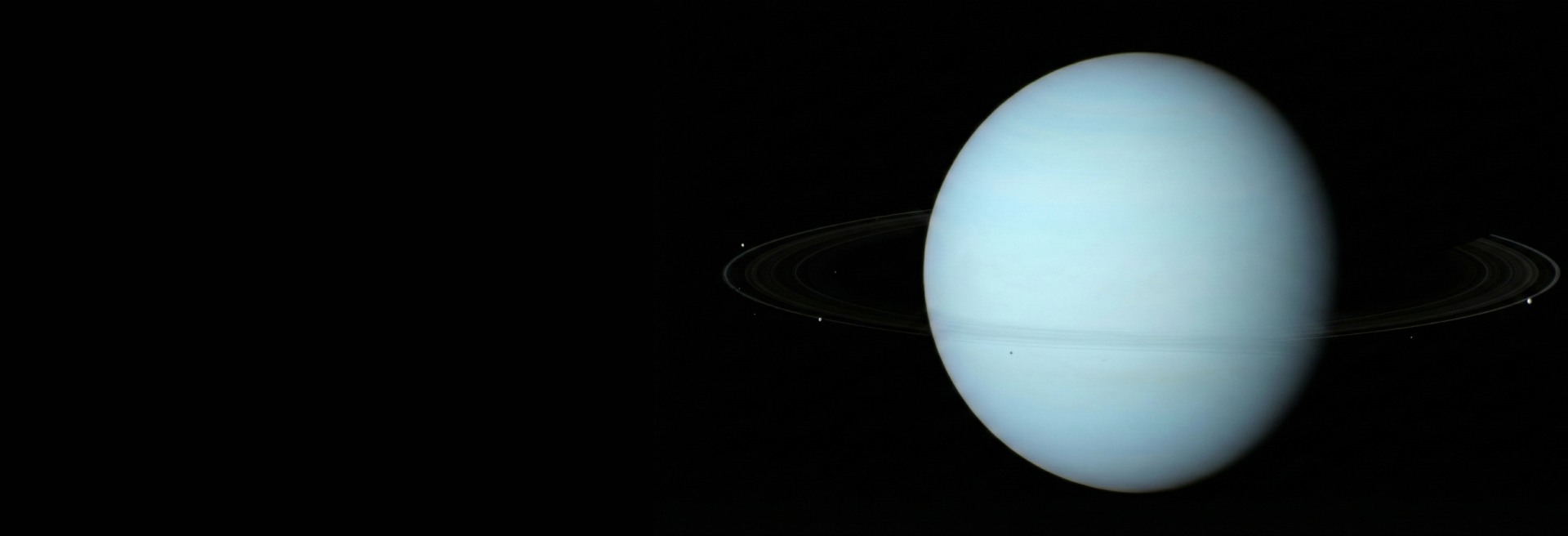
Introduction to Uranus
Uranus holds a special place in astronomy as the first planet discovered with a telescope. On March 13, 1781, British astronomer William Herschel observed what he initially thought was a comet but soon realized was a previously unknown planet, doubling the known size of the solar system in an instant. This discovery revolutionized our understanding of the cosmos and demonstrated that there might be more to explore beyond the planets known since antiquity.
Named after the Greek god of the sky (the father of Saturn and grandfather of Jupiter in mythology), Uranus is classified as an "ice giant" along with Neptune. These planets differ fundamentally from the gas giants Jupiter and Saturn, with interiors dominated by water, methane, and ammonia ices rather than hydrogen and helium gas.
Uranus orbits the Sun at an average distance of 2.9 billion kilometers (19.2 AU), taking 84 Earth years to complete one orbit. This means that a single season on Uranus lasts about 21 years. The planet's most distinctive feature is its extreme axial tilt of 98 degrees—essentially, Uranus rolls around the Sun on its side with its poles alternately pointing toward and away from the Sun. This unique orientation creates the most extreme seasonal variation in the solar system.
Physical Characteristics
Uranus is the third-largest planet by diameter and fourth-largest by mass. Its physical properties reflect its status as an ice giant with a fundamentally different internal structure than the gas giants.
Uranus Quick Facts
- Diameter: 51,118 km (4 Earths wide)
- Mass: 8.68 × 10²⁵ kg (14.5 Earth masses)
- Density: 1.27 g/cm³
- Surface Gravity: 8.87 m/s² (0.9× Earth's)
- Day Length: 17 hours, 14 minutes (retrograde)
- Year Length: 84 Earth years
- Moons: 27 known
- Distance from Sun: 2.9 billion km (19.2 AU)
Data: NASA Planetary Science
Size and Mass
With a diameter of 51,118 kilometers, Uranus is large enough to fit 63 Earths inside its volume. However, due to its lower density compared to the rocky planets, Uranus has a mass only 14.5 times that of Earth. This makes Uranus less massive than Jupiter (318 Earth masses), Saturn (95 Earth masses), and Neptune (17 Earth masses), despite being larger than Neptune in diameter.
Featureless Appearance
Uranus appears as a nearly featureless blue-green sphere, lacking the dramatic cloud bands and storms visible on Jupiter and Saturn. When Voyager 2 visited Uranus in 1986, it found a remarkably bland world with only a few faint clouds visible. This calm appearance results from an overlying haze layer that obscures deeper atmospheric features. However, modern observations with advanced telescopes have revealed more activity than Voyager observed, including clouds, storms, and even lightning.
The Extreme Axial Tilt
Uranus's most distinctive feature is its extreme axial tilt of 98 degrees. While most planets spin roughly upright relative to their orbital planes (Earth's tilt is 23.5 degrees), Uranus essentially lies on its side as it orbits the Sun. This creates a unique situation where Uranus appears to roll along its orbital path rather than spin like a top.
Seasons on Their Side
This extreme tilt creates the most unusual seasons in the solar system. Each pole experiences 42 years of continuous sunlight followed by 42 years of complete darkness. During the solstices, one pole points almost directly at the Sun while the other faces away into the darkness of space. During the equinoxes, the Sun appears to rise and set normally at mid-latitudes, but remains on the horizon at the poles.
When Voyager 2 visited in 1986, Uranus's south pole was pointed almost directly at the Sun, and nearly the entire southern hemisphere was in sunlight. By 2030, the equinox will have passed and the northern hemisphere will be approaching summer solstice. These extreme seasonal changes drive complex atmospheric dynamics and may contribute to the periodic storms observed on Uranus.
What Caused the Tilt?
The most widely accepted explanation for Uranus's tilt is that the planet suffered one or more massive collisions with Earth-sized objects during the chaotic early solar system. Such an impact or series of impacts could have knocked Uranus onto its side. Computer simulations suggest a grazing collision with an object twice Earth's mass could produce Uranus's current tilt while preserving its ring and moon system.
An alternative hypothesis suggests that gravitational interactions during the migration of the giant planets in the early solar system could have gradually tilted Uranus through resonances. However, this mechanism typically requires very specific conditions and is considered less likely than the impact hypothesis.
Effects on the Moons and Rings
Uranus's moons and rings orbit in the planet's equatorial plane, which means they also orbit "on their side" relative to Uranus's orbit around the Sun. From Earth, we see the rings and moons from different angles as Uranus orbits the Sun—sometimes viewing them edge-on, and other times seeing them face-on, creating a bull's-eye appearance when the rings encircle the planet vertically relative to Earth.
Atmosphere and Composition
Uranus's atmosphere extends for thousands of kilometers before gradually transitioning into the planet's fluid interior. The atmosphere's composition and dynamics create Uranus's distinctive appearance and weather patterns.
Atmospheric Composition
Uranus's atmosphere is composed of approximately 83% hydrogen, 15% helium, and 2% methane, with trace amounts of other hydrocarbons and ices. The methane in the upper atmosphere absorbs red wavelengths of sunlight while reflecting blue and green wavelengths, giving Uranus its characteristic cyan color. At deeper levels, water and ammonia clouds form, though these are hidden beneath the visible haze layer.
Temperature and Weather
Uranus holds the record for the coldest planetary atmosphere in the solar system, with temperatures plunging to -224°C (-371°F) in the upper atmosphere. Paradoxically, Uranus is colder than Neptune despite being closer to the Sun. This is because Uranus radiates very little internal heat—only about 1.06 times the energy it receives from the Sun, far less than the other giant planets which radiate 1.5-2.6 times their received solar energy.
For decades after Voyager 2's flyby, Uranus was thought to be a bland, inactive world. However, improved telescopes have revealed increasing atmospheric activity. Clouds have been observed moving rapidly through the atmosphere, and in 2014, astronomers detected a massive storm system covering a significant portion of the planet. These observations suggest Uranus's weather is more active and complex than once thought.
Wind Speeds
Wind speeds on Uranus reach up to 900 km/h (560 mph), though this is slower than the winds on Saturn and Neptune. Interestingly, winds blow in the direction of the planet's rotation at the equator but in the opposite direction near the poles, creating a complex wind pattern influenced by the planet's unusual orientation and extreme seasons.
The main weather layer where temperatures plunge to −224°C — the coldest planetary atmosphere in the solar system. Methane ice clouds form here; hydrogen sulphide clouds form slightly deeper. Wind speeds reach 900 km/h, blowing in opposite directions at the equator and poles.
Click any layer to explore it
Interior Structure
Uranus's internal structure differs significantly from the gas giants Jupiter and Saturn. As an ice giant, Uranus has a small rocky core surrounded by a thick mantle of "ices" in fluid form.
Layers of Uranus
Uranus's interior is thought to consist of three main regions:
- Core: A small rocky/icy core possibly containing silicates and iron, with a mass of around 0.5 Earth masses
- Icy Mantle: A thick mantle of hot, dense fluid consisting of water, methane, and ammonia "ices" at temperatures of thousands of degrees and extreme pressure. Despite high temperatures, these materials remain in a superionic state—somewhere between solid and liquid
- Atmosphere: A hydrogen-helium atmosphere extending about 20% of the radius, gradually transitioning into the mantle
The Missing Heat
One of Uranus's greatest mysteries is its lack of internal heat. Jupiter, Saturn, and Neptune all radiate significantly more heat than they receive from the Sun, powered by gravitational contraction and (in some cases) helium differentiation. Uranus, however, radiates almost no excess heat.
Several explanations have been proposed:
- The massive impact that tilted Uranus may have released most of its primordial heat
- Uranus's interior may have a unusual thermal conductivity that traps heat deep inside
- Convection in Uranus's interior may be inhibited by compositional layering
Understanding Uranus's internal heat budget remains an active area of planetary science research.
Uranus's Ring System
Uranus has 13 known rings, discovered unexpectedly in 1977 when astronomers observed Uranus passing in front of a star. The star blinked multiple times before and after Uranus itself blocked the star, revealing the presence of narrow rings surrounding the planet.
Ring Characteristics
Uranus's rings are dramatically different from Saturn's bright, icy rings. They are extremely dark—reflecting only about 2% of incident light—and are composed of dark particles ranging from dust-sized grains to boulders several meters across. The dark color suggests the particles contain organic compounds that have been darkened by radiation processing.
The rings are remarkably narrow, ranging from just a few kilometers to about 100 kilometers wide, with sharp edges. This narrowness suggests they are confined by shepherd moons, though not all shepherd moons have been identified. The rings also appear incomplete or "spotty" in places, with variations in density around their circumference.
The Named Rings
Uranus's rings are designated by Greek letters and numbers in order of discovery. The most prominent rings are:
- ε (Epsilon) Ring: The brightest and most massive ring, variable in width from 20 to 96 km
- α (Alpha) and β (Beta) Rings: Narrow rings about 7-12 km wide
- η (Eta), γ (Gamma), δ (Delta), and λ (Lambda) Rings: Additional narrow rings
- 1986U2R and ν (Nu) Rings: Faint dusty rings discovered by Voyager 2
- μ (Mu) Ring: A faint outer ring discovered in 2005
Ring Formation
The origin of Uranus's rings likely involves the destruction of one or more small moons that wandered too close to the planet and were torn apart by tidal forces. The dark, rocky composition suggests the destroyed moon(s) were similar to Uranus's small inner moons. The narrow, well-defined nature of the rings indicates they are relatively young and actively maintained by shepherd moons.
The Moons of Uranus
Uranus has 27 known moons, all named after characters from the works of William Shakespeare and Alexander Pope. This unique naming convention makes Uranus the only planet whose moons aren't named after mythological figures. The five largest moons—Miranda, Ariel, Umbriel, Titania, and Oberon—were all discovered before the space age and are substantial worlds in their own right.
Titania and Oberon
Titania and Oberon are Uranus's two largest moons, discovered by William Herschel in 1787, just six years after he discovered Uranus itself. Titania, with a diameter of 1,578 kilometers, is the eighth-largest moon in the solar system. Its surface shows evidence of past geological activity, including enormous fault canyons up to 1,500 kilometers long. Oberon, slightly smaller at 1,523 kilometers, has a heavily cratered ancient surface with some of the tallest peaks in the Uranian system, rising up to 6 kilometers high.
Umbriel and Ariel
Umbriel and Ariel were discovered in 1851 by William Lassell. Umbriel is the darkest of the five major moons, with an ancient, heavily cratered surface showing little evidence of geological activity. Its dark surface may be covered by carbonaceous material. In contrast, Ariel displays evidence of relatively recent geological activity, with fewer craters, bright ice deposits, and extensive fault valleys indicating past expansion and fracturing of the surface.
Miranda: The Frankenstein Moon
Miranda is perhaps the most fascinating moon in the Uranian system. Despite being the smallest of the five major moons at just 472 kilometers in diameter, Miranda displays an extraordinarily varied and extreme landscape unlike anything else in the solar system. Its surface appears to be a patchwork of different terrain types, including:
- Heavily cratered regions that appear ancient
- Grooved, striated regions called "coronae" with parallel ridges
- Verona Rupes, a cliff that plunges 20 kilometers—the tallest cliff known in the solar system
- Sharp boundaries between different terrain types
Miranda's bizarre appearance led scientists to nickname it the "Frankenstein moon." Several theories attempt to explain its strange geology. It may have been shattered by an impact and reassembled, with different pieces freezing in different orientations. Alternatively, tidal heating from orbital resonances in the past may have caused intense geological activity that created the coronae. Miranda remains one of the solar system's most geologically perplexing bodies.
Small Inner Moons
Uranus has 13 small inner moons discovered by Voyager 2 and later ground-based observations. These small moons orbit between Uranus and the ring system or within the rings themselves. Several serve as shepherd moons that help confine the narrow rings through their gravitational influence. These tiny moons are dark objects, likely similar in composition to the ring particles.
Magnetosphere
Uranus's magnetic field is one of the most unusual in the solar system. Unlike most planetary magnetic fields, which align roughly with the rotation axis, Uranus's magnetic field is tilted 59 degrees from its rotation axis and offset from the planet's center by about one-third of the planet's radius.
A Lopsided Field
This extreme tilt and offset create a highly asymmetric magnetosphere unlike any other planet's. As Uranus rotates, the magnetic field wobbles dramatically, creating a corkscrew-shaped magnetotail behind the planet. On one side of the planet, the magnetic field lines may be nearly parallel to the solar wind, while 17 hours later (half a Uranian day), they point in completely different directions.
Generation of the Field
The unusual magnetic field structure suggests it's generated not in a metallic core (as on Earth) but in a conducting fluid layer in the outer parts of the planet's interior—possibly in the water-ammonia "ocean" mantle. This conducting layer, under extreme pressure, may create electric currents that generate the magnetic field through dynamo action. Neptune has a similarly tilted and offset magnetic field, supporting this theory for ice giant magnetospheres.
Auroras
Like other planets with magnetic fields, Uranus experiences auroras when charged particles interact with its atmosphere. However, due to the extreme tilt of both the planet and its magnetic field, Uranus's auroras appear in unusual locations and move dramatically as the planet rotates. They've been observed in ultraviolet and infrared wavelengths by spacecraft and ground-based telescopes.
Exploration History
Uranus has been visited by only one spacecraft: Voyager 2, which flew past the planet on January 24, 1986. This remains humanity's only close-up look at Uranus, making it one of the least-explored planets in the solar system.
Discovery by Herschel
William Herschel discovered Uranus on March 13, 1781, while conducting a systematic survey of the night sky with a homemade telescope from his garden in Bath, England. Initially thinking it was a comet, he soon realized it moved too slowly and showed a disk rather than a point of light. The discovery was revolutionary—it doubled the known size of the solar system and proved that there were planets beyond those known since antiquity.
Herschel wanted to name the planet "Georgium Sidus" (George's Star) after King George III, but the international astronomy community eventually settled on Uranus, following the tradition of naming planets after Greco-Roman deities.
Early Observations
For nearly two centuries after its discovery, Uranus could only be studied through telescopes. Observations revealed the planet's blue-green color, its unusual axial tilt, and gradually discovered its five major moons and several rings. However, Uranus remained largely mysterious—a distant, faint disk that revealed few details even through the largest telescopes.
Voyager 2: The Only Visitor
Voyager 2's encounter with Uranus on January 24, 1986, transformed our understanding of the planet. After visiting Jupiter (1979) and Saturn (1981), Voyager 2 used gravity assists to reach Uranus 4.5 years later. At the time of the flyby, Uranus's south pole was pointed almost directly at the Sun, and Voyager approached from the direction of the illuminated southern hemisphere.
Key discoveries from Voyager 2's Uranus flyby:
- Discovered 10 new moons, bringing the total to 15 (now 27 with additional ground-based discoveries)
- Discovered two new rings and revealed the structure of previously known rings
- Measured the planet's magnetic field and discovered its extreme tilt and offset
- Studied the atmospheres and surfaces of Uranus's five major moons
- Revealed Miranda's extraordinarily varied and dramatic terrain
- Confirmed Uranus's extremely low internal heat output
- Measured atmospheric composition and cloud structure
- Observed a relatively bland, featureless atmosphere with only a few faint clouds
After the Uranus encounter, Voyager 2 continued to Neptune, which it reached in 1989, before leaving the solar system.
Modern Observations
Since Voyager 2, Uranus has been studied exclusively through ground-based and Earth-orbiting telescopes. The Hubble Space Telescope has observed Uranus extensively, revealing more atmospheric activity than Voyager saw, including clouds, storms, and changing weather patterns as the planet progressed through its 84-year orbit. These observations suggest Uranus's atmosphere is more dynamic when viewed over longer timescales.
Interesting Facts About Uranus
Uranus's unique characteristics make it one of the most peculiar planets in our solar system.
- First Planet Discovered with a Telescope: Uranus was the first planet discovered in modern times, expanding the known solar system beyond the five planets visible to the naked eye. Its discovery by William Herschel in 1781 demonstrated that systematic observation could reveal previously unknown worlds.
- Extreme Seasons: Due to its 98-degree axial tilt, each pole of Uranus experiences 42 years of continuous sunlight followed by 42 years of total darkness. If you lived on Uranus's north pole, you would experience one sunrise and one sunset per Uranian year—84 Earth years.
- Coldest Atmosphere: Despite being closer to the Sun than Neptune, Uranus has the coldest atmospheric temperature ever measured in the solar system at -224°C (-371°F). Scientists still don't fully understand why Uranus radiates so little internal heat.
- Retrograde Rotation: Due to its extreme tilt, Uranus technically has a retrograde rotation—it spins in the opposite direction to most other planets. However, this is a consequence of defining retrograde based on the north pole, which points "downward" on Uranus.
- Literary Moons: Uranus is the only planet whose moons are named after literary characters rather than mythological figures. The five major moons are named after characters from Shakespeare (Oberon, Titania, Miranda, Ariel) and Pope (Umbriel), while smaller moons are named after additional Shakespearean characters.
- Tallest Cliff: Miranda's Verona Rupes is the tallest known cliff in the solar system, plunging about 20 kilometers (12 miles). Due to Miranda's low gravity, an object dropped from the top would take about 12 minutes to hit the bottom.
- Ring Discovery: Uranus's rings were discovered accidentally in 1977 when the planet passed in front of a star. Astronomers observed the star blink multiple times before and after Uranus blocked it, revealing the presence of narrow rings that couldn't be seen directly.
- Only One Visitor: Voyager 2 remains the only spacecraft to visit Uranus, making it one of the least-explored planets. All our close-up knowledge of Uranus comes from observations made during a few hours in January 1986.
- Diamond Rain: Scientists theorize that deep within Uranus (and Neptune), methane may be compressed into diamond crystals that rain slowly downward toward the core. Laboratory experiments have demonstrated this process is possible under the extreme pressure and temperature conditions found in ice giant interiors.
External Resources
- NASA Uranus Overview - Official NASA page with latest Uranus discoveries
- Uranus on Wikipedia - Comprehensive encyclopedia article
- Voyager 2 Uranus Encounter - Details of humanity's only visit to Uranus
- The Planetary Society: Uranus - Educational resources and mission updates
Frequently Asked Questions
Why is Uranus tilted on its side?
Uranus has an extreme axial tilt of 98 degrees, meaning it essentially rolls around the Sun on its side with its poles facing the Sun at different points in its orbit. The most widely accepted explanation is that early in its history, Uranus suffered one or more massive collisions with Earth-sized objects that knocked it onto its side. Alternatively, gravitational interactions with other planets during migration in the early solar system might have gradually tilted Uranus. This unique orientation creates the most extreme seasons in the solar system, with each pole experiencing 42 years of continuous sunlight followed by 42 years of darkness.
What makes Uranus an ice giant instead of a gas giant?
Uranus is classified as an "ice giant" rather than a "gas giant" because its composition differs significantly from Jupiter and Saturn. While gas giants are composed primarily of hydrogen and helium, ice giants have much smaller amounts of these light elements. Instead, Uranus's interior consists mainly of "ices"—water, methane, and ammonia—surrounding a small rocky core. These materials exist in hot, dense fluid states under extreme pressure, not as solid ice. This composition makes Uranus fundamentally different from the gas giants despite its large size.
Why is Uranus blue-green in color?
Uranus appears blue-green due to methane in its atmosphere. Methane absorbs red wavelengths of sunlight but reflects blue and green wavelengths back to space, giving Uranus its distinctive cyan color. While Neptune also contains methane and appears blue, Uranus has a lighter, more pale blue-green appearance. Recent research suggests that both planets may also have a layer of photochemical haze that affects their coloration, with Uranus having a thicker, hazier layer that makes it appear lighter than Neptune.
How many moons does Uranus have?
Uranus has 27 known moons, all named after characters from the works of William Shakespeare and Alexander Pope—the only planet whose moons are not named after mythological figures. The five largest moons are Miranda, Ariel, Umbriel, Titania, and Oberon. Miranda is particularly fascinating with its extreme geological features, suggesting a violent history. Most of Uranus's smaller moons were discovered by Voyager 2 or through ground-based observations, and they orbit in the planet's equatorial plane, which means they also orbit "on their side" due to Uranus's tilt.
Is Uranus the coldest planet in the solar system?
Yes, Uranus holds the record for the coldest atmospheric temperature ever measured in the solar system: -224°C (-371°F). Surprisingly, Uranus is colder than Neptune despite being closer to the Sun. This is because Uranus has very little internal heat—it radiates almost no more heat than it receives from the Sun, unlike all other giant planets. Scientists aren't sure why Uranus lacks internal heat; it may have lost it through the massive collision that tilted the planet, or its interior structure may prevent efficient heat transfer from the core to the surface.
Does Uranus have rings like Saturn?
Yes, Uranus has a ring system, though it's much fainter and less spectacular than Saturn's. Uranus has 13 known rings, discovered in 1977 when they blocked starlight during a stellar occultation. The rings are extremely dark—reflecting only about 2% of incident light—and are composed of dark material, possibly organic compounds processed by radiation. The rings are narrow and range from just a few kilometers to about 100 kilometers wide. Like Uranus's moons, the rings orbit in the planet's equatorial plane and appear to encircle the planet vertically when viewed from Earth during certain parts of Uranus's orbit.