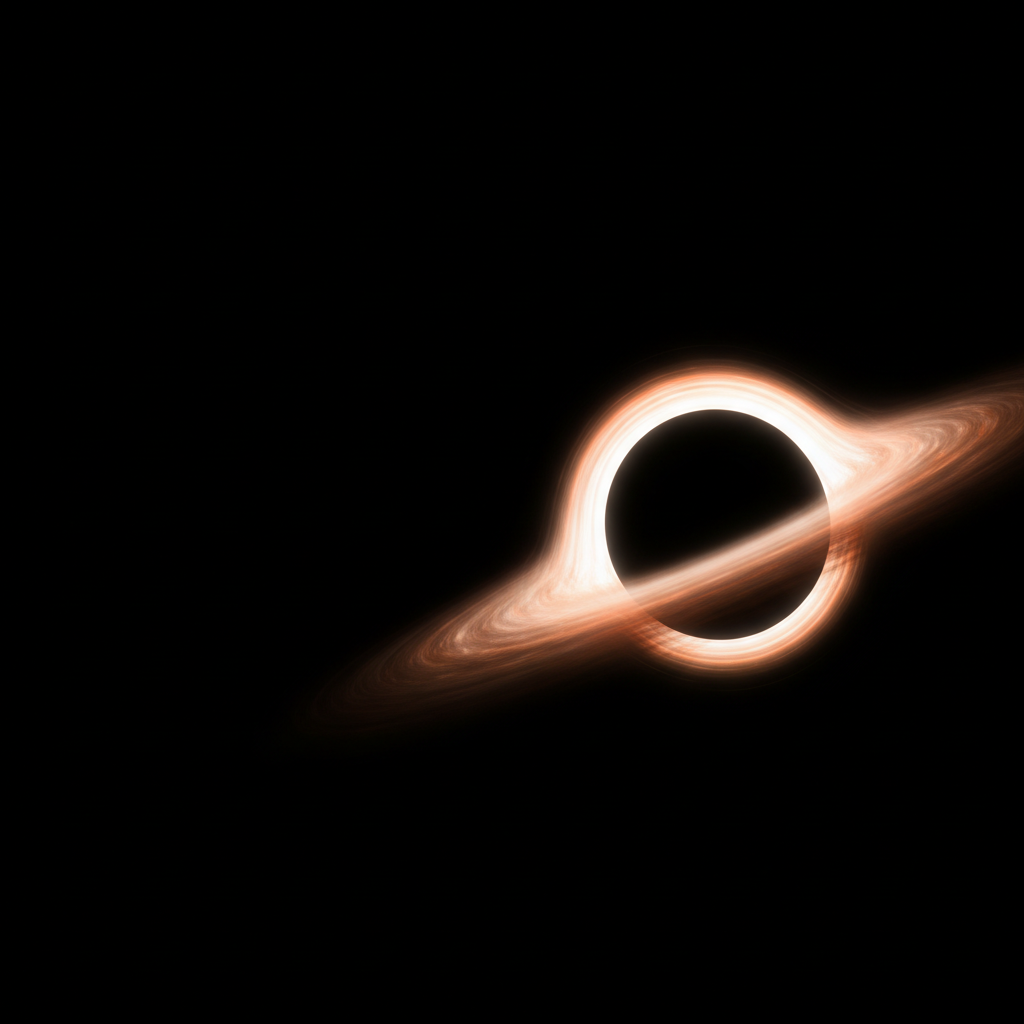
Introduction to Black Holes
Black holes represent the ultimate triumph of gravity over all other forces in nature. When a massive star—typically more than 20 times the mass of our Sun—exhausts its nuclear fuel, there is no outward pressure left to resist the inward crush of gravity. The star's core collapses catastrophically in a fraction of a second, compressing matter to such extreme densities that it warps spacetime itself, creating a region from which nothing, not even light, can escape.
The concept of an object so dense that light cannot escape was first proposed mathematically in the 18th century, but it wasn't until Einstein's general theory of relativity in 1915 that the physics of black holes could be properly understood. Karl Schwarzschild solved Einstein's equations in 1916, finding that a sufficiently compressed mass would create a boundary—now called the event horizon—beyond which escape becomes impossible. For decades, black holes remained theoretical curiosities, mathematical solutions that physicists doubted could exist in reality.
The discovery of Cygnus X-1 in the 1970s changed everything. This X-ray binary system contained an invisible compact object far too massive to be a neutron star, forcing astronomers to accept that black holes were real. Since then, thousands of stellar black holes have been identified through X-ray emissions from their accretion disks, and the 2015 detection of gravitational waves from merging black holes opened an entirely new window into these extreme objects.
Black holes are more than cosmic vacuum cleaners. They are laboratories for testing the most extreme predictions of physics, from the nature of spacetime to the fate of information. They power some of the most energetic phenomena in the universe, drive the evolution of galaxies, and challenge our understanding of reality itself.
Physical Characteristics
Stellar black holes are defined by remarkably few parameters. According to the "no-hair theorem," a black hole is completely described by just its mass, spin, and electric charge. Everything else about the star that formed it—its composition, shape, magnetic fields—is erased in the collapse. This simplicity makes black holes among the most elegant objects in physics, yet also the most extreme.
Black Hole Quick Facts
- Mass Range: 3 to 100+ solar masses (M☉)
- Schwarzschild Radius: ~3 km per solar mass
- Escape Velocity: Speed of light (c) at event horizon
- Density: Infinite at singularity, varies at horizon
- Temperature: Near absolute zero for stellar black holes
- Nearest Known: Gaia BH1 (~1,560 light-years)
Data: NASA Black Holes
The event horizon marks the point of no return. Its radius, called the Schwarzschild radius, is directly proportional to the black hole's mass: about 3 kilometers for every solar mass. A black hole with 10 solar masses would have an event horizon radius of 30 kilometers. Despite this relatively small size, the mass concentration creates gravitational fields of unimaginable strength.
At the center lies the singularity—a point where general relativity predicts infinite density and curvature of spacetime. Whether singularities truly exist or represent a breakdown of our physical theories remains one of the deepest questions in physics. Near the event horizon, tidal forces become so extreme that they would stretch any object into a thin stream of particles—a process colorfully termed "spaghettification."
Event Horizon and Ergosphere
The event horizon is not a physical surface but rather a mathematical boundary in spacetime. An observer falling through it would notice nothing special at the moment of crossing—no wall, no barrier. But once inside, every possible path through spacetime leads inexorably toward the singularity. Even traveling at the speed of light, escape becomes geometrically impossible.
Rotating black holes have an additional feature called the ergosphere, a region outside the event horizon where spacetime itself is dragged around by the black hole's spin. Objects in the ergosphere cannot remain stationary relative to distant observers—they must rotate with the black hole. This frame-dragging effect, predicted by general relativity, has been confirmed for rotating Earth and other massive bodies.
Accretion Disks and X-ray Emission
When a black hole pulls gas from a companion star or surrounding nebula, the infalling material doesn't plunge straight in. Conservation of angular momentum forces it to spiral inward, forming a flattened accretion disk. Friction within the disk heats the gas to millions of degrees, causing it to emit intense X-rays and gamma rays. These emissions make black holes among the brightest objects in X-ray astronomy.
The inner edge of the accretion disk hovers just outside the event horizon, at the innermost stable circular orbit. For a non-rotating black hole, this occurs at three times the Schwarzschild radius. Material closer than this spirals inward at near light speed, often emitting a final burst of radiation before disappearing forever beyond the event horizon.
Formation and Evolution
Stellar black holes are born in the violent death throes of massive stars. When a star more than about 20 solar masses exhausts its nuclear fuel, its core—now composed primarily of iron—can no longer generate energy through fusion. With no outward pressure to counteract gravity, the core undergoes catastrophic collapse.
Core Collapse and Supernova
In less than a second, the core implodes, compressing matter from the size of Earth to less than 20 kilometers across. This collapse releases an enormous amount of gravitational potential energy—equivalent to the Sun's total energy output over 10 billion years, released in a few seconds. The implosion bounces off the ultra-dense core, launching a supernova explosion that blows away the star's outer layers.
If the remaining core mass exceeds about 2.5-3 solar masses—the Tolman-Oppenheimer-Volkoff limit for neutron stars—not even neutron degeneracy pressure can resist gravity. The core continues collapsing, passing through its own event horizon to become a black hole. The exact mass threshold depends on the core's rotation and composition, making the boundary between neutron star and black hole formation somewhat uncertain.
Direct Collapse
Very massive stars (above ~40-50 solar masses) may collapse directly into black holes without producing a bright supernova. These stars lose so much mass through stellar winds that their outer envelopes may be thin at death, producing a faint or failed supernova. Some extremely massive stars may collapse directly to black holes with barely any visible outburst—a process called a failed supernova or direct collapse.
Hawking Radiation and Evaporation
Stephen Hawking's groundbreaking 1974 discovery showed that black holes are not entirely black. Quantum effects near the event horizon cause black holes to emit thermal radiation and slowly lose mass. This Hawking radiation has a temperature inversely proportional to the black hole's mass: for a stellar-mass black hole, the temperature is about a billionth of a degree above absolute zero—far colder than the cosmic microwave background.
As a result, stellar black holes don't evaporate—they actually gain mass by absorbing background radiation. Only microscopic primordial black holes from the early universe could have evaporated by now. A solar-mass black hole would take 10^67 years to evaporate, vastly longer than the current age of the universe (10^10 years).
Mergers and Gravitational Waves
When two black holes orbit each other, they emit gravitational waves—ripples in spacetime that carry away energy and angular momentum. This causes the orbit to decay, bringing the black holes closer together. Eventually, they spiral together and merge in a fraction of a second, releasing enormous energy as gravitational waves. The 2015 detection of such a merger by LIGO opened the era of gravitational wave astronomy and confirmed a key prediction of general relativity.
Detection and Observation
Since black holes emit no light of their own, detecting them requires observing their gravitational effects on surrounding matter and spacetime. Multiple complementary techniques have revealed thousands of stellar black holes and established their properties with remarkable precision.
X-ray Binary Systems
The most common method for finding stellar black holes is through X-ray binaries. When a black hole orbits a normal star closely enough, it pulls gas from its companion. This gas forms a superheated accretion disk that emits brilliant X-rays. By measuring the orbital period and Doppler shifts in the companion star's spectrum, astronomers can calculate the invisible object's mass. If it exceeds about 3 solar masses, it must be a black hole—too massive to be a white dwarf or neutron star.
Cygnus X-1, discovered as an X-ray source in 1964, became the first widely accepted black hole candidate through this method. The optical counterpart, a blue supergiant star, shows a 5.6-day orbital wobble indicating an unseen companion of at least 15 solar masses—well above the neutron star mass limit.
Gravitational Wave Astronomy
The 2015 detection of gravitational waves by LIGO revolutionized black hole astronomy. The signal GW150914 came from two black holes (36 and 29 solar masses) merging 1.3 billion light-years away. The merger lasted just 0.2 seconds but released more power than all the stars in the visible universe combined. Since then, dozens of black hole mergers have been detected, revealing a population of black holes more massive than previously thought possible from stellar evolution.
Gravitational Microlensing
When a black hole passes in front of a distant star, its gravity bends the background star's light, causing a temporary brightening. By studying the duration and shape of this microlensing event, astronomers can determine the lensing object's mass and distance. This technique can find isolated black holes that aren't in binary systems or actively accreting matter—objects otherwise invisible.
Notable Examples
Cygnus X-1: The first widely accepted stellar black hole, with a mass of about 21 M☉, orbiting a blue supergiant every 5.6 days. Located 6,070 light-years away, it's one of the brightest X-ray sources in the sky.
V404 Cygni: A low-mass X-ray binary containing a 9 M☉ black hole orbiting a K-type star every 6.5 days. Famous for its dramatic outbursts when mass transfer episodes cause the accretion disk to flare brilliantly in X-rays.
GW150914: The first detected gravitational wave event, produced by two black holes merging into a single 62 M☉ black hole. The three solar masses of "missing" mass was converted to gravitational wave energy—confirming Einstein's E=mc² at cosmic scales.
Gaia BH1: Discovered in 2022 through precise astrometry, this is the nearest known stellar black hole at ~1,560 light-years. It's a dormant black hole of about 10 M☉ orbiting a Sun-like star every 185 days, detected purely through the companion's orbital motion.
Interesting Facts About Black Holes
- Spaghettification: The technical term for the stretching that occurs near a black hole is "tidal disruption." The difference in gravitational pull between your head and feet near a stellar black hole would be so extreme that you'd be stretched into a thin stream of atoms long before reaching the event horizon. Supermassive black holes have gentler tidal forces, so you might cross their event horizons intact—but you still couldn't escape.
- Time Dilation: According to general relativity, time passes more slowly in strong gravitational fields. An observer watching someone fall into a black hole would see them slow down and freeze at the event horizon, taking infinite time to cross. The infalling person experiences no such delay—from their perspective, they fall through in finite time. This is the famous "frozen star" paradox that confused physicists for decades.
- Information Paradox: Quantum mechanics says information cannot be destroyed, but general relativity says anything falling into a black hole is lost forever. This conflict, known as the black hole information paradox, remains one of the deepest problems in theoretical physics. Hawking radiation may encode the information, but exactly how remains hotly debated.
- Event Horizon Telescope: In 2019, the Event Horizon Telescope captured the first image of a black hole's shadow—the supermassive black hole at the center of galaxy M87. The image shows a dark region (the shadow) surrounded by a bright ring of emission from the accretion disk. This confirmed predictions of general relativity with unprecedented precision.
- Black Hole Mergers: When two black holes merge, they create a new black hole that initially "rings" like a struck bell, emitting gravitational waves at specific frequencies. By analyzing these ringdown signals, astronomers can test whether the merged object truly is a black hole as predicted by general relativity—so far, every test has confirmed Einstein's theory.
- No-Hair Theorem: Black holes are remarkably simple objects, characterized by only three properties: mass, spin, and electric charge. Everything else about the original star—its chemical composition, magnetic field, surface features—is erased. Physicist John Wheeler summarized this as "black holes have no hair," meaning no distinguishing features beyond those three numbers.
- Spin and Frame Dragging: Most black holes rotate rapidly, spinning near their theoretical maximum. The fastest rotating black hole ever measured spins at 98% of the maximum possible rate. This rotation drags spacetime around with it in a vortex-like effect, creating an ergosphere where nothing can remain stationary relative to distant observers.
- Black Holes Don't Suck: Despite popular depictions, black holes don't act like cosmic vacuum cleaners. Their gravitational pull follows the same inverse-square law as any massive object. If the Sun suddenly became a black hole (it can't—it's not massive enough), Earth's orbit wouldn't change at all. You have to get very close to the event horizon before the extreme gravitational effects manifest.
External Resources
- NASA Black Holes - NASA's comprehensive guide to black holes, with news, images, and mission updates
- ESA Black Holes - European Space Agency's black hole research and observations
- Cygnus X-1 on Wikipedia - Detailed article on the first confirmed stellar black hole
- LIGO Gravitational Wave Detections - Catalog of gravitational wave events from merging black holes
- Event Horizon Telescope - Project that captured the first black hole image
Frequently Asked Questions
What is a stellar black hole?
A stellar black hole forms when a massive star—typically more than 20 solar masses—exhausts its nuclear fuel and undergoes a supernova explosion. The core collapses under its own gravity to a point of infinite density called a singularity, surrounded by an event horizon from which nothing, not even light, can escape. Stellar black holes typically have masses between 3 and 100 solar masses. They are the most common type of black hole and the endpoint of the most massive stellar lives.
What is the event horizon?
The event horizon is the boundary around a black hole where the escape velocity equals the speed of light. Inside the event horizon, the gravitational pull is so strong that nothing—not matter, not information, not light—can escape. It's not a physical surface but rather a point of no return. The radius of the event horizon (called the Schwarzschild radius) is proportional to the mass of the black hole: for a black hole with the Sun's mass, it would be about 3 kilometers in radius.
Can we see black holes?
Black holes themselves are invisible because no light escapes them, but we can detect them indirectly. When gas and dust spiral into a black hole, they form a superheated accretion disk that glows brightly in X-rays. We can also detect black holes through gravitational lensing (bending of light), stellar orbits around invisible massive objects, and gravitational wave detections. In 2019, the Event Horizon Telescope captured the first image of a black hole's shadow—the supermassive black hole at the center of galaxy M87.
What happens if you fall into a black hole?
From your perspective, falling into a black hole might seem relatively normal at first. As you approach the event horizon, you'd see light from the outside universe blueshifting and appearing to concentrate ahead of you. For a stellar-mass black hole, tidal forces would stretch you apart (spaghettification) before you reached the event horizon. For a supermassive black hole, you might cross the event horizon without noticing—but you'd be unable to escape and would eventually reach the singularity.
Do black holes evaporate?
Yes, according to Stephen Hawking's theory, black holes slowly lose mass through a quantum mechanical process called Hawking radiation. Virtual particle pairs constantly form and annihilate near the event horizon, but sometimes one particle escapes while the other is captured, effectively causing the black hole to radiate energy and lose mass. For stellar-mass black holes, this process is incredibly slow—they would take longer than the current age of the universe many times over to evaporate. Only tiny primordial black holes could evaporate in observable timescales.
How were the first black holes discovered?
The first strong evidence for black holes came from X-ray binary systems where a compact object was accreting gas from a companion star. Cygnus X-1, discovered in 1964 and confirmed as a black hole candidate in the 1970s, was the first accepted black hole. The mass was determined by studying the orbital motion of its companion star—the system requires an invisible object of at least 6 solar masses, far too massive to be a neutron star. Modern confirmations come from gravitational wave detections of merging black holes.
What is the largest known stellar black hole?
As of recent surveys, some of the most massive known stellar black holes have masses between 50-100 solar masses. However, the detection of gravitational waves from merging black holes has revealed objects with masses that were unexpected by standard stellar evolution models. The black holes detected in the merger GW150914 had masses of about 36 and 29 solar masses. There may also be intermediate-mass black holes forming from the direct collapse of massive stars without a supernova.