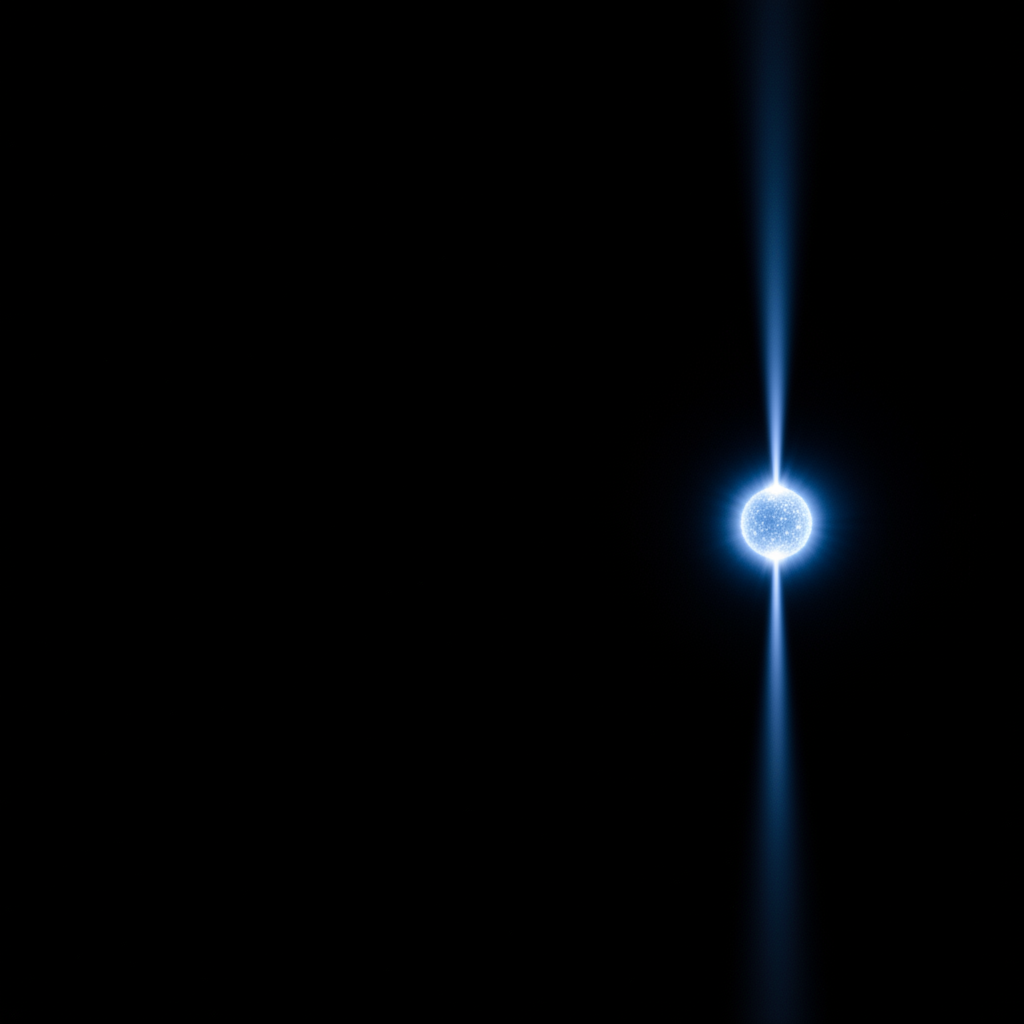
Introduction to Neutron Stars
Neutron stars are among the most extreme objects in the universe. With masses 1-2 times that of the Sun compressed into a sphere just 20 kilometers across, they are the densest objects outside of black holes. A teaspoon of neutron star material would weigh about a billion tons.
These stellar remnants rotate rapidly, generate powerful magnetic fields, and emit beams of radiation. When we detect these beams as regular pulses, we call them pulsars.
Physical Properties
Neutron Star Quick Facts
- Diameter: ~20 km
- Mass: 1-2 solar masses
- Density: ~10^17 kg/m³
- Rotation Period: Milliseconds to seconds
- Magnetic Field: 10^8 to 10^15 Tesla
Data: NASA Universe
Formation via Supernova
Neutron stars form when massive stars (8-20 solar masses) exhaust their nuclear fuel and undergo core collapse supernova explosions.
Pulsars
Pulsars are rapidly rotating neutron stars emitting beams of radiation. Some spin hundreds of times per second.
Magnetars
Magnetars have the strongest magnetic fields in the universe and occasionally release massive energy bursts.
Notable Neutron Stars
Crab Pulsar
The remnant of the 1054 supernova, rotating 30 times per second.
PSR J1748-2446ad
The fastest known pulsar, spinning 716 times per second.
Observing Neutron Stars
Most neutron stars are observed through radio pulses or X-ray emissions.
Interesting Facts
- Incredibly Dense: A teaspoon of neutron star material would weigh about a billion tons.
- Cosmic Lighthouses: Pulsars are among the most precise natural clocks in the universe.
- First Exoplanets: The first confirmed exoplanets were discovered orbiting a pulsar in 1992.
- Gravitational Waves: Merging neutron stars produce gravitational waves and create heavy elements.
- Starquakes: Magnetars experience sudden cracking of the crust releasing enormous energy.
- Extreme Magnetism: Magnetar magnetic fields are the strongest in the universe.
- Millisecond Pulsars: Some spin hundreds of times per second.
- Spaghettification: Tidal forces near neutron stars would stretch objects into thin strands.
External Resources
Frequently Asked Questions
What is a neutron star?
A neutron star is the incredibly dense collapsed core of a massive star (8-20 solar masses) that exploded as a supernova. Neutron stars typically contain 1-2 solar masses within a diameter of just 20 kilometers—making them the densest objects besides black holes.
What is a pulsar?
A pulsar is a rapidly rotating neutron star that emits beams of electromagnetic radiation from its magnetic poles. As the neutron star spins, these beams sweep through space like a lighthouse. Pulsars were discovered in 1967 by Jocelyn Bell Burnell.
What is a magnetar?
A magnetar is a neutron star with an extremely powerful magnetic field—a quadrillion times stronger than Earth's. They occasionally release massive bursts of X-ray and gamma-ray energy called starquakes.
How fast do neutron stars spin?
Neutron stars can spin remarkably fast. Young neutron stars may spin a few times per second, while millisecond pulsars can spin hundreds of times per second. The fastest known pulsar rotates 716 times per second.
Can anything orbit a neutron star?
Yes, neutron stars can have planets. The first confirmed exoplanets were found orbiting the pulsar PSR 1257+12 in 1992. Neutron stars can also have companion stars in binary systems.
What would happen if you approached a neutron star?
Approaching a neutron star would be extremely lethal. Its gravitational field would tear you apart through tidal forces. The radiation environment is deadly, and gravity is 200 billion times stronger than Earth's.