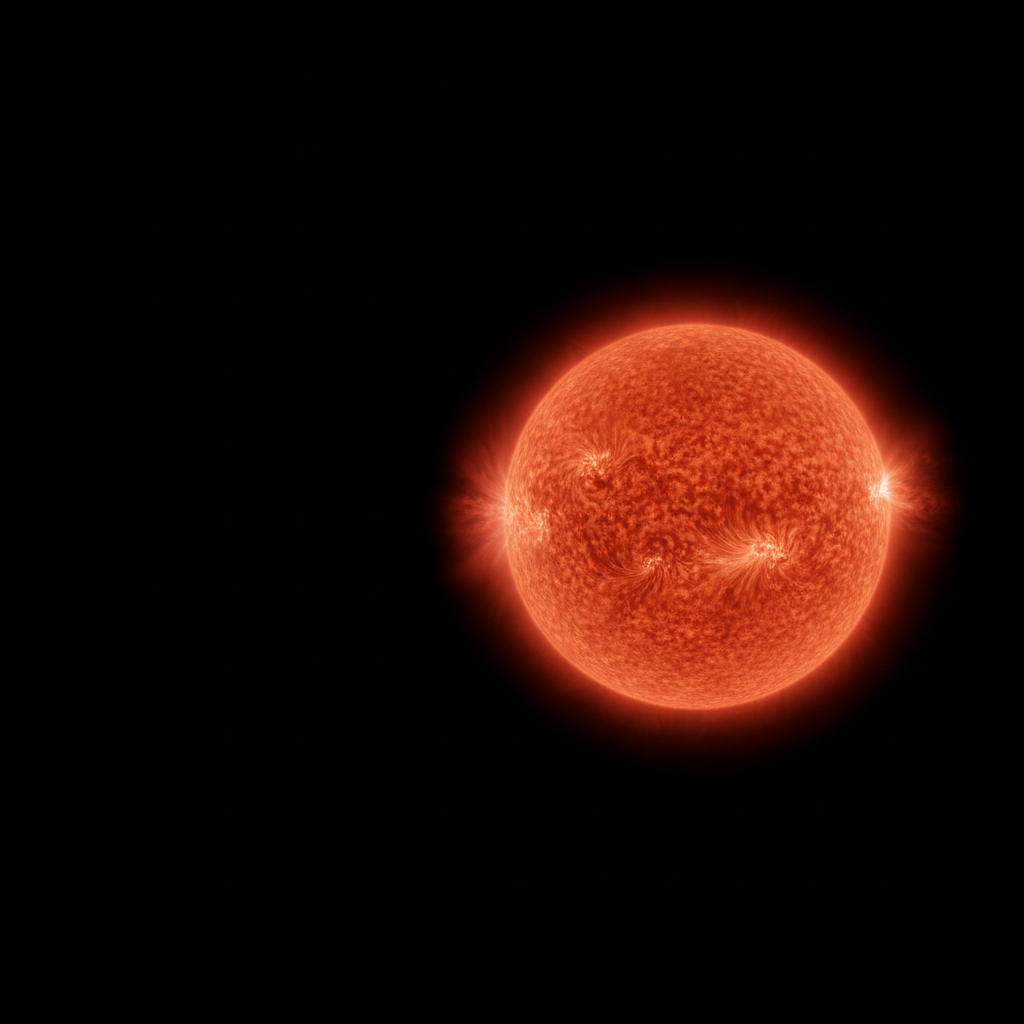
Introduction to Red Giant Stars
Red giants represent one of the most dramatic transformations in the universe—the death throes of Sun-like stars that have exhausted their hydrogen fuel. What was once a stable, middle-aged star suddenly blooms outward into a vast, cool, luminous giant, sometimes growing to hundreds of times its original diameter. This spectacular expansion is a fundamental stage of stellar evolution that virtually every low to medium-mass star undergoes.
For our own Sun, this fate awaits in roughly 5 billion years. When the Sun finally runs out of hydrogen to fuse in its core, it will begin swelling into a red giant—eventually growing large enough to engulf the inner planets. This prospect, though distant, gives red giants a particular personal relevance for humanity.
Despite their dramatic appearance, red giants are well understood by astronomers. They represent a predictable stage in the stellar life cycle, following naturally from the exhaustion of main sequence hydrogen burning. The physics governing their structure, composition, and eventual fate has been worked out in detail through decades of theoretical work and observational confirmation.
Red giants are also among the most visible stars in the night sky. Their high luminosity and characteristic red-orange color make them stand out prominently. Stars like Arcturus, Aldebaran, and Pollux are all red giants, and they have been familiar objects in the night sky since antiquity.
Physical Characteristics
Red giants are physically much larger than main sequence stars, yet paradoxically cooler at their surfaces. This combination of large size and low temperature gives them their distinctive red-orange color and makes them highly luminous despite the cool surface.
Red Giant Quick Facts
- Size Range: 10 to 100 solar radii
- Surface Temperature: 3,500 to 5,000 K
- Luminosity: 10 to 1,000 solar luminosities
- Mass Range: 0.6 to 8 solar masses (original)
- RGB Phase Lifespan: ~1-2 billion years
- Spectral Class: K or M
Data: NASA Stellar Evolution
The enormous size of red giants is a direct consequence of the internal changes occurring as the star exhausts its fuel. When the hydrogen in the core is depleted, hydrogen fusion continues in a shell around the inert helium core. This shell burning provides more energy than before, inflating the outer layers dramatically. The star's radius can grow from 1 solar radius to 10-100 solar radii over millions of years.
Despite being vastly larger, red giants have lower surface gravity than main sequence stars because their mass is spread over a much larger volume. This low gravity means their outer layers are only loosely bound, and stellar winds can carry material away at significant rates.
The Stellar Evolution Path to Red Giants
The path from main sequence star to red giant is a gradual process that takes hundreds of millions to billions of years, depending on the star's original mass.
Core Hydrogen Exhaustion
On the main sequence, a star fuses hydrogen into helium in its core. Over billions of years, the hydrogen supply dwindles as helium accumulates. The core contracts under gravity, heating up. Meanwhile, hydrogen continues fusing in a shell around the increasingly inert helium core.
The Subgiant Phase
As the hydrogen-burning shell grows, the outer layers begin expanding and cooling. The star moves off the main sequence onto the subgiant branch. This phase may last several hundred million years for a Sun-like star.
Red Giant Branch Ascent
Eventually, the star's outer layers have expanded and cooled enough for the surface to become convective. The star climbs the red giant branch (RGB) on the HR diagram, growing ever larger and more luminous while the surface temperature remains roughly constant. The star can become several hundred times more luminous than the present-day Sun during this ascent.
Tip of the Red Giant Branch
The ascent of the red giant branch ends when the helium core reaches conditions hot enough for helium fusion—the helium flash in low-mass stars. The star then settles into a stable helium-burning phase.
The Helium Flash
The helium flash is one of the most dramatic events in the life of a low-mass star—a brief but enormously energetic ignition of helium fusion in the star's degenerate core. Despite its violence, this event is hidden from outside observers.
Why It Happens
As the helium core accumulates, it becomes so compressed that it enters a state called electron degeneracy. In degenerate matter, pressure no longer depends on temperature. When helium ignition begins, the resulting temperature increase doesn't relieve pressure through expansion, causing a runaway thermonuclear reaction.
The Flash Itself
Within minutes to hours, the helium flash releases an enormous amount of energy—temporarily matching the luminosity of an entire galaxy. However, all this energy is deposited in the star's thick outer envelope and never reaches the surface as visible light. The flash effectively converts the degenerate core into a normal, thermally-supported core.
After the Flash
Following the helium flash, the star settles into a new, stable phase burning helium in its core and hydrogen in a surrounding shell. It moves to the horizontal branch on the HR diagram—a phase that may last another 100 million years.
Composition and Layers
Red giants have a complex internal structure, quite different from main sequence stars.
The Helium Core
At the center of a red giant on the RGB is an inert helium core, left behind from billions of years of hydrogen fusion. This core is incredibly dense—roughly the size of Earth but containing much of the star's original mass.
Hydrogen-Burning Shell
Surrounding the helium core is a thin shell where hydrogen fusion continues. This shell produces most of the star's energy during the red giant phase and gradually moves outward through the star as it processes more hydrogen.
The Convective Envelope
The vast, cool outer layers form a deep convective envelope where energy is transported upward by the mixing of hot and cool gas. This deep convection can dredge up material from deeper layers, enriching the surface with nuclear fusion products.
Stellar Winds
Red giants have powerful stellar winds that continuously shed mass into space. These winds play a crucial role in determining the star's eventual fate and enrich the interstellar medium with heavy elements.
Notable Red Giant Stars
Many of the most recognizable stars in the night sky are red giants, their high luminosity making them visible despite being much farther away than most stars we see.
Arcturus (Alpha Bootis)
The brightest star in the northern celestial hemisphere and fourth brightest overall, Arcturus is an orange giant about 36 light-years away. It shines at magnitude -0.05, is about 25 times the radius of the Sun, 170 times more luminous, and has a surface temperature of 4,286 K.
Aldebaran (Alpha Tauri)
The red "eye" of Taurus the Bull, Aldebaran is a prominent orange giant about 65 light-years away. With a radius about 44 times the Sun's and a surface temperature of 3,900 K, it is a classic example of a K-type giant.
Mira (Omicron Ceti)
The prototype "long-period variable" red giant, Mira pulsates with a period of about 332 days, varying in brightness by a factor of 1,500. At maximum it can shine at magnitude 2 (easily visible), at minimum around magnitude 10. Mira is about 400 light-years away.
Pollux (Beta Geminorum)
The brightest star in Gemini, Pollux is an orange giant about 34 light-years away with a confirmed extrasolar planet orbiting it. It represents a relatively cool, luminous K-type giant that the Sun will eventually resemble.
Observing Red Giants
Red giants are among the easiest types of stars to identify visually, thanks to their distinctive red-orange coloration and high brightness. Many of the brightest stars in the sky are red or orange giants.
Identifying Red Giants by Color
The reddish tint of stars like Arcturus (orange), Aldebaran (orange-red), and Antares (reddish) is immediately apparent to the naked eye under good conditions. Their color directly indicates cool surface temperatures (3,500-5,000 K).
Seasonal Visibility
Different red giants dominate different seasons. Arcturus is a spring and summer star in the northern hemisphere, while Aldebaran is prominent in winter skies. Antares (a red supergiant) marks the heart of Scorpius and is best seen in summer.
Variable Red Giants
Several red giants are variable stars worth monitoring. Mira (Omicron Ceti) varies dramatically between magnitudes 2 and 10 over 332 days and is tracked by amateur astronomers worldwide through the AAVSO.
Interesting Facts About Red Giants
- Future Sun: Our own Sun will become a red giant in approximately 5 billion years, potentially engulfing Earth as it swells to over 100 times its current radius.
- Planetary Nebula Factories: When a red giant eventually sheds its outer layers, it creates a beautiful planetary nebula. The Ring Nebula (M57) is a classic example of such a remnant.
- Arcturus Navigation: Arcturus is easily found by following the arc of the Big Dipper's handle outward—"Arc to Arcturus." It has been used for navigation since ancient times.
- Ancient Bright Stars: Many of the 50 brightest stars in the night sky are red or orange giants. Their high luminosity makes them visible at much greater distances than typical main sequence stars.
- Planetary Survivors: Some planets orbiting red giants may survive the expansion phase if they orbit far enough out. Gas giant planets at several AU could persist as the star inflates.
- Element Factories: Red giants produce significant amounts of carbon, nitrogen, and other elements through nuclear burning. When mass is shed, these elements enrich the interstellar medium for future star and planet formation.
- Helium Flash Energy: The helium flash in a Sun-like star releases energy comparable to the Sun's entire main sequence output compressed into a few minutes—yet is completely invisible from outside.
- Pulsating Giants: Many red giants pulsate, slowly expanding and contracting over months to years. These pulsations cause predictable brightness changes and were among the first types of variable stars studied systematically.
External Resources
- NASA Stars & Stellar Evolution - NASA's overview of star types and life cycles
- Red Giant on Wikipedia - Comprehensive encyclopedia article on red giant stars
- ESA Stars - European Space Agency stellar science resources
- Stellar Evolution on Wikipedia - Full stellar evolution from birth to death
Frequently Asked Questions
What is a red giant star?
A red giant is an evolved star that has exhausted the hydrogen in its core and entered a new phase of stellar evolution. When core hydrogen runs out, the core contracts and heats up while the outer layers expand dramatically, cooling as they spread out. This cooling makes the star glow red-orange rather than yellow-white. Red giants are 10 to 100 times larger than they were on the main sequence, yet they have cooler surface temperatures (below 5,000 K).
Will our Sun become a red giant?
Yes, in about 5 billion years, the Sun will exhaust the hydrogen in its core and begin expanding into a red giant. During this process, it will grow large enough to engulf Mercury and Venus, and possibly Earth as well. The Sun will eventually shed its outer layers as a planetary nebula, leaving behind a dense white dwarf about the size of Earth. This is the eventual fate of all stars with masses between about 0.6 and 8 solar masses.
How long do stars stay red giants?
The red giant phase is relatively short compared to the main sequence. A Sun-like star spends about 10 billion years on the main sequence but only around 1-2 billion years as a red giant. The most luminous part of the red giant branch (near the helium flash) lasts only about 100 million years. After the helium flash, the star settles into a more stable phase burning helium in its core.
What is the helium flash?
The helium flash is a brief, explosive event that occurs in low-mass stars (less than about 2 solar masses) when helium ignition suddenly begins in the degenerate core. Because the degenerate core can't expand to cool itself, the temperature rise accelerates the fusion rate, causing a runaway reaction that releases enormous energy over just a few hours or days. Despite its intensity, the helium flash is invisible from outside the star—all the energy is absorbed by the star's thick outer layers.
What are the most famous red giant stars?
Some of the most visible red giants include Arcturus (the brightest star in the northern celestial hemisphere), Aldebaran (the red eye of Taurus the Bull), and Pollux in Gemini. Mira is a famous pulsating red giant variable star that changes dramatically in brightness over about 332 days. These stars are so luminous that despite being hundreds of light-years away, they are among the brightest stars in our night sky.
What comes after the red giant phase?
After the red giant phase, a star's fate depends on its mass. Low and medium-mass stars (like the Sun) will lose their outer layers as a beautiful planetary nebula, leaving a hot white dwarf remnant. Higher-mass stars may go through additional evolutionary stages—becoming asymptotic giant branch (AGB) stars, then carbon stars—before finally losing their envelopes. The most massive stars become red supergiants and eventually explode as supernovae.