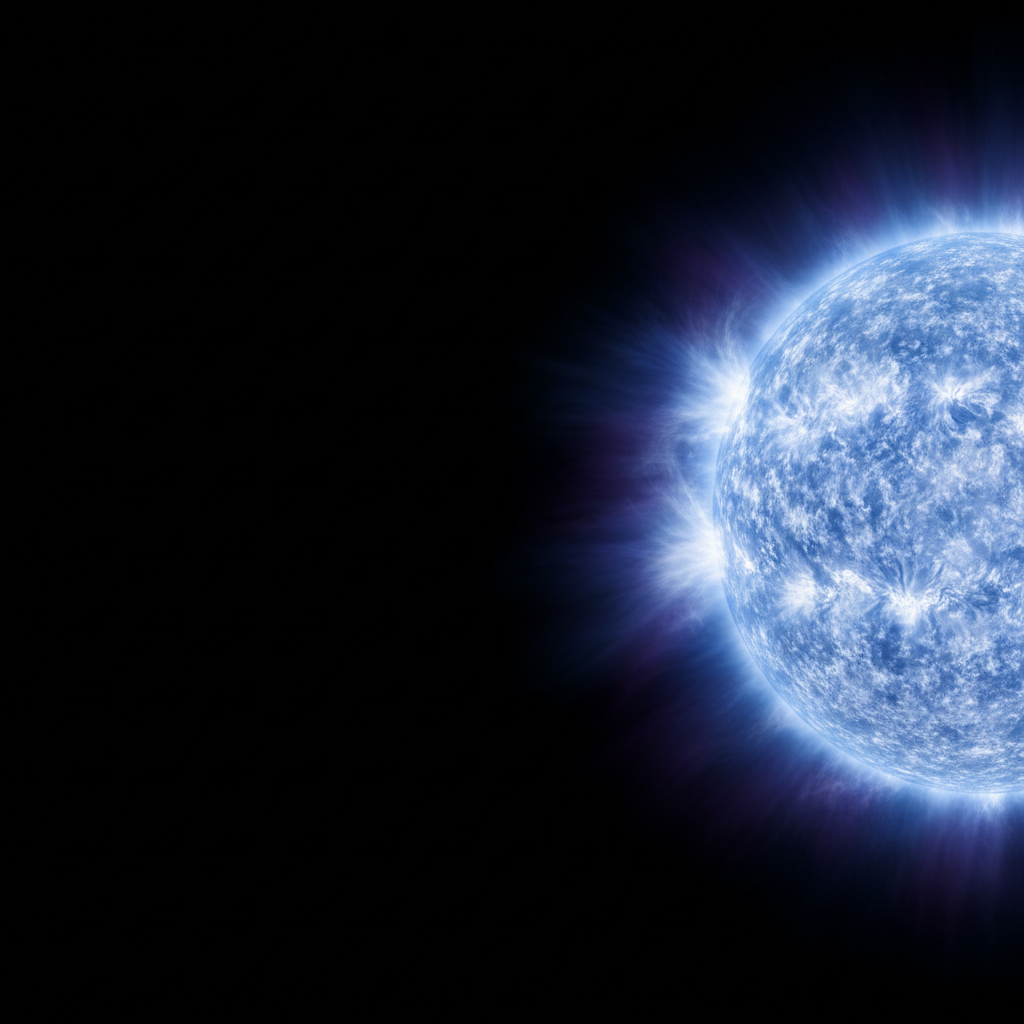
Introduction to Supergiant Stars
Supergiant stars represent the most luminous and spectacular phase in the evolution of massive stars. With masses ranging from 10 to 70 times that of our Sun and luminosities reaching a million times solar, these stellar behemoths shine with extraordinary brilliance across vast distances. Despite their rarity—supergiants make up less than 1% of all stars—their extreme brightness makes them visible across our galaxy and beyond.
The term "supergiant" encompasses two distinct classes: blue supergiants and red supergiants, each representing different stages in massive stellar evolution. Blue supergiants are hot, compact giants with surface temperatures between 10,000 and 50,000 K, appearing brilliant blue-white in color. Red supergiants are cool, bloated stars with temperatures between 3,000 and 4,500 K, glowing red-orange and swollen to enormous sizes—some large enough to engulf the orbit of Jupiter if placed at the Sun's position.
These stars live fast and die young. A supergiant's prodigious energy output comes at a steep cost: they burn through their nuclear fuel at a furious rate, exhausting it in just a few million years compared to the Sun's 10-billion-year lifetime. This makes supergiants relatively young stars, still in the prime of their lives despite being on an inexorable path toward explosive death. When a supergiant finally exhausts its fuel, it dies in one of nature's most violent events—a supernova explosion that briefly outshines an entire galaxy.
Famous supergiants dot our night sky. Betelgeuse, the red-orange star marking Orion's shoulder, is a red supergiant roughly 700 times larger than the Sun. Rigel, Orion's blue-white foot, is a blue supergiant pumping out over 100,000 times the Sun's power. These stars are not just celestial landmarks—they are cosmic element factories, forging heavy elements in their cores and dispersing them throughout space when they explode, seeding future generations of stars and planets.
Physical Characteristics
Supergiants occupy the upper reaches of the Hertzsprung-Russell diagram, far above the main sequence where most stars reside. Their physical properties span enormous ranges, determined primarily by their mass and evolutionary stage. Despite their name suggesting great size, blue supergiants are actually relatively compact, while red supergiants achieve truly staggering dimensions.
Supergiant Quick Facts
- Mass Range: 10 to 70 solar masses (M☉)
- Size Range: 15-25 R☉ (blue) to 200-1,500 R☉ (red)
- Temperature: 3,000-4,500 K (red), 10,000-50,000 K (blue)
- Luminosity: 10,000 to 1,000,000 times the Sun
- Lifetime: 1 to 10 million years
- Examples: Betelgeuse, Antares, Rigel, Deneb
Data: NASA Stars & Stellar Evolution
The luminosity-to-mass ratio for supergiants is extreme. A 20-solar-mass supergiant can shine with the power of 100,000 Suns, vastly exceeding what the mass-luminosity relation would predict for a main sequence star of the same mass. This extraordinary brightness comes from their evolved state: they've exhausted hydrogen in their cores and now fuse heavier elements, with enormously expanded envelopes that radiate energy across vast surface areas.
Red supergiants achieve their colossal sizes through extreme expansion. When these stars exhaust core hydrogen and begin fusing helium and heavier elements, their outer layers balloon outward, increasing the radius by hundreds or even thousands of times while the surface temperature drops. The result is a star that could encompass most of the inner solar system yet has a surface temperature cooler than a candle flame. Despite the cool surface, the total energy output remains enormous simply because of the vast radiating area.
Blue Supergiants
Blue supergiants are hot, luminous stars with masses typically between 10 and 40 solar masses. They maintain compact sizes of 15-25 solar radii—smaller than red supergiants but still larger than main sequence stars. Surface temperatures range from 10,000 to 50,000 K, giving them their characteristic blue-white color. These stars are so hot that most of their energy emerges as ultraviolet radiation, invisible to our eyes but detectable by space telescopes.
Blue supergiants represent two possible evolutionary stages: they can be relatively young massive stars that have just left the main sequence, or they can be older stars that were once red supergiants now contracting and heating up in their final evolutionary phases. The exact evolutionary path depends on the star's mass and rate of mass loss through stellar winds.
Red Supergiants
Red supergiants are among the physically largest stars known, with radii that can exceed 1,000 times the Sun's. Betelgeuse, at approximately 700-900 solar radii, varies in size due to pulsations—large-scale convective cells roiling beneath its surface. The largest known star, Stephenson 2-18, is a red supergiant estimated at 2,150 solar radii. If placed at the Sun's location, its surface would extend beyond Saturn's orbit.
Despite their size, red supergiants have average densities far lower than Earth's atmosphere. Most of the star's mass remains concentrated in the core, while the tenuous outer envelope extends across billions of kilometers. These stars experience strong stellar winds, losing mass at rates of 10^-7 to 10^-4 solar masses per year—the Sun loses only 10^-14 solar masses per year by comparison.
Nuclear Burning and Fusion Stages
Inside a supergiant, nuclear fusion proceeds through multiple stages like layers of an onion. The core fuses helium into carbon and oxygen; surrounding shells fuse hydrogen to helium. As each fuel is exhausted, the core contracts and heats until it ignites the next element: carbon fuses to neon and magnesium, neon to oxygen and magnesium, oxygen to silicon and sulfur, and finally silicon to iron. Each successive stage generates less energy and proceeds faster—silicon burning lasts only a few days before the star dies.
Evolution and Stellar Winds
Supergiants represent an advanced evolutionary stage for massive stars, beginning their lives on the main sequence and progressing through expansion, pulsation, and eventually explosive death. The exact evolutionary path depends critically on the star's initial mass, metallicity, and rate of mass loss.
Main Sequence to Supergiant
A star becomes a supergiant after exhausting the hydrogen in its core. For stars above 10 solar masses, this happens in just a few million years. Once core hydrogen is depleted, the core contracts while a shell of hydrogen around it continues fusion. The core heating causes the outer envelope to expand dramatically, increasing the star's radius by factors of ten to hundreds. Surface temperature drops, and the star becomes a red supergiant.
More massive stars may take a blueward path, becoming blue supergiants first before evolving to red supergiants. Others may oscillate between blue and red phases, creating complex evolutionary tracks. The most massive stars (above ~40 M☉) may skip the red supergiant phase entirely, remaining hot blue supergiants until death.
Stellar Winds and Mass Loss
Supergiants lose mass through powerful stellar winds driven by radiation pressure on atoms in their outer atmospheres. For blue supergiants, these winds can reach velocities of 1,000-3,000 km/s, carrying away 10^-6 solar masses per year. Red supergiants have slower but denser winds, removing mass at similar or even higher rates. Over a supergiant's lifetime, these winds can strip away 20-30% of the star's initial mass, dramatically affecting its evolution and ultimate fate.
This mass loss creates vast circumstellar envelopes of gas and dust around supergiants. When Betelgeuse eventually explodes as a supernova, the blast wave will plow into this previously ejected material, creating spectacular light echoes and emission structures visible for centuries.
The Supernova Destiny
Every supergiant is destined to die in a supernova explosion. When the core finally fuses silicon to iron, fusion stops—iron nuclei are so tightly bound that fusing them consumes energy rather than releasing it. With no energy source to support the core, catastrophic collapse ensues. In less than a second, the core implodes, rebounds, and launches a shock wave that obliterates the star in a Type II supernova.
For stars between 10 and ~25 solar masses, the core collapse produces a neutron star. For stars above ~25 solar masses, the core collapses directly into a black hole. The boundary between these outcomes depends on complex physics involving rotation, magnetic fields, and neutrino transport, making individual predictions uncertain.
Pulsations and Variability
Many red supergiants pulsate semi-regularly, expanding and contracting over periods of months to years with brightness variations of 1-2 magnitudes. Betelgeuse's famous 2019-2020 dimming event combined pulsational darkening with the ejection of a large dust cloud that blocked starlight, demonstrating the dynamic and chaotic nature of these evolved giants. These pulsations help drive mass loss by lifting material from the surface where radiation pressure can push it away entirely.
Observing Supergiant Stars
Thanks to their extreme luminosity, supergiants are visible across vast distances, making them valuable markers for studying galactic structure and distance measurement. Many of the brightest stars in the night sky are supergiants, easily visible to the naked eye despite being hundreds or thousands of light-years away.
Notable Examples
Betelgeuse (Alpha Orionis): The famous red supergiant marking Orion's eastern shoulder is one of the few stars whose disk can be resolved by telescopes—its angular size is about 50 milliarcseconds. With a radius approximately 700-900 R☉, Betelgeuse is classified as M2Iab and varies in brightness over a roughly 400-day cycle. Located about 550 light-years away, it will eventually explode as a supernova, though probably not for another 100,000 years.
Antares (Alpha Scorpii): This M1.5Iab-Ib red supergiant in Scorpius is about 550 times larger than the Sun and 10,000 times more luminous. Its name means "rival of Mars" due to its distinctly red color. Antares has a hot B-type companion star that orbits every 1,200 years, though the companion is often lost in the glare of the supergiant primary.
Rigel (Beta Orionis): Despite being designated Beta, Rigel is usually the brightest star in Orion (Betelgeuse varies). This B8Ia blue supergiant is about 120,000 times more luminous than the Sun and 78 times larger. Located ~860 light-years away, Rigel is actually a multiple star system with three fainter companions.
Deneb (Alpha Cygni): One of the most luminous stars visible to the naked eye, Deneb is an A2Ia supergiant approximately 200,000 times more luminous than the Sun. Its distance is uncertain (estimates range from 1,500 to 2,600 light-years), making it one of the most distant stars bright enough to be prominent in the night sky.
VY Canis Majoris: This extreme red hypergiant is one of the largest known stars, with estimates placing its radius at 1,420 R☉ (though uncertainty is large). Located 3,800 light-years away, VY CMa is surrounded by a complex nebula of ejected material and may explode as a supernova within the next 100,000 years.
Interferometry and Direct Imaging
The largest supergiants like Betelgeuse and Antares have angular sizes large enough to be resolved by optical interferometry—combining light from multiple telescopes to achieve extremely high angular resolution. These observations reveal surface features, brightness variations, and even hints of convection cells on their photospheres. Such studies provide unique insights into stellar atmospheres and mass loss processes.
Amateur Observation
Many supergiants make excellent targets for amateur astronomers. Their colors are vivid—the contrast between red Betelgeuse and blue Rigel is obvious even to the naked eye. Variable red supergiants like Betelgeuse can be monitored over months to track pulsation cycles. With modest telescopes, the circumstellar nebulae around some supergiants become visible, testament to their powerful stellar winds.
Interesting Facts About Supergiants
- Betelgeuse's Great Dimming: In late 2019 and early 2020, Betelgeuse dimmed to its faintest level in recorded history, dropping by about 40% in brightness. While some speculated the star was about to explode, astronomers determined the dimming was caused by a massive surface mass ejection followed by dust formation that temporarily blocked starlight. The event provided unprecedented data on mass loss processes in red supergiants.
- Onion-Shell Burning: Inside a supergiant near the end of its life, nuclear fusion proceeds in concentric shells like layers of an onion. The iron core is surrounded by a silicon-burning shell, which is surrounded by oxygen, neon, carbon, helium, and hydrogen-burning shells. Each layer operates at different temperatures and densities, with the entire structure supported against gravity by the pressure generated from nuclear fusion.
- The Humphreys-Davidson Limit: There appears to be an upper limit to supergiant luminosity at about 10^6 solar luminosities. Stars approaching this limit become unstable to radiation-driven mass loss and eruptions. This empirical boundary, discovered by studying luminous stars in nearby galaxies, suggests fundamental limits to stellar stability and may explain why we don't observe even more extreme supergiants.
- Hypergiant Classification: The most extreme supergiants are classified as hypergiants, denoted by luminosity class 0 or Ia-0. These rare stars like Eta Carinae and VY Canis Majoris are among the most luminous and unstable stars known, often surrounded by vast nebulae of ejected material. They may represent a brief transition stage between supergiants and supernova explosions.
- Extreme Mass Loss: Red supergiants can lose mass at rates exceeding 10^-4 solar masses per year—a million times faster than the Sun's solar wind. At this rate, a 20-solar-mass supergiant would lose several solar masses over its red supergiant lifetime. This mass loss significantly affects the star's evolution, potentially determining whether it explodes as a Type II supernova or collapses directly to a black hole.
- Supernova Progenitors: All Type II supernovae come from supergiants, but not all supergiants produce visible supernova explosions. Some very massive stars undergo "failed supernovae" where the outer layers fall back onto the core, directly forming a black hole with minimal visible outburst. The 25-solar-mass star N6946-BH1 in a nearby galaxy may have disappeared this way in 2009.
- Convection Cells: Interferometric observations of supergiants like Betelgeuse reveal enormous convection cells—bright and dark patches on the stellar surface caused by huge bubbles of hot gas rising and cool gas sinking. A single convection cell can be larger than Earth's orbit around the Sun. These cells are visible as the star's surface is not uniformly bright, showing clear signs of dynamic atmospheric activity.
- Spectral Signatures: Supergiant spectra show narrower absorption lines than main sequence stars due to lower surface gravity—gas escapes more easily from the tenuous atmospheres. They also show emission lines from extended atmospheres and stellar winds. The luminosity class (I for supergiants) in stellar classification is determined precisely by measuring these line widths and strengths.
External Resources
- NASA Stars & Stellar Evolution - Comprehensive guide to star types and evolution, including supergiants
- Supergiant Stars on Wikipedia - Detailed encyclopedia article on supergiant classification and properties
- Betelgeuse on Wikipedia - In-depth article on the famous red supergiant including recent research
- ESO: Betelgeuse's Dimming Explained - Research explaining the 2019-2020 Great Dimming event
- VY Canis Majoris - Article on one of the largest known stars
Frequently Asked Questions
What is a supergiant star?
A supergiant star is an extremely massive and luminous evolved star, typically 10 to 70 times the mass of the Sun. They are among the brightest stars in the universe, with luminosities ranging from 10,000 to over a million times that of the Sun. Supergiants come in two main types: blue supergiants (hot surface temperatures 10,000-50,000 K, compact size) and red supergiants (cool surface temperatures 3,000-4,500 K, enormous size reaching 1,000+ solar radii). Despite their brilliance, supergiants are rare and short-lived.
How big is a supergiant star?
Supergiant sizes vary dramatically by type. Blue supergiants are typically 15-25 times the radius of the Sun. Red supergiants are vastly larger—Betelgeuse, the famous red supergiant in Orion, has a radius roughly 700-900 times that of the Sun, though it varies due to pulsations. The largest known star, VY Canis Majoris, is a red hypergiant estimated at 1,400-2,100 solar radii. If placed at the center of our solar system, it would engulf everything out to Saturn's orbit.
How long do supergiants live?
Supergiant stars are among the shortest-lived stars in the universe despite their enormous power. A typical supergiant lives only a few million years—compared to our Sun's 10-billion-year lifespan. The most massive stars can burn through their fuel in as little as 1-3 million years. This is because they burn fuel at a prodigious rate: a supergiant might consume in one year what the Sun takes millions of years to burn. Their intense radiation pressure and fast stellar winds also continuously blow material off their surfaces.
Will Betelgeuse explode?
Betelgeuse, the bright red-orange star in Orion's shoulder, is indeed a red supergiant destined to explode as a supernova—but probably not for another 100,000 years or more. Its famous 'dimming event' in 2019-2020 was caused by a massive surface mass ejection followed by dust formation, not an imminent explosion. When it does explode, Betelgeuse will briefly outshine the full Moon and be visible in daylight, but at 700 light-years distance, it poses no danger to Earth.
What is the difference between a red giant and a red supergiant?
While both are evolved stars with expanded, cool outer layers, red giants and red supergiants differ significantly. Red giants form from low to medium-mass stars (like the Sun), reaching sizes of 10-100 solar radii and luminosities up to 1,000 solar. Red supergiants form from massive stars (8+ solar masses), reaching sizes of 200-1,500 solar radii and luminosities of 10,000-300,000 solar. Red supergiants end their lives in supernova explosions, while red giants shed their layers as planetary nebulae, leaving white dwarf remnants.
What elements do supergiants produce?
Supergiants are cosmic element factories. Through successive fusion stages in their cores, they fuse hydrogen into helium, helium into carbon and oxygen, and continue up the periodic table through neon, magnesium, silicon, and finally iron. When they explode as supernovae, these heavy elements are dispersed throughout the galaxy. Elements heavier than iron are created during the supernova explosion itself through rapid neutron capture (r-process). Most of the heavy elements in your body—calcium in your bones, iron in your blood—were forged in the hearts of ancient supergiants.